Question
How the gravitational field at a point inside a solid sphere vary with distance x from its centre, if x <R and x > R (R-radius)?

Answer

$\text{E}_{\text{g}}\propto\text{x if x}<\text{R and E}_{\text{g}}\propto\frac{1}{\text{x}^2}\text{ if x}>\text{R}$

Need a full question paper?

Generate a complete, print-ready paper with questions like this in minutes — across 16+ boards, with answer keys.
Start Generating Free

Similar questions

An electric bulb is hanging over a table at a height of 1m above it. The illuminance on the table directly below the bulb is 40 lux. The illuminance at a point on the table 1m away from the first point will be about:
  1. 10 lux
  2. 14 lux
  3. 20 lux
  4. 28 lux
Why does a child feel more pain when she falls down on a hard cement floor, than when she falls on the soft muddy ground in the garden?
Which law is to be used by a man stranded at the middle of a pond, when no friction is experienced by the boat?
Choose the correct alternative:
The formula $-\text{G Mm}\Big(\frac{1}{\text{r}_2}-\frac{1}{\text{r}_1}\Big)$ is more/ less accurate than the formula mg(r2 - r1) for the difference of potential energy between two points r2 and r1 distance away from the centre of the earth.
How does viscous force differ from normal friction?
A body having constant linear momentum then force acting on the body is equal to _______.
If on giving 40J of heat to a system, work done on the system is 10J. What will be the change in internal energy of the system?
What is the weight of a person standing in a freely falling elevator?
Which one among a solid, liquid and gas of the same mass and at the same temperature has the greatest internal energy and which one has the least?
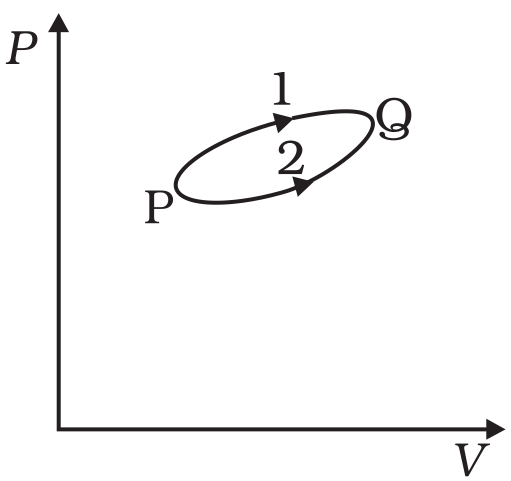
A system goes from P to Q by two different paths in the P-V diagram as shown in Fig. Heat given to the system in path 1 is 1000J. The work done by the system along path 1 is more than path 2 by 100J. What is the heat exchanged by the system in path 2?