Question
How the photoelectric effect depends on time? Explain.

Answer

Experimental studies of photoelectric effect have shown that if the frequency of incident radiation is greater than the threshold frequency of a photosensitive metal, electrons are instantaneously emitted from the metal, even for low intensities.
If the frequency is greater than the threshold frequency, electrons are emitted in only $10^{-9}$ sec or less.

Need a full question paper?

Generate a complete, print-ready paper with questions like this in minutes — across 16+ boards, with answer keys.
Start Generating Free

Similar questions

What is the principle of superposition of charges?
The torque of a force $\overrightarrow{\text{F}}$ about a point is defined as $\overrightarrow{\text{r}}=\overrightarrow{\text{r}}\times\overrightarrow{\text{F}}.$ Suppose $\overrightarrow{\text{r}}, \overrightarrow{\text{F}}$and $\overrightarrow{\text{r}}$ are all nonzero. Is $\text{r}\times\overrightarrow{\text{r}}\Bigg|\Bigg|\overrightarrow{\text{F}}$ always true? Is it ever true?
If a constant potential difference is applied across a bulb, the current slightly decreases as time passes and then becomes constant. Explain.
Two beams, one of red light and the other of blue light, of the same intensity are incident on a metallic surface to emit photoelectrons. Which one of the two beams emits electrons of greater kinetic energy?
Electric charge is distributed in a small volume. The electric flux passing through a total charge enclosed by a spherical surface of radius 10 cm is 10 Vm . Then what will be the flux associated with a concentric sphere of radius 20 cm ?
What is rms value $($root mean square$)$?
Derive the equation of rms values of voltage and current?
In a Michelson experiment for measuring speed of light, the distance travelled by light between two reflections from the rotating mirror is 4.8km. The rotating mirror has a shape of a regular octagon. At what minimum angular speed of the mirror (other than zero) the image is formed at the position where a non-rotating mirror forms it?
Balmer series was observed and analysed before the other series. Can you suggest a reason for such an order?
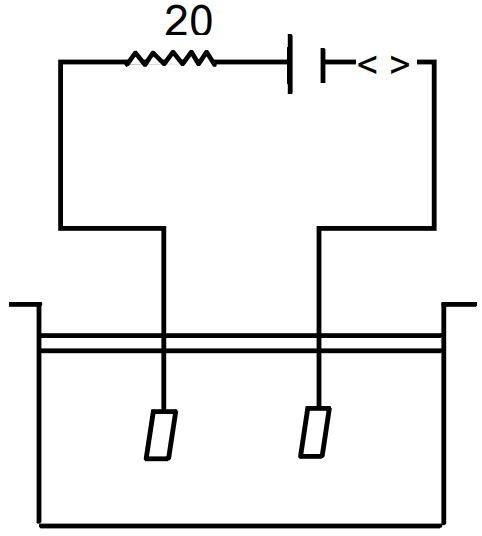
Figure shows an electrolyte of AgCl through which a current is passed. It is observed that 2.68g of silver is deposited in 10 minutes on the cathode. Find the heat developed in the $20\Omega$ resistor during this period. Atomic weight of silver is 107.9g/mole.
Let $\overrightarrow{\text{A}}=5\vec{\text{i}}-4\vec{\text{j}}$ and $\overrightarrow{\text{B}}=-7.5\vec{\text{i}}+6\vec{\text{j}}.$
  1. Do we have $\overrightarrow{\text{B}}\text{k}\vec{\text{A}}?$
  2. Can we say $\frac{\overrightarrow{\text{B}}}{\overrightarrow{\text{A}}}=\text{k}?$