Question

How will you bring out the following conversion?
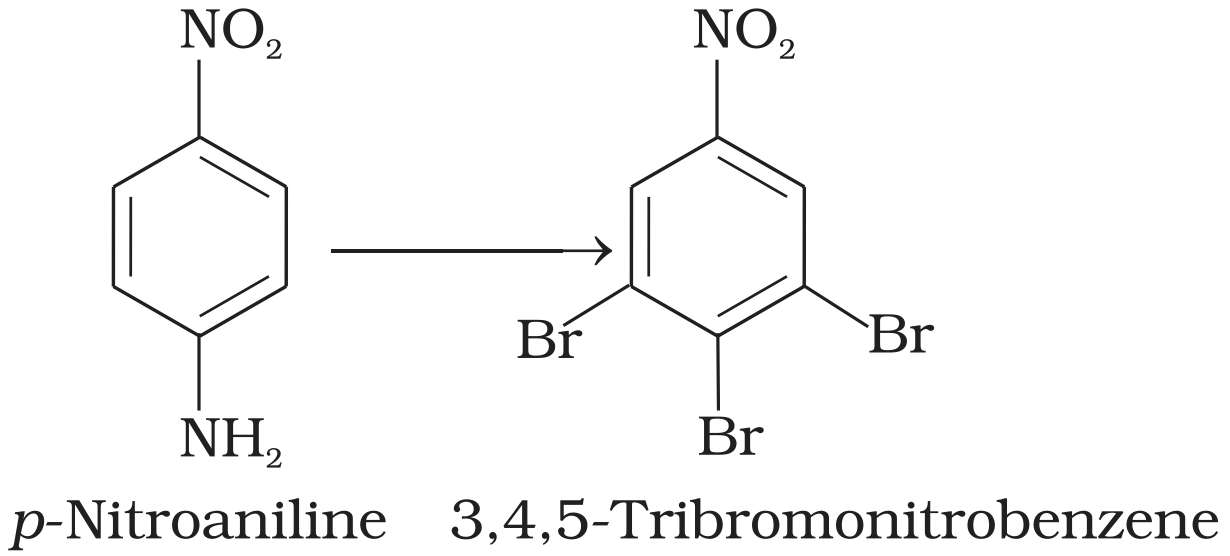
Answer

Get the step-by-step solution for this question inside the Vidyadip app.

Get the answer in the app

Need a full question paper?

Generate a complete, print-ready paper with questions like this in minutes — across 16+ boards, with answer keys.

Start Generating Free

Similar questions

Note: In the following questions a statement of assertion followed by a statement of reason is given. Choose the correct answer out of the following choices.
Assertion: Semiconductors are solids with conductivities in the intermediate range from $10^{-6}-10^4 \mathrm{ohm}^{-1} \mathrm{\sim m}^{-1}$.
Reason: Intermediate conductivity in semiconductor is due to partially filled valence band.
How do tranquilizers and analgesics work?
Distinguish between:
  1. Hexagonal and monoclinic unit cells.
  2. Face-centred and end-centred unit cells.
The rate of reaction, $2NO + Cl_2→ 2NOCl$ is doubled when concentration of $Cl_2$ is doubled and it becomes eight times when concentration of both NO and $Cl_2$ are doubled. Deduce the order of the reaction.
Give Reasons:
Relative ease of dehydration of alcohols is 3° > 2° > 1°.
$^{238}_{92}\text{U}$ Change to $^{206}_{92}\text{Pb}$ by successive radioactive decay. A sample of urenium ore was anlaysed and found to contain $1.0\ g$ of $^{238}\text{U}$ and $0.1\ g$ of $^{206}\text{Pb}$ had accumulated due to decay of $^{238}\text{U}$, find out the age of ore. (Half- life of $^{238}\text{U}$$= 4.5\times10^9$ years).
Given that the standard electrode potentials $(E^o)$ of metals are:
$K^+/K = –2.93\ V,\ Ag^+/Ag = 0.80\ V,\ Cu^{2+}/Cu = 0.34\ V,$
$Mg^{2+}/Mg = -2.37\ V,\ Cr^{3+}/Cr = – 0.74\ V,\ Fe^{2+}/Fe = – 0.44\ V.$
Arrange these metals in an increasing order of their reducing power.
Cyanide ion acts as an ambident nucleophile. From which end it acts as a stronger nucleophile in aqueous medium? Give reason for your answer.
Define the following terms:
  1. Abnormal molar mass.
  2. van’t Hoff factor (i).
Describe how the following conversions can be brought about (any two)?
i. Cyclohexanol to cyclohexan-1-one.
ii. Ethyl benzene to benzoic acid.
iii. Bromobenzene to benzoic acid.