Question
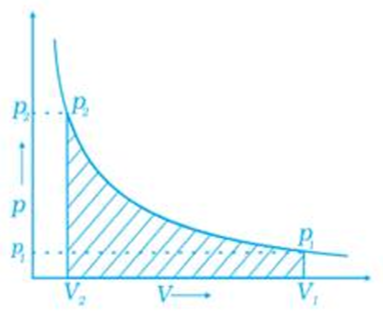
How will you calculate work done on an ideal gas in a compression, when the change in pressure is carried out in infinite steps?
Answer

When compression is carried out in infinite steps with the change in pressure, it is a reversible process.
Work done can be calculated from pV -plot when pressure is not constant.
A pV plot of the work of compression which is carried out by the change in pressure in infinite steps during compression from the initial volume, $V _{ i }$ to the final volume, $V _{ f }$ is shown in the figure. The work done on the gas is represented by the shaded area.
Image

Need a full question paper?

Generate a complete, print-ready paper with questions like this in minutes — across 16+ boards, with answer keys.
Start Generating Free

Similar questions

Calculate the wavelength of an electron moving with a velocity of 2.05 × 10⁷ms–1.
Balance the following redox reactions by ion-electron method:
$\text{Cr}_2\text{O}_7^{2-}+\text{SO}_2(\text{g})\rightarrow\text{Cr}^{3+}(\text{aq})+\text{SO}^{2-}_4(\text{aq})$ (in acidic solution).
Use Lewis symbols to show electron transfer between the following atoms to form cations and anions:
K and S.
An alkane has a molecular mass of 72. Give all the possible structural isomers along with their IUPAC names.
An alkyl halide 'A' of formula C6H13Cl on treatment with alcoholic KOH gives two isomeric alkenes 'B' and 'C' with molecular formula C6H12. Both alkenes on hydrogenation give 2, 3-dimethyl butane. Predict the structure of ‘A’, 'B' and 'C'.
Balance the following equations by the oxidation number method.
$\text{MnO}_2+\text{C}_2\text{O}^{2-}_4\xrightarrow{ \ \ \ \ \ \ \ }\text{Mn}^{2+}+\text{CO}_2$
Which of the following reactions will get affected by increasing the pressure? Also, mention whether change will cause the reaction to go into forward or backward direction.
(i) $COCl _2(g) \rightleftharpoons CO ( g )+ Cl _2(g)$
(ii) $CH _4(g)+2 S_2(g) \rightleftharpoons CS _2(g)+2 H _2 S( g )$
(iii) $CO _2(g)+ C ( s ) \rightleftharpoons 2 CO ( g )$
(iv) $2 H _2(g)+ CO ( g ) \rightleftharpoons CH _3 OH ( g )$
(v) $CaCO _3(s) \rightleftharpoons CaO ( s )+ CO _2(g)$
(vi) $4 NH _3(g)+5 O _2(g) \rightleftharpoons 4 NO ( g )+6 H _2 O ( g )$
Describe what you need to do in the laboratory to test
i. the law of conservation of mass,
ii. the law of definite proportion
iii. the law of multiple proportions.
Give the name and atomic number of the inert gas atom in which the total number of d-electrons is equal to the difference in numbers of total p and s electrons.