Question types

Model Paper 4 question types

36 questions across 6 question groups — pick any mix to generate a Chemistry paper with step-by-step answer keys.

36
Questions
6
Question groups
5
Question types
Sample Questions

Model Paper 4 questions

One sample from each question group in this chapter. Select any group above to see the full set with answer keys.

Standard Molar Enthalpy of formation is:
  • A
    the standard enthalpy change for the formation of one mole of a compound from its elements in at a pressure of 10 bar and $30^{\circ} C$.
  • B
    the standard enthalpy change for the formation of one kg of a compound from its elements in their most stable states of aggregation.
  • the standard enthalpy change for the formation of one mole of a compound from its elements in their most stable states of aggregation.
  • D
    the standard enthalpy change for the formation of one mole of a compound from its elements in at a pressure of 2 bar and $25^{\circ}$ C.

Answer: C.

View full solution
If the concentration of glucose $\left( C _6 H _{12} O _6\right)$ in blood is $0.9 g L { }^{-1}$, what will be the molarity of glucose in blood?
  • A
    50 M
  • 0.005 M
  • C
    0.5 M
  • D
    5 M

Answer: B.

View full solution
Which of the following compounds is/are amphoteric in nature?
  • A
    $As _2 O _3$
  • Both $AI _2 O _3$ and $As _2 O _3$
  • C
    $CI _2 O _7$
  • D
    $AI _2 O _3$

Answer: B.

View full solution
Calculate the wavelength of the radiation which would cause photochemical dissociation of a chlorine molecule.
The bond dissociation energy $Cl - Cl$ of bond is $245 kJ mol ^{-1}$.
View full solution
Q 113 Marks Question3 Marks
1. Use the following reactions to arrange the elements $A , B , C$ and D in order of their redox reactivity
a. $A + B ^{+} \rightarrow A ^{+}+ B$
b. $B + D ^{+} \rightarrow B ^{+}+ D$
c. $C ^{+}+ D \rightarrow$ No reaction
d. $B + C ^{+} \rightarrow B ^{+}+ C$
2. On the basis of above redox activity series, predict which of the following reactions would you expect to occur?
a. $A ^{+}+ C \rightarrow A + C ^{+}$
b. $A ^{+}+ D \rightarrow A + D ^{+}$
View full solution
Q 133 Marks Question3 Marks
Among the elements $B , AI , C$ and Si
1. Which has the highest first ionization enthalpy?
2. Which has the most negative electron gain enthalpy?
3. Which has the largest atomic radius?
4. Which has the most metallic character?
View full solution
1. Two liquids (A) and (B) can be separated by the method of fractional distillation. The boiling point of a liquid (A) is less than the boiling point of a liquid (B). Which of the liquids do you expect to come out first in the distillate? Explain.
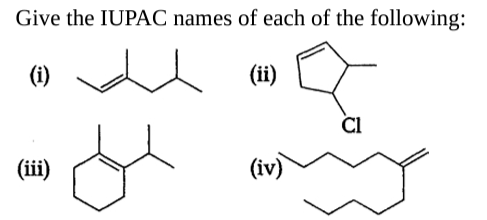
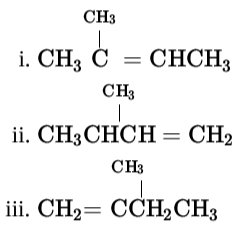
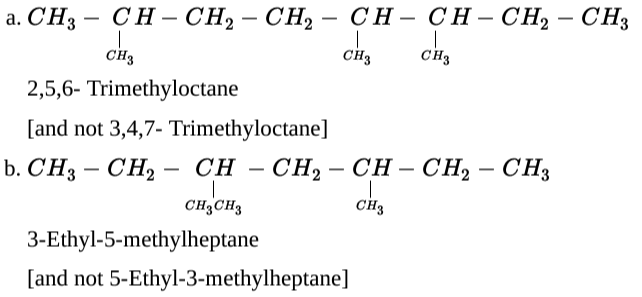
2. Structures and IUPAC names of some hydrocarbons are given below. Explain why the names given in the parentheses are incorrect.
Image
View full solution
Attempt any five of the following:
1. Convert 1-bromopropane to 2-bromopropane.
2. Although benzene is highly unsaturated it does not undergo addition reactions.
3. How is alkene produced by vicinal dihalide?
4. How will you convert ethanoic acid into ethene?
5. What is the number of $\sigma$ and $\pi$ bond in $N \equiv C - CH = CH - C \equiv N$ ?
6. Write the general formula for alkynes.
7. What do you mean by delocalization?
View full solution
1. a. Define the following terms:
i. Enantiomers
ii. Racemic mixture
b. Why is chlorobenzene resistant to nucleophilic substitution reaction?
2. What is the general molecular formula of saturated monohydric alcohols?
View full solution
The ionization constant of benzoic acid is $6.46 \times 10^{-5}$ and $K _{\text {sp }}$ for silver benzoate is $2.5 \times 10^{-13}$. How many times is silver benzoate more soluble in a buffer of pH 3.19 compared to its solubility in pure water?
View full solution
Determine the solubilities of silver chromate, barium chromate, ferric hydroxide, lead chloride and mercurous iodide at 298 K from their solubility product constants.
1. $K _{ sp }\left( Ag _2 CrO _4\right)=1.1 \times 10^{-12}$,
2. $Ksp \left( BaCrO _4\right)=1.2 \times 10^{-10}$,
3. $K _{ sp }\left[ Fe ( OH )_3\right]=1.0 \times 10^{-3}$,
Determine also the molarities of individual ions.
View full solution
Assertion (A): A certain element X, forms three binary compounds with chlorine-containing 59.68 %, 68.95 % and 74.75 % chlorine respectively. These data illustrate the law of multiple proportions.
Reason (R): According to law of multiple proportions, the relative amounts of an element combining with some fixed amount of a second element in a series of compounds are the ratios of small whole numbers.
  • Both A and R are true and R is the correct explanation of A
  • B
    Both A and R are true hut R is not the correct explanation of A.
  • C
    A is true but R is false.
  • D
    A is false but R is true.

Answer: A.

View full solution
Assertion (A): The energy of quantum of radiation is given by $E = h \nu$.
Reason (R): Quantum in the energy equation signifies the principal quantum number.
  • A
    Both A and R are true and R is the correct explanation of A

  • B
    Both A and R are true hut R is not the correct explanation of A.
  • A is true but R is false.
  • D
    A is false but R is true.

Answer: C.

View full solution
Assertion (A): The IUPAC name for $CH _3 CH = CH - C \equiv CH$ is pent-3-en-1-yne and not pent-2-en-4-yne.
Reason (R): While deciding the locants for double and triple bonds, lowest sum rule is always followed.
  • Both A and R are true and R is the correct explanation of A.
  • B
    Both A and R are true but R is not the correct explanation of A.
  • C
    A is true but R is false.
  • D
    A is false but R is true.

Answer: A.

View full solution
Assertion (A): Acetylene is acidic in nature.
Reason (R): Acetylene is sp hybridised.
  • A
    Both A and R are true and R is the correct explanation of A
  • Both A and R are true hut R is not the correct explanation of A.
  • C
    A is true but R is false.
  • D
    A is false but R is true.

Answer: B.

View full solution
The molecular orbital theory is based on the principle of a linear combination of atomic orbitals. According to this approach when atomic orbitals of the atoms come closer, they undergo constructive interference as well as destructive interference giving molecular orbitals, i.e., two atomic orbitals overlap to form two molecular orbitals, one of which lies at a lower energy level (bonding molecular orbital). Each molecular orbital can hold one or two electrons in accordance with Pauli's exclusion principle and Hund's rule of maximum multiplicity.
For molecules up to $N _2$, the order of filling of orbitals is:
Image
Bond order $=\frac{1}{2}$ [bonding electrons - antibonding electrons]
Bond order gives the following information:
I. If bond order is greater than zero, the molecule/ion exists otherwise not.
II. Higher the bond order, higher is the bond dissociation energy.
III. Higher the bond order, greater is the bond stability.
IV. Higher the bond order, shorter is the bond length.

1. Arrange the following negative stabilities of $CN , CN ^{+}$and $CN ^{-}$in increasing order of bond. (1)
2. The molecular orbital theory is preferred over valence bond theory. Why? (1)
3. Ethyne is acidic in nature in comparison to ethene and ethane. Why is it so? (2)
OR
Bonding molecular orbital is lowered by a greater amount of energy than the amount by which antibonding molecular orbital is raised. Is this statement correct? (2)
View full solution
The phenomenon of the existence of two or more compounds possessing the same molecular formula but different properties is known as isomerism. Such compounds are called isomers. Compounds having the same molecular formula but different structures (manners in which atoms are linked) are classified as structural isomers. Structural isomers are classified as chain isomer, position isomer, functional group isomer. Meristematic arises due to different alkyl chains on either side of the functional group in the molecule and stereoisomerism and can be classified as geometrical and optical isomerism. Hyperconjugation is a general stabilising interaction. It involves delocalisation of $\sigma$ electrons of the C-H bond of an alkyl group directly attached to an atom of an unsaturated system or to an atom with an unshared p orbital. This type of overlap stabilises the carbocation because electron density from the adjacent $\sigma$ bond helps in dispersing the positive charge.

1. Why Isopentane, pentane and Neopentane are chain isomers?
2. The molecular formula $C _3 H _8 O$ represents which isomer?
3. What type of isomerism is shown by Methoxypropane and ethoxyethane?
OR
Why hyperconjugation is a permanent effect?
View full solution

Generate a Model Paper 4 paper free

Pick question groups from the list above, set marks and difficulty, and export a branded PDF with step-by-step answer keys. First 3 chapters free — no signup.

Download App