Questions

3 Marks Question

Take a timed test

7 questions · self-marked practice — reveal the answer and mark yourself.

Question 13 Marks
1. Use the following reactions to arrange the elements $A , B , C$ and D in order of their redox reactivity
a. $A + B ^{+} \rightarrow A ^{+}+ B$
b. $B + D ^{+} \rightarrow B ^{+}+ D$
c. $C ^{+}+ D \rightarrow$ No reaction
d. $B + C ^{+} \rightarrow B ^{+}+ C$
2. On the basis of above redox activity series, predict which of the following reactions would you expect to occur?
a. $A ^{+}+ C \rightarrow A + C ^{+}$
b. $A ^{+}+ D \rightarrow A + D ^{+}$
Answer
1. The electrochemical series or redox activity is based on the decreasing order of reduction potentials. This means that the species which gets reduced is higher in the electrochemical series as compared to the other which is to get oxidised (lose electrons).
In reaction (a), $B ^{+}$gets reduced by A and therefore B is higher than A in electrochemical series.
In reaction (b), $D ^{+}$gets reduced by B and therefore, D is higher in the electrochemical series than B .
In reaction (c), $C ^{+}$does not get reduced by D , therefore, C is lower than D in electrochemical series. But according to reaction
(d), $C ^{+}$gets reduced by B and therefore, C is higher in electrochemical series than B .
Thus, the correct order is D > C > B > A
2. Both reactions do not occur because A cannot be reduced by C as well as D .
View full question & answer
Question 23 Marks
Calculate the number of atoms in each of the following
1. 52 mole of Ar
2. 52 u of He
3. 52 g of He .
Answer
1. 1 mole of Ar contains $6.022 \times 10^{23}$ atoms
$\therefore 52$ mole of Ar will contain $6.022 \times 10^{23} \times 52=3.13 \times 10^{25}$ atoms
2. 4 u of $He =1 He$ atom
$\therefore 52 u$ of $He =\frac{1}{4} \times 52 He$ atoms $=13 He$ atoms.
3. 1 mol atom of $He =4 g=6.023 \times 10^{23}$ atoms
4 g of He contains $6.022 \times 10^{23}$ atoms
52 g of He will contain $=\frac{6.022 \times 10^{23} \times 52}{4}=7.83 \times 10^{24}$ atoms.
View full question & answer
Question 33 Marks
Among the elements $B , AI , C$ and Si
1. Which has the highest first ionization enthalpy?
2. Which has the most negative electron gain enthalpy?
3. Which has the largest atomic radius?
4. Which has the most metallic character?
Answer
1. C has the highest first ionization enthalpy.
2. C has the most negative electron gain enthalpy.
3. AI has the largest atomic radius.
4. AI has the most metallic character.
View full question & answer
Question 43 Marks
What is the number of photons of light with wavelength 4000 pm which provides 1 J of energy?
Answer
$
\begin{aligned}
& \text { Energy of photon }(E)=\frac{hc}{\lambda} \\
& h=6.626 \times 10^{-34} Js, c=3 \times 10^8 ms^{-1}, \lambda=4000 pm=4000 \times 10^{-12}=4 \times 10^{-9} m \\
& \therefore \text { Energy of photon }(E)=\frac{\left(6.626 \times 10^{-34} Js\right) \times\left(3 \times 10^8 ms^{-1}\right)}{\left(4 \times 10^{-9} m\right)}=4.969 \times 10^{-17} J
\end{aligned}
$
Now, $4.969 \times 10^{-17} J$ is the energy of photon $=1$
$\therefore 1 J$ is the energy of photons $=\frac{1}{4.969 \times 10^{-17}}=2.012 \times 10^{16}$ photons.
View full question & answer
Question 53 Marks
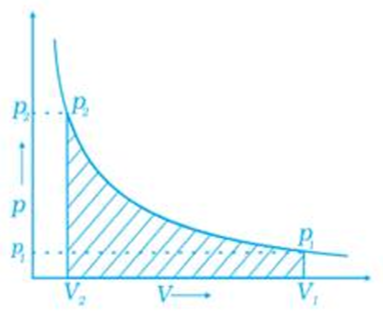
How will you calculate work done on an ideal gas in a compression, when the change in pressure is carried out in infinite steps?
Answer
When compression is carried out in infinite steps with the change in pressure, it is a reversible process.
Work done can be calculated from pV -plot when pressure is not constant.
A pV plot of the work of compression which is carried out by the change in pressure in infinite steps during compression from the initial volume, $V _{ i }$ to the final volume, $V _{ f }$ is shown in the figure. The work done on the gas is represented by the shaded area.
Image
View full question & answer
Question 63 Marks
1. Two litres of an ideal gas at a pressure of 10 atm expands isothermally at $25^{\circ} C$ into a vacuum until itstotal volume is 10 litres. How much heat is absorbed and how much work is done in the expansion against a constant external pressure of 1 atm?
2. What is free energy in terms of thermodynamics?
3. Define a system.
Answer
$
\begin{aligned}
& 1. W=-P_{ext} \cdot \Delta V \\
& P_{ext}=1 atm \\
& \Delta V=10-2 L=8 L \\
& \therefore W=-1 \times 8=-8 atm-L
\end{aligned}
$
We have $q =- w = p _{\text {ext }}(8)=8$ litre-atm
2. Free energy of a system is the capacity to do work.
$
G=H-T \Delta S
$
3. A system in thermodynamics refers to that part of the universe in which observations are made.
View full question & answer
Question 73 Marks
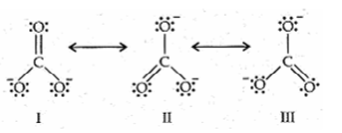
Explain the important aspect of resonance with reference to the $CO _3^{2-}$ ion.
Answer

Image
Resonance in, $CO _3^{2-}$ I, II and III represent the three canonical forms.
i. In these structures, the position of nuclei is the same.
ii. All the three forms have the almost equal energy
iii. The same number of paired and unpaired electrons they differ only in their position.
View full question & answer