Question
How will you conclude that the same potential difference (voltage) exists across three resistors connected in a parallel arrangement to a battery?
Answer


Perform an activity to investigate the relation between potential difference across parallel combination of resistors and the potential difference across each individual resistors,
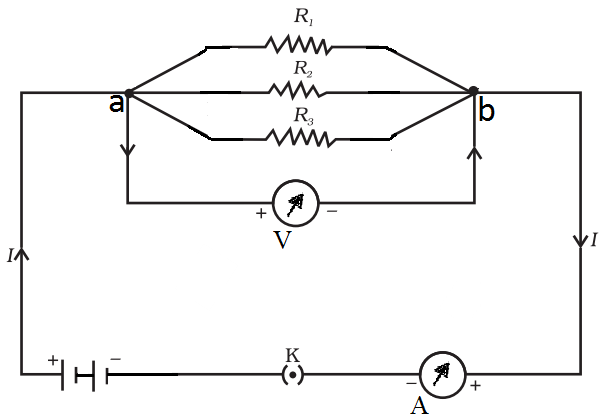
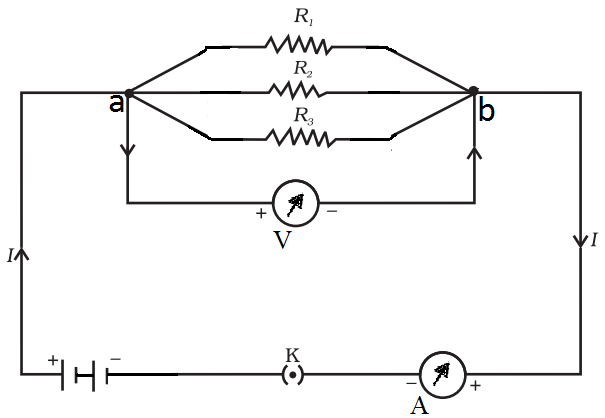
  1. Connect three resistors of resistances $R _1, R _2$ and $R _3$ in parallel. One end of each resistor is joined at a common point ‘a’ and the other end of each resistor is connected at another common point ‘b’.
  2. Connect the parallel combination of resistors with a battery, a plug key K and an ammeter A as shown in figure.
  1. Now connect a voltmeter across the parallel combination of resistors between a and b points.
  2. Note the reading of voltmeter. Let it be V. This is the potential difference across the parallel combination of resistors.
  3. Now, disconnect the voltmeter and connect it across $R_1$ as shown in figure.
  1. Note the reading of voltmeter. It is found to be V.
  2. Disconnect the voltmeter and connect it across $R _2$. Note the reading of voltmeter. It is found to be V .
  3. Again disconnect the voltmeter and connect it across $R _3$. Note the reading of voltmeter. It is found to be V .
Conclusion: When resistors are connected in parallel to each other, potential difference across each resistor is equal to the potential difference across the parallel combination of resistors.

Need a full question paper?

Generate a complete, print-ready paper with questions like this in minutes — across 16+ boards, with answer keys.

Start Generating Free

Similar questions

A strip of metal X is dipped in a blue coloured salt solution $YSO _4$. After some time, a layer of metal Y from the salt solution is formed on the surface of metal strip $X$. Metal $X$ is used in galvanisation whereas metal $Y$ is used in making electric wires. Metal $X$ and metal $Y$ together form an alloy $Z$.
a. What could metal $X$ be?
b. What could metal $Y$ be?
c. Name the metal salt $YSO _4$.
d. What type of chemical reaction takes place when metal X reacts with salt solution $YSO _4$ ? Write the equation of the chemical reaction involved.
e. Name the alloy Z.
Differentiate between myopia and hypermetropia. What type of spectacles should be worn by a person having the defects of myopia as well as hypermetropia? How does it help?
Explain briefly movements in plants.
Given below are certain situations. Analyze and describe its possible impact on a person :
a) Testes of a male boy are not able to descend into scrotum during his embryonic development.
b) Vas deferens of a man is plugged.
c) Prostate and seminal vesicles are not functional.
d) Egg is not fertilised in a human female.
e) Placenta does not attach to the uterus optimally.
What is the environment? What type of substances are the major pollutants of the environment?
What is meant by speciation? List four factors that could lead to speciation. Which of these cannot be a major factor in the speciation of a self-pollinating plant species. Give reason to justify your answer.
Why detergents are better cleansing agents than soaps? Explain.
Draw a neat diagram of fate of pollen after landing on stigma. Also, label the following parts.
  1. Female germ cell.
  2. Pollen tube.
  3. Pollen grain.
  4. Male germ cell.
  1. What is meant by saying that the potential difference between two points is 1 volt? Name a device that helps to measure the potential difference across a conductor.
  2. Why does the connecting cord of an electric heater not glow hot while the heating element does?
  3. Electrical resistivities of some substances at $20^{0}\text{C}$ are given below:
Silver $1.60\times10^{-8} \Omega \text{ m}$
Copper $1.62\times10^{-8} \Omega \text{ m}$
Tungsten $5.20\times10^{-8} \Omega \text{ m}$
Iron $10.0\times10^{-8} \Omega \text{ m}$
Mercury $94.0\times10^{-8} \Omega \text{ m}$
Nichrome $100\times10^{-6} \Omega \text{ m}$
Answer the following questions in relation to them:
  1. Among silver and copper, which one is a better conductor? Why?
  2. Which material would you advise to be used in electrical heating devices? Why?
  1. State in brief the functions of the following organs in the human female reproductive system:
Ovary, Fallopian tube, Uterus
  1. What is menstruation? Why does it occur?