Question
Why detergents are better cleansing agents than soaps? Explain.

Answer


A substance capable of removing grease and dirt from any fabric or body is called detergent. The detergents are of two types Le. soapy and non-soapy detergents. The soapy detergents are soaps whereas the non-soapy detergents are synthetic detergents or simply detergents. Although both are cleansing agents, they differ in chemical composition. In the present chapter, we shall briefly discuss the composition and cleansing action of soaps and synthetic detergents.
Soaps are the sodium and potassium salts of long chain fatty acids with general formula RCOONa or RCOOK. The acids present have the formula RCOOH where R may have following values.
$C _{15} H _{31} COOH$
Palmitic acid
$\left(R=C_{15} H_{31}\right)$
$C_{17} H_{33} COOH$
Oleic acid
$\left(R=C_{17} H_{33}\right)$
$C_{17} H_{35} COOH$
$ Stearic acid$
$\left(R=C_{17} H_{35}\right)$
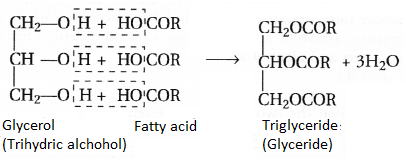
These fatty acids exist as triesters of glycerol which is a trihydric alcohol. The triesters are also called triglycerides or simply glycerides and are the constituents of edible oils and fats. These are of animal and vegetable origin e.g. castor oil, linseed oil or soyabean oil. Chemically the triglycerides are formed as a result of esterification reaction.

Need a full question paper?

Generate a complete, print-ready paper with questions like this in minutes — across 16+ boards, with answer keys.

Start Generating Free

Similar questions

Breathing cycle is an essential process for the exchange of gases’. Justify this statement.
  1. Write chemical equation for the following reactions:
  1. Calcium metal reacts with water.
  2. Cinnabar is heated in the presence of air.
  3. Manganese dioxide is heated with aluminium powder.
  1. What are alloys? List two properties of alloys.
An element X forms two oxides XO and $XO _2$. The oxide XO has no action on litmus solution but oxide $XO _2$ turns litmus solution red.
a. What is the nature of oxide XO ?
b. What is the nature of oxide $XO _2$ ?
c. Would you call element $X$ a metal or a non-metal? Give reason for your choice.
d. Can you give an example of element like $X$ ?
A silvery-white metal X taken in the form of ribbon, when ignited, burns in air with a dazzling white flame to form a white powder Y. When water is added to powder Y, it dissolves partially to form another substance Z.
  1. What could metal X be?
  2. What is powder Y?
  3. With which substance metal X combines to form powder Y?
  4. What is substance Z? Name one domestic use of substance Z.
  5. Write a balanced chemical equation of the reaction which takes place when metal X burns in air to form powder Y.
A compound C (molecular formula, $C _2 H _4 O _2$) reacts with Na - metal to form a compound R and evolves a gas that burns with a pop sound. Compound C on treatment with an alcohol A in presence of an acid forms a sweetsmelling compound S (molecular formula, $C _3 H _6 O _2$). On the addition of NaOH to C, it also gives R and water. S on treatment with NaOH solution gives back R and A.
Identify C, R, A, S, and write down the reactions involved.
With a schematic diagram, explain the overall process of respiration.
An object 5cm high is held 25cm away from a converging lens of focal length 10cm. Find the position, size and nature of the image formed. Also draw the ray diagram.
There are three plants A, B and C. The flowers of plant A open their petals in bright light during the day but close them when it gets dark at night. On the other hand, the flowers of plant B open their petals at night but close them during the day when there is bright light. The leaves of plant C fold up and droop when touched with fingers or any other solid object.
  1. Name the phenomenon shown by the flowers of (i) plant A, and (ii) plant B.
  2. Name one flower each which behaves like the flower of (i) plant A, and (ii) plant B.
  3. Name the phenomenon exhibited by the leaves of plant C.
  4. Name a plant whose leaves behave like those of plant C.
  5. Which plant/ plants exhibit the phenomenon based on growth movements?
Draw the structure of a neuron and explain its function.
Following are the two examples of plant movement. One is drooping of leaves in touch-me-not plant and second is
attaching of pea plant to a support with the help of tendrils.
i. What is the stimulus which is common for movement in both the cases?
ii. What is the difference in movement in both the plants? Explain
iii. Give appropriate scientific terms for the movements described in both cases.