Question
How does $Cu_2O$ act as both oxidant and reductant? Explain with proper reactions showing the change of oxidation numbers in each example.

Answer

$Cu^+$ undergoes disproportionation to form $Cu^{2+}$ and $Cu$.
$2\text{Cu}^+(\text{aq})\xrightarrow{\ \ \ \ }\text{Cu}^{2+}(\text{aq})+\text{Cu}(\text{s})$
Thus, Cu+ or Cu2O acts both as an oxidant as well as reductant.
  1. When heated in air, $Cu_2O$ is oxidised to $CuO$.
$\stackrel{+1\ \ \ \ \ \ }{\text{Cu}_2}\stackrel{-2\ \ \ }{\text{O}}+\frac12\stackrel{0\ \ \ }{\text{O}_2}\xrightarrow{\ \ \ \ \ \ }2\stackrel{+2\ \ \ \ }{\text{Cu}}\stackrel{-2\ \ }{\text{O}}$

i.e. $Cu_2O$ acts as a reductant and reduces $O_2$ to $O^{2-}$.
  1. When heated with $Cu_2S$, it oxidises $S^{2-}$ to $SO_2$ and hence, $Cu_2O$ acts as an oxidant.
$2\stackrel{+1\ \ \ \ \ \ }{\text{Cu}_2}\stackrel{-2}{\text{O}}+\stackrel{+1\ \ \ \ \ }{\text{Cu}_2}\stackrel{-2}{\text{S}}\xrightarrow{\ \ \ \ \ \ }6\stackrel{0\ \ \ \ \ \ }{\text{Cu}}+\stackrel{+4\ \ \ \ \ \ \ }{\text{SO}_2}$

Need a full question paper?

Generate a complete, print-ready paper with questions like this in minutes — across 16+ boards, with answer keys.

Start Generating Free

Similar questions

Consider the reactions:$2\text{S}_2\text{O}^{2-}_{3}(\text{aq})+\text{I}_2(\text{s})\rightarrow\text{S}_4\text{O}^{2-}_{6}(\text{aq})+2\text{I}^{-}(\text{aq})$
$\text{S}_2\text{O}^{2-}_{3}(\text{aq})+2\text{Br}_2(\text{l})+5\text{H}_2\text{O(l)}\rightarrow\\2\text{SO}^{2-}_{4}(\text{aq})+4\text{Br}^{-}(\text{aq})+10\text{H}^+(\text{aq})$
Why does the same reductant, thiosulphate react differently with iodine and bromine?
1. Consider the same expansion, but this time against a constant external pressure of 1 atm.
2. What do you mean by entropy?
3. Air contains about $99 \%$ of $N _2$ and $O _2$ gases. Why they do not combine to form NO under the standard conditions? Standard Gibbs energy of formation of $NO ( g )$ is $86.7 kJ mol ^{-1}$.
How is ozone produced in stratosphere?
For the following bond cleavages, use curved-arrows to show the electron flow and classify each as homolysis or heterolysis. Identify reactive intermediate produced as free radical, carbocation and carbanion.
Given$\text{N}_2(\text{g}) + 3\text{H}_2(\text{g}) \xrightarrow{ \ \ \ \ \ \ }2\text{NH}_3(\text{g}) ; \Delta_{\text{r}}\text{H}^\ominus= –92.4\text{kJ} \ \text{mol}^{–1}$
What is the standard enthalpy of formation of $\text{NH}_{3}$ gas?
  1. What are the reactions involved in removing $\text{SO}_2$ from the atmosphere by passing it through a solution containing citrate ions?
  2. What is the most important sink of CO pollutant?
  3. How are fuel gases from industries freed from oxides of nitrogen and sulphur?
i. Arrange $\mathrm{NH}_3, \mathrm{PH}_3, \mathrm{AsH}_3, \mathrm{SbH}_3$ in increasing order of boiling point.
ii. Identify complex, interstitial, covalent and polymeric hydrides from the following.
$\mathrm{BeH}_2, \mathrm{AsH}{ }_3, \mathrm{LaH}_3, \mathrm{LiAlH}_4$.
An alkyl halide ' A ' of formula $\mathrm{C}_6 \mathrm{H}_{13} \mathrm{Cl}$ on treatment with alcoholic KOH gives two isomeric alkenes ' B ' and ' C ' with molecular formula $\mathrm{C}_6 \mathrm{H}_{12}$. Both alkenes on hydrogenation give 2, 3-dimethyl butane. Predict the structure of 'A', 'B' and ' C '.
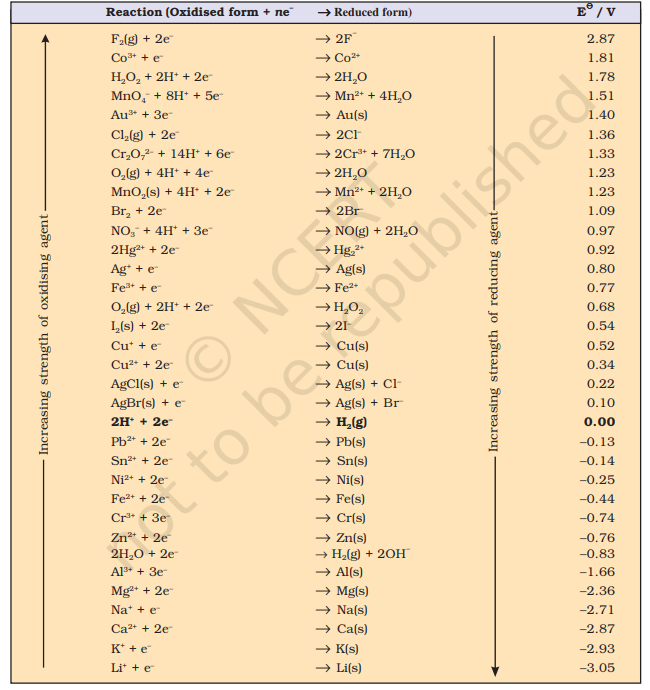
Using the standard electrode potentials given in the Table, predict if the reaction between the following is feasible:

$\mathrm{Fe}^{3+}(\mathrm{aq})$ and $\mathrm{l}^{-}(\mathrm{aq})$.
1. Give the mathematical expression of enthalpy.
2. Neither q nor W is a state function but $q + W$ is a state function. Explain why?
3. The standard heat of formation of $Fe _2 O _3$ (s) is $824.2 kJ mol ^{-1}$ Calculate heat change for the reaction.
$
4 Fe(s)+3 O_2(g) \rightarrow 2 Fe_2 O_3(s)
$