Question
What do you understand by the terms
1. rest
2. motion? Support your answer by giving two examples each

Answer

(i) Rest: A body is said to be at rest if it does not change its position with respect to its immediate surroundings.
For example:
(a) A chair lying in a room.
(b) A stone lying on the ground.
(ii) Motion: A body is said to be in motion if it changes its position with respect to its immediate surroundings.
For example:
(a) A car running on the road.
(b) A football moving on the ground.

Need a full question paper?

Generate a complete, print-ready paper with questions like this in minutes — across 16+ boards, with answer keys.

Start Generating Free

Similar questions

Give two examples to show that greater the mass, greater is the inertia of the body.
Find the length of a second's pendulum at a place where $g = 10 m s^{-2}$ (Take $\pi = 3.14$)
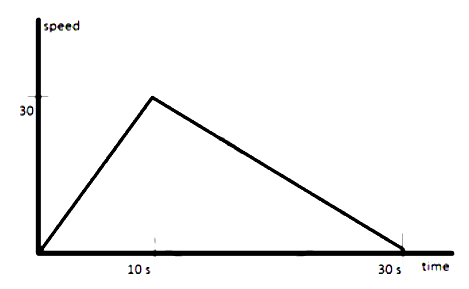
A car accelerates to a velocity of 30 m/s in $10 \ s$ and then decelerates for 20 s so that it stops. Draw a velocity-time graph to represent the motion and find:
The Deceleration.
The least count of a vernier callipers is 0.01 cm and it has an error of +0.07 cm . While measuring the radius of a sphere, the main scale reading is 2.90 cm and the 5 th vernier scale division coincides with main scale. Calculate the correct radius.
State three precautions you would take while measuring the volume of an irregular solid lighter than water, using a measuring cylinder.
(i) Parallel rays are incident:
1. on regular surface and
2. on irregular surface. In what respect do reflected rays in (1) differ from those of (2)?
(ii) Write down four characteristics of image formed in a plane mirror.
A screw thread has 20 threads in 1 cm and its circular scale has 50 divisions. Calculate its pitch and least count.
A stone is dropped freely from the top of a tower and it reaches the ground in $4$ s. Taking $g = 10m s^{-2},$ calculate the height of the tower.
A cyclist driving at $36 kmh ^{-1}$ stops his motion in 2 s , by the application of brakes. Calculate
1. retardation
2. distance covered during the application of brakes.
(a) What is a second's pendulum?
(b) A second's pendulum is taken on the surface of moon where acceleration due to gravity is $l / 6$ th of that of earth. Will the time period of pendulum remain same or increase or decrease? Give a reason.