MCQ
Hydrogen bond energy is equal to
  • A
    $3 -7$ $cals$
  • B
    $30 -70\, cals$
  • $3 -10\, k\,cals$
  • D
    $30 -70\, k\,cals$

Answer

Correct option: C.
$3 -10\, k\,cals$
c
Depending on geometry and environment, the hydrogen bond free energy content is between $1$ and $5 \,k \,cal / mol$. This makes it stronger than a van der Waals interaction, but weaker than covalent or ionic bonds.

Need a full question paper?

Generate a complete, print-ready paper with questions like this in minutes — across 16+ boards, with answer keys.

Start Generating Free

Similar questions

The enthalpy of formation of ammonia is $ - 46.0\,kJ\,mo{l^{ - 1}}$. The enthalpy change for the reaction $2N{H_3}(g) \to 2{N_2}(g) + 3{H_2}(g)$ is......$kJ$  $mo{l^{ - 1}}$
The correct statement about the structure of water:
For chemical reactions, the calculation of change in entropy is normally done
Which of the following pair of elements belong to the same period?
The densities of graphite and diamond at $298\, K$  are $2.25 $ and $3.31 \,g \,cm^{-3}$ respectively. If the standard free energy difference $(\Delta {G^o})$ is equal to $1895 \,J$ $mo{l^{ - 1}}$, the pressure at which graphite will be transformed diamond at $298\, K$  is
The $\ce{C−C}$ bond length of the following molecules is in the order :
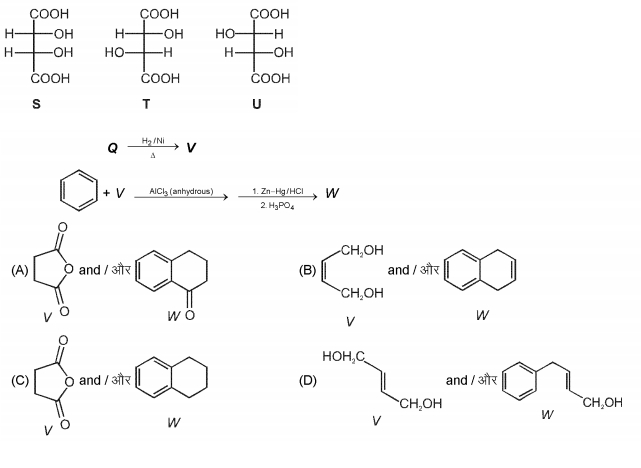
$P$ and $Q$ are isomers of dicarboxylic acid $C _4 H _4 O _4$. Both decolorize $Br _2 / H _2 O$. On heating, $P$ forms the cyclic anhydride.

Upon treatment with dilute alkaline $KMnO _4, P$ as well as $Q$ could produce one or more than one from $S , T$ and $U$.$Image$

$1.$ Compounds formed form $P$ and $Q$ are, respectively

$(A)$ Optically active $S$ and optically active pair $(T, U)$

$(B)$ Optically inactive $S$ and optically inactive pair $(T, U)$

$(C)$ Optically active pair $(T, U)$ and optically active $S$

$(D)$ Optically inactive pair $(T, U)$ and optically inactive $S$

$2.$ In the following reaction sequences $V$ and $W$ are respectively :$Image$

mcq $Image$

Give the answer question $1$ and $2.$
Going from fluorine to chlorine, bromine and iodine, the electronegativity
Conversion of $C{H_4}$ to $C{H_3}Cl$ is an example of which of the following reaction
Most stable carbonium ion is