Question
$i.$ A Why does the electric field inside a dielectric slab decrease when kept in an external electric field?
$B.$ Derive an expression for the capacitance of a parallel plate capacitor filled with a medium of dielectric constant $K.$
$ii.$ A charge $q =2 \mu C$ is placed at the centre of a sphere of radius $20 \ cm $. What is the amount of work done in moving $4 \mu C$ from one point to another point on its surface?
$iii.$ Write a relation for polarisation $\overrightarrow{ P }$ of a dielectric material in the presence of an external electric field.
Answer

$i.$ A. A dielectric material gets polarized when it is placed in an external electric field.
The field produced due to the polarization of material reduces the effect of external electric field.
Hence, the electric field inside a dielectric decreases.
$B.$ Electric field in vacuum between the plates $= E 0=\frac{\sigma}{\varepsilon_0}$
Electric field in dielectric between the plates, $E =\frac{E_0}{K}$
Potential difference between the capacitor plates
$V=E t+E_0(d-t)$
where $'t'$ is the thickness of dielectric slab.
$ V =\frac{E_0}{K} t + E _0(d- t )$
$V =\frac{\sigma}{\varepsilon_o}\left[\frac{t}{K}+( d - t )\right]$
$V =\frac{\sigma}{\varepsilon_o}\left[\frac{t+K(d-t)}{K}\right]$
$\text { As } C =\frac{Q}{V}$
$\Rightarrow C =\frac{\varepsilon_0 A K}{t+K(d-t)}$
$ii.$ The surface of the sphere is equipotential.
So, the work done in moving the charge from one point to the other is zero.
$ W = q \Delta V (\because \Delta V =0)$
$=0$
$iii. P =\chi E$

Need a full question paper?

Generate a complete, print-ready paper with questions like this in minutes — across 16+ boards, with answer keys.

Start Generating Free

Similar questions

A resistor of resistance $100\Omega$ is connected to an AC source $\in=(12\text{V})\sin(250\pi\text{s}^{-1})\text{t}.$ Find the energy dissipated as heat during $\text{t}=0$ to $\text{t}=1.0\text{ms}.$
What is a moving coil galvanometer? Write its working by drawing its diagram and its principle. Prove that current in it is proportional to the produced deflection.###What is a galvanometer? Explain construction, working and principle of a moving coil galvanometer.
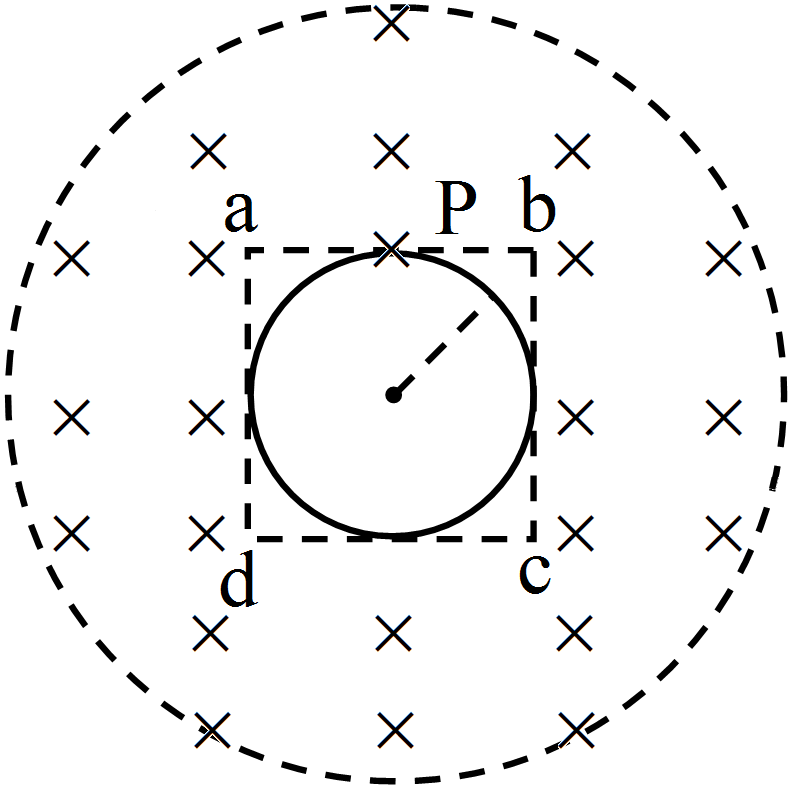
A uniform magnetic field B exists in a cylindrical region, shown dotted in figure. The magnetic field increases at a constant rate $\frac{\text{dB}}{\text{dt}}.$ Consider a circle of radius r coaxial with the cylindrical region.
  1. Find the magnitude of the electric field E at a point on the circumference of the circle.
  2. Consider a point P on the side of the square circumscribing the circle. Show that the component of the induced electric field at P along ba is the same as the magnitude found in part (a).

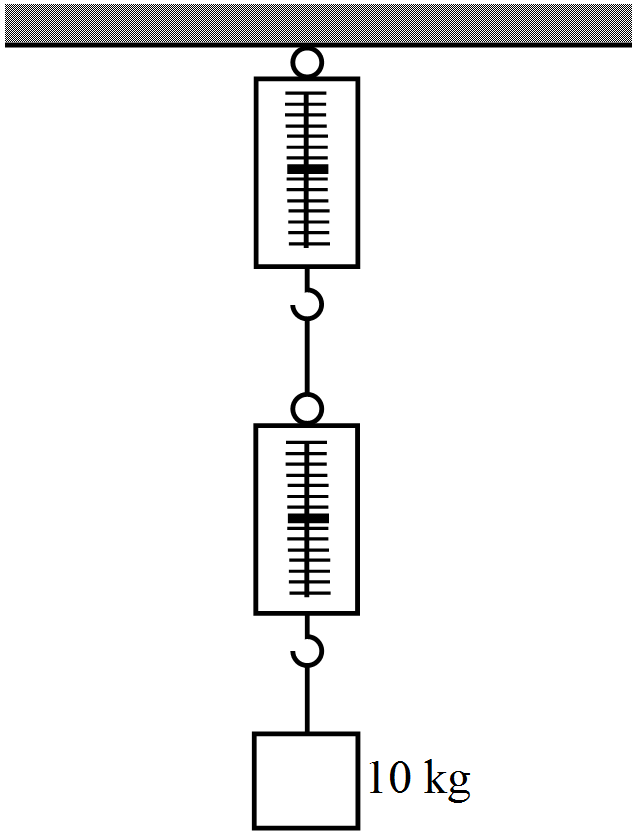
A block of mass $10\ kg$ is suspended through two light spring balances as shown in figure:
An LR circuit with emf $\in$ is connected at t = 0.
  1. Find the charge Q which flows through the battery during 0 to t.
  2. Calculate the work done by the battery during this period.
  3. Find the heat developed during this period.
  4. Find the magnetic field energy stored in the circuit at time t.
  5. Verify that the results in the three parts above are consistent with energy conservation.
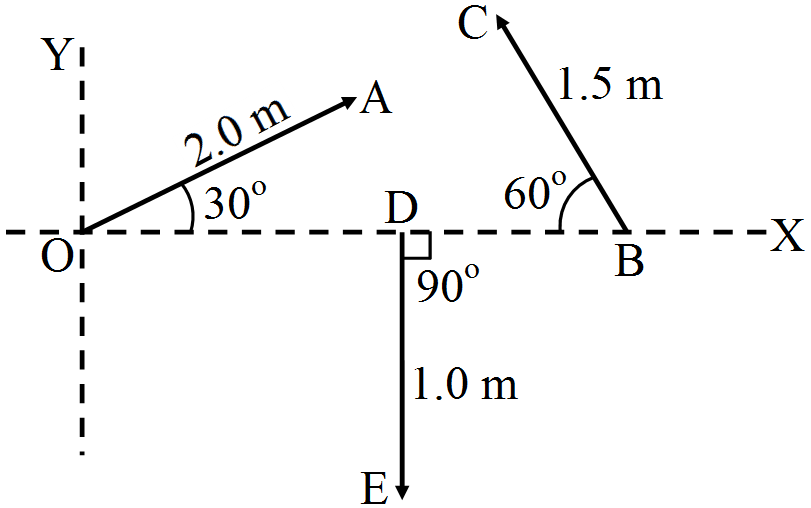
Refer to figure. Find
  1. The magnitude.
  2. x and y components
  3. The angle with the X-axis of the resultant of $\overrightarrow{\text{OA}},\overrightarrow{\text{BC}}$ and $\overrightarrow{\text{DE}}.$
In a series RC circuit with an AC source, $\text{R}=300\Omega,\text{C}=25\mu\text{F},\in_0=50\text{V}$ and $\nu=\frac{50}{\pi}\text{Hz}.$ Find the peak current and the average power dissipated in the circuit.
The volume of an ideal gas $(\gamma=1.5)$ is changed adiabatically from 4.00 litres to 3.00 litres. Find the ratio of,
  1. The final pressure to the initial pressure.
  2. The final temperature to the initial temperature.
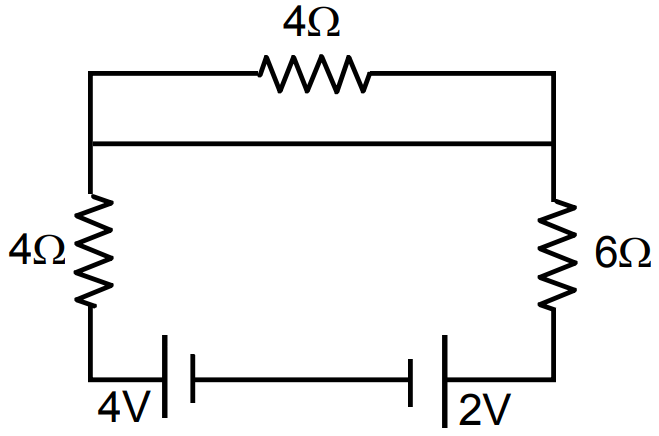
Find the currents through the three reaiators shown in figure.
An electric current flows in a wire from north to south. What will be the direction of the magnetic field due to this wire at a point east of the wire? West of the wire? Vertically above the wire? Vertically below the wire?