Question types

MODEL PAPER 3 question types

38 questions across 6 question groups — pick any mix to generate a Physics paper with step-by-step answer keys.

38
Questions
6
Question groups
5
Question types
Sample Questions

MODEL PAPER 3 questions

One sample from each question group in this chapter. Select any group above to see the full set with answer keys.

An equi$-$convex crown glass lens has a focal length $20 \ cm$ for violet rays. Here $\mu_{ v }=1.5 \ \mu_{ r }=1.47$. Its focal length for red rays is
  • A
    $24.85 \ cm$
  • B
    $20.82 \ cm$
  • $21.28 \ cm$
  • D
    $22.85 \ cm$

Answer: C.

View full solution
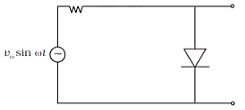
The output of the given circuit in Figure.
Image
  • A
    would be like a half-wave rectifier with negative cycles in output
  • B
    would be like a half-wave rectifier with positive cycles in output
  • C
    would be like that of a full-wave rectifier
  • D
    would be zero at all times
View full solution
The magnitude of the electric field due to a point charge object at a distance of 4.0 m is $9 N / C$. From the same charged object the electric field of magnitude, $16 \frac{N}{ C }$ will be at a distance of
  • A
    3m
  • B
    1m
  • C
    6m
  • D
    2m
View full solution
Phenomenon of bending of waves around corners of obstacle without a change in medium is called _________.
  • A
    diffraction
  • B
    interference
  • C
    reflection
  • D
    refraction
View full solution
Assertion (A): An electric lamp is connected in series with a long solenoid of copper with air core and then connected to ac source. If an iron rod is inserted in solenoid, the lamp will become dim.
Reason (R): If an iron rod is inserted in solenoid, the inductance of solenoid increases.
  • A
    Assertion and reason both are correct statements and reason is correct explanation for assertion.
  • B
    Assertion and reason both are correct statements but reason is not correct explanation for assertion.
  • C
    Assertion is correct statement but reason is wrong statement.
  • D
    Assertion is wrong statement but reason is correct statement.
View full solution
Assertion (A): Colours are seen in thin layers of oil on the surface of the water.
Reason (R): White light is composed of several colours.
  • A
    Both A and R are true and R is the correct explanation of A.
  • B
    Both A and R are true but R is not the correct explanation of A.
  • C
    A is true but R is false.
  • D
    A is false but R is true.
View full solution
Assertion (A): Two equipotential surfaces cannot cut each other.
Reason (R): Two equipotential surfaces cannot cut each other.
  • A
    Both A and R are true and R is the correct explanation of A.
  • B
    Both A and R are true but R is not the correct explanation of A.
  • C
    A is true but R is false.
  • D
    A is false but R is true.
View full solution
Assertion (A): If the frequency of the incident light on a metal surface is doubled, the kinetic energy of emitted electrons is more than doubled.
Reason (R): The metal will provide additional energy to the emitted photoelectron for light of higher frequency than that for lower frequency.
  • A
    Both A and R are true and R is the correct explanation of A.
  • B
    Both A and R are true but R is not the correct explanation of A.
  • C
    A is true but R is false.
  • D
    A is false but R is true.
View full solution
A long straight wire carrying a current of $30$ A is placed in an external uniform magnetic field of $4.0 \times 10^{-4} T$ parallel to the current. Find the magnitude of the resultant magnetic field at a point $2.0 \ cm$ away from the wire.
View full solution
The maximum torque acting on a coil of effective area $0.04 m^2$ is $4 \times 10^{-8} Nm$ when the current in it is $100 \ pA$ . Find the magnetic induction in which it is kept.
View full solution
An $\alpha-$particle after passing through a potential difference of $2 \times 10^6 V$ falls on a silver foil. The atomic number of silver is $47 .$ Calculate $(i)$ the kinetic energy of the $\alpha$-particle at the time of falling on the foil $(ii)$ the kinetic energy of the $\alpha$-particle at a distance of $5 \times 10^{-14} m$ from the nucleus and $(iii)$ the shortest distance from the nucleus of silver to which the $\alpha-$particle reaches.
View full solution
Two identical bars, one of paramagnetic material and other of diamagnetic material are kept in a uniform external magnetic field parallel to it. Draw diagrammatically the modifications in the magnetic field pattern in each case.
View full solution
Q 153 Marks Question3 Marks
A metallic rod of length l and resistance R is rotated with a frequency $\nu$ , with one end hinged at the centre and the other end at the circumference of a circular metallic ring of radius l, about an axis passing through the centre and perpendicular to the plane of the ring. A constant and uniform magnetic field B parallel to the axis is present everywhere.
i. Derive the expression for the induced emf and the current in the rod.
ii. Due to the presence of the current in the rod and of the magnetic field, find the expression for the magnitude and direction of the force acting on this rod.
iii. Hence obtain the expression for the power required to rotate the rod.
View full solution
Q 163 Marks Question3 Marks
State Lenz's law. Give one example to illustrate this law. "The Lenz's law is a consequence of the principle of conservation of energy." Justify this statement.
View full solution
Q 173 Marks Question3 Marks
In a Young's double experiment, the slits are $1.5 mm$ apart. When the slits are illuminated by a monochromatic light source and the screen is kept $1 m$ apart from the slits, width of $10$ fringes is measured as $3.93 \ mm.$
Calculate the wavelength of light used. What will be the width of $10$ fringes when the distance between the slits and the screen is increased by $0.5 m$. The source of light used remains the same.
View full solution
Q 183 Marks Question3 Marks
The photon emitted during the de-excitation from the first excited level to the ground state of hydrogen atom is used to irradiate a photocathode of a photocell, in which stopping potential of 5 V is used. Calculate the work function of the cathode used.
View full solution
Q 193 Marks Question3 Marks
The radionuclide ${ }^{11} C$ decays according to ${ }_6^{11} C \rightarrow{ }_5^{11} B+ e ^{+}+ v : T _{1 / 2}=20.3\  min$. The maximum energy of the emitted positron is $0.960 MeV$ . Given the mass values: $m \left({ }_6^{11} C \right)=11.011434 u$ and $m \left({ }_5^{11} B\right)=11.009305 u$, calculate $Q$ and compare it with the maximum energy of the positron emitted.
View full solution
$i$. What do you understand by the sharpness of resonance in a series $L-C-R$ circuit? Derive an expression for $Q$ factor of the circuit.
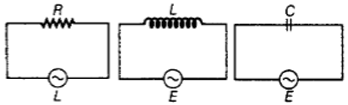
$ii$. Three electrical circuits having $AC$ sources of variable frequency are shown in the figures. Initially, the current flowing in each of these is same. If the frequency of the applied $AC$ source is increased, how will the current flowing in these circuits be affected? Give the reason for your answer.
Image
View full solution
$a.$ Show that an ideal inductor does not dissipate power in an ac circuit.
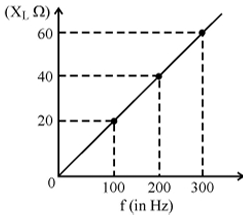
$b.$ The variation of inductive reactance $\left( X _{ L }\right)$ of an inductor with the frequency $( f )$ of the $ac$ source of $100 V$ and variable frequency is shown in the fig.
Image

$i.$ Calculate the self$-$inductance of the inductor.
$ii.$ When this inductor is used in series with a capacitor of unknown value and a resistor of $10 \Omega$ at $300 s^{-1}$, maximum power dissipation occurs in the circuit. Calculate the capacitance of the capacitor.
View full solution
$i.$ A Why does the electric field inside a dielectric slab decrease when kept in an external electric field?
$B.$ Derive an expression for the capacitance of a parallel plate capacitor filled with a medium of dielectric constant $K.$
$ii.$ A charge $q =2 \mu C$ is placed at the centre of a sphere of radius $20 \ cm $. What is the amount of work done in moving $4 \mu C$ from one point to another point on its surface?
$iii.$ Write a relation for polarisation $\overrightarrow{ P }$ of a dielectric material in the presence of an external electric field.
View full solution
$a.$ Use Huygen's geometrical construction to show how a plane wavefront at $t = 0$ propagates and produces a wavefront at a later time.
$b.$ Verify, using Huygen's principle, Snell's law of refraction of a plane wave propagating from a denser to a rarer medium.
$c.$ Illustrate with the help of diagrams the action of
$i.$ convex lens and
$ii.$ concave mirror, on a plane wavefront incident on it.
View full solution
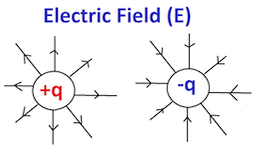
Electric field intensity at any point is the strength of the electric field at that point. It is also defined as the force experienced by unit positive charge placed at that point. Electric Field Intensity is a vector quantity. It is denoted by E. When placed within the electric field, the test charge will experience an electric force - either attractive or repulsive.
Image
(i) The Electric field at a point is
(a) discontinuous only if there is a negative charge at that point
(b) always continuous
(c) continuous if there is charge at that point
(d) continuous if there is no charge at that point

(ii) A charge is distributed uniformly over a ring of radius a. Obtain an expression for the electric intensity E at a point on the axis of the ring. Hence the points at large distances from the ring, it behaves like a point charge is:
(a) $E =\frac{1}{4 \pi \varepsilon_0} \cdot \frac{q}{x}$
(b) $E =\frac{1}{2 \pi \varepsilon_0} \cdot \frac{Q}{x^2}$
(c) $E =\frac{1}{4 \pi \varepsilon_0} \cdot \frac{q}{x^4}$
(d) $E =\frac{1}{4 \pi \varepsilon_0} \cdot \frac{Q}{x^2}$

(iii) Force acting on an electron in a uniform electric field of $5 \times 10^4 N / C$ is:
(a) $8 \times 10^{-15} N$
(b) $-7 \times 10^{-15} N$
(c) $-8 \times 10^{-15} N$
(d) $7 \times 10^{-15} N$

(iv) At a particular point, the electric field depends upon:
(a) source charge Q only
(b) both Q and q
(c) test charge $q_0$ only
(d) neither Q nor q

OR

Four charges of the same magnitude and same sign are placed at the corners of a square, of each side 0.1 m. then electric field intensity at the centre of the square is:
(a) $0.01 N / C$
(b) $0.25 N / C$
(c) zero
(d) $0.1 N / C$

View full solution
Maxwell showed that the speed of an electromagnetic wave depends on the permeability and permittivity of the medium through which it travels. The speed of an electromagnetic wave in free space is given by  $C=\frac{1}{\sqrt{\mu_0 \varepsilon_0}}$ The fact led Maxwell to predict that light is an electromagnetic wave. The emergence of the speed of light from purely electromagnetic considerations is the crowning achievement of Maxwell’s electromagnetic theory. The The fact led Maxwell to predict that light is an electromagnetic wave. The emergence of the speed of light from purely electromagnetic considerations is the crowning achievement of Maxwell’s electromagnetic theory. The speed of an electromagnetic wave in any medium of permeability $\mu$ and permittivity $\varepsilon$ will be$\frac{c}{\sqrt{K \mu_r}}$ where K is the dielectric constant of the medium and $\mu_r$ is the relative permeability.

(i) The dimensions of $\frac{1}{2} \varepsilon_0 E^2$ ( $\varepsilon_0$ : permittivity of free space; $E =$ electric field $)$ is
(a) $MLT ^{-1}$ (b) $ML ^{-1} T^{-2}$ (c) $ML ^2 T^{-2}$ (d) $ML ^2 T^{-1}$

(ii) Let $\left[\varepsilon_0\right]$ denote the dimensional formula of the permittivity of the vacuum. If $M =$ mass, $L =$ length, $T =$ time and $A =$ electric current, then
(a) $\left[\varepsilon_0\right]= ML ^2 T^{-1}$
(b) $\left[\varepsilon_0\right]= MLT ^{-2} A^{-2}$
(c) $\left[\varepsilon_0\right]= M ^{-1} L^{-3} T^4 A^2$
(d) $\left[\varepsilon_0\right]= M ^{-1} L^{-3} T^2 A$

(iii) An electromagnetic wave of frequency 3 MHz passes from vacuum into a dielectric medium with permittivity $\varepsilon=4$. Then
(a) wavelength is halved and the frequency remains unchanged.
(b) wavelength and frequency both remain unchanged
(c) wavelength is doubled and the frequency remains unchanged
(d) wavelength is doubled and the frequency becomes half

OR

The electromagnetic waves travel with
(a) the speed of light $c =3 \times 10^8 m s ^{-1}$ in
(b) the speed of light $c =3 \times 10 m s ^{-1}$ in fluid medium. solid medium
(c) the speed of light $c =3 \times 10^8 m s ^{-1}$ in
(d) the same speed in all media free space

(iv) Which of the following are not electromagnetic waves?
cosmic rays, $\gamma$-rays, $\beta$-rays, X-rays
(a) $\beta$-rays (b) X-rays (c) $\gamma$-rays (d) cosmic rays
View full solution

Generate a MODEL PAPER 3 paper free

Pick question groups from the list above, set marks and difficulty, and export a branded PDF with step-by-step answer keys. First 3 chapters free — no signup.
Download App