Question
$i.$ Distinguish between ionic and covalent compounds under the following properties:
$a.$ Strength of forces between constituent elements
$b.$ Solubility of compounds in water
$c.$ Electrical conduction in substances
$ii.$ Explain how the following metals are obtained from their compounds by the reduction process:
$a.$ Metal $M$ which is in the middle of the reactivity series.
$b.$ Metal $N$ which is high up in the reactivity series. Give one example of each type.
Answer

$i$. a. Ionic compounds have strong force of attraction between the oppositely charged ions $($e.g., $Na ^{+}$and $Cl ^{-}),$ so they are solids.
Covalent compounds have weak force of attraction between their molecules, so they are usually liquids or gases.
$b$. Ionic compounds are soluble in water but covalent compounds are insoluble in water.
$c$. Ionic compounds conduct electricity when dissolved in water or when melted because they contain ions $($charged particles$)$. But, covalent compounds like glucose do not conduct electricity because they do not contain ions.
$ii$. a. The metal M which is in the middle of the reactivity series $($such as iron, zinc, lead, copper, etc.$)$ is moderately reactive.
So, for obtaining such metals from their compounds, their sulphides and carbonates $($in which they are present in nature$)$ are first converted into their oxides by the process of roasting and calcination respectively. For example,
$\underset{\substack{\text { Zinc Sulphide }$
$\text { (Sulphideore) }}}{2 \ce{ZnS ( s )}+3 O _2(g)} \xrightarrow{\text { Heat }} \ce{2 ZnO ( s )+2 SO _2(g)}$
$\underset{\substack{\text { Zinc Carbonate }$
$\text { (Carbonate are) }}}{ \ce{ZnCO _3(s)}} \xrightarrow{\text { Heat }} \ce{ZnO ( s )+ CO _2(g)}$
The metal oxide $(MO)$ are then reduced to the corresponding metals by using suitable reducing agents such as carbon. For example, zinc metal from its oxide is obtained as follow:
$\underset{\text { Zinc oxide }}{ \ce{ZnO (s)}+C(s)} \rightarrow \underset{\text { Zinc }}{ \ce{Zn (s)}}+ \ce{CO ( g )}$
$b$. The metal N which is high up in the reactivity series $($such as sodium, magnesium, calcium, aluminium, etc.$),$ is very reactive and cannot be obtained from its compound by heating with carbon.
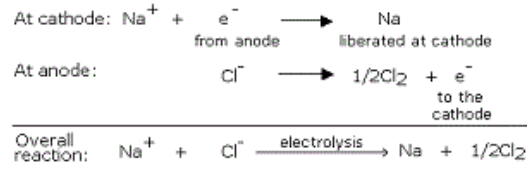
Therefore, such metals are obtained by electrolytic reduction of their molten salt.
For example, sodium is obtained by the electrolysis of molten sodium chloride $\ce{(NaCl)}$.

Image

Need a full question paper?

Generate a complete, print-ready paper with questions like this in minutes — across 16+ boards, with answer keys.

Start Generating Free

Similar questions

$a.$ Calculate the resistance of a metal wire of length $2 m$ and area of cross$-$section $1.55 \times 10^{-6} m^2$ $($Resistivity of the metal is $\left.2.8 \times 10^{-8} \Omega m\right)$
$b.$ Why are alloys preferred over pure metals to make the heating elements of electrical heating devices?
AB is a current carrying conductor in the plane of the paper as shown in Figure. What are the directions of magnetic fields produced by it at points P and Q? Given $r_1 > r_2$, where will the strength of the magnetic field be larger?
Where do plants get each of the raw materials required for photosynthesis?
No chemical reaction takes place when granules of a solid, A, are mixed with the powder of another solid, B. However when the mixture is heated, a reaction takes place between its components. One of the products, C, is a metal and settles down in the molten state while the other product, D, floats over it. It was observed that the reaction is highly exothermic.
  1. Based on the given information make an assumption about A and B and write a chemical equation for the chemical reaction indicating the conditions of reaction, physical state of reactants and products and thermal status of the reaction.
  2. Mention any two types of reactions under which above chemical reaction can be classified.
Give three reasons why different electrical appliances in a domestic circuit are connected in parallel.
When an object is placed 20cm from a concave mirror, a real image magnified three times is formed. Find:
  1. The focal length of the mirror.
  2. Where must the object be placed to give a virtual image three times the height of the object?
What are outside raw materials used for by an organism?
Describe the layering method for the artificial propagation of plants. Illustrate your answer with the help of a labelled diagram. Name any five plants which are propagated by the layering method.
Why is atomic number considered to be a more appropriate parameter than atomic mass for the classification of elements in a periodic table? How does the metallic character of elements vary as we move (i) from left to right in a period, and (ii) top to bottom in a group in the modern periodic table? Give reasons to justify your answers.
The image of a candle flame formed by a lens is obtained on a screen placed on the other side of the lens. If the image is three times the size of the flame and the distance between lens and image is 80cm, at what distance should the candle be placed from the lens? What is the nature of the image at a distance of 80cm and the lens?