Question types

MODEL PAPER 10 question types

49 questions across 6 question groups — pick any mix to generate a Science paper with step-by-step answer keys.

49
Questions
6
Question groups
5
Question types
Sample Questions

MODEL PAPER 10 questions

One sample from each question group in this chapter. Select any group above to see the full set with answer keys.

Q 1M.C.Q1 Mark
Assertion (A): Recycling is the way of managing plastic waste.
Reason (R): Broken plastic articles are sent to plastic processing units where they are melted and remoulded to make new plastic articles.
  • A
    Both A and R are true and R is the correct explanation of A.
  • B
    Both A and R are true but R is not the correct explanation of A.
  • C
    A is true but R is false.
  • D
    A is false but R is true.
View full solution
Q 2M.C.Q1 Mark
Assertion (A): A compass is kept near a wire carrying current gets deflected
Reason (R): Electric current is capable of producing a magnetic effect.
  • A
    Both A and R are true and R is the correct explanation of A
  • B
    Both A and R are true but R is not the correct explanation of A.
  • C
    A is true but R is false.
  • D
    A is false but R is true
View full solution
Q 3M.C.Q1 Mark
Assertion (A): DNA copying is necessary during reproduction.
Reason (R): DNA copying leads to the transmission of characters from parents to offspring.
  • A
    Both A and R are true and R is the correct explanation of A.
  • B
    Both A and R are true but R is not the correct explanation of A.
  • C
    A is true but R is false.
  • D
    A is false but R is true.
View full solution
Q 4M.C.Q1 Mark
Assertion (A): Silver articles become black after sometime when exposed to sunlight
Reason (R): It is because silver reacts with carbonates present in the air.
  • A
    Both A and R are true and R is the correct explanation of A.
  • B
    Both A and R are true but R is not the correct explanation of A.
  • C
    A is true but R is false.
  • D
    A is false but R is true.
View full solution
Q 5M.C.Q1 Mark
Food web is constituted by
  • A
    relationship between animals and environment.
  • B
    relationship between plants and animals
  • C
    various interlinked food chains in an ecosystem
  • D
    relationship between the organisms and the environment
View full solution
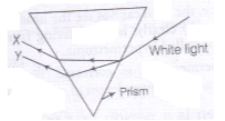
When a beam of white light is passed through a triangular glass prism, it gets dispersed into its seven colour
components. Why do we get these colours? In the given figure, the colours X and Y represent the extreme components of the spectrum. Identify X and Y.

Image
View full solution
Your uncle has come from the village to renew the contract to supply frogs to the laboratories of the colleges of the town. While talking to you, he mentioned that cases of malaria have increased in his village. In addition population of grasshoppers has also increased who are damaging crops.
i. What could be the reasons for such problems faced by villagers?
ii. What suggestions will you give to your uncle?
View full solution
$i.$ A wire of resistance $2$ has been connected to a source of $50 V$ as its two ends. What is the current flowing
through the wire?
$ii.$ An electric kettle rated at $220 V, 2.2 kW$ works for $3h.$ Calculate the energy consumed and the current drawn.
View full solution
Two plants, A with white flowers and B with red flowers were crossed. The $F _1$ progeny shows all red flowersand $F _2$ has three red and one white. Categorise the trait as dominant and recessive
View full solution
$i.$ One half of a convex lens of focal length $10 \ cm$ is covered with a black paper. Can such a lens produce an image
of a complete object placed at a distance of $30 \ cm$ from the lens? Draw a ray diagram to justify your answer.
$ii.$ A $4 \ cm$ tall object is placed perpendicular to principal axis of a convex lens of focal length $20 \ cm.$ The distance of
the object from the lens is $15 \ cm.$ Find the nature, position and the size of the image.
View full solution
An object $4.0 \ cm$ in size, is placed $25.0 \ cm$ in front of a concave mirror of focal length $15.0 \ cm.$
$i.$ At what distance from the mirror should a screen be placed in order to obtain a sharp image?
$ii.$ Find the size of the image.
$iii.$ Draw a ray diagram to show the formation of image in this case.
View full solution
a. Define the term isomer
b. Two compounds have same molecular formula $C _3 H _6 O$. Write the name of these compounds and their structural formula.
c. How would you bring the following conversions:
i. Ethanol to ethene
ii. Propanol to propanoic acid
View full solution
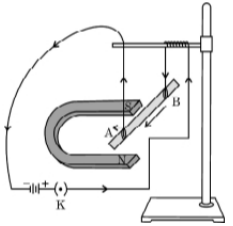
A student was asked to perform an experiment to study the force on a current carrying conductor in a magnetic
field. He took a small aluminum rod AB, a strong horse shoe magnet, some connecting wires, a battery and a
switch and connected them as shown. He observed that on passing current, the rod gets displaced. On reversing
the direction of current, the direction of displacement also gets reversed. On the basis of your understanding of
this phenomenon, answer the following questions :

Image
(a) State the condition under which the displacement of the rod is largest for the same magnitude of current flowing through it.
(b) State the rule that determines the direction of the force on the conductor AB.
(c)
i. If the U shaped magnet is held vertically and the aluminum rod is suspended horizontally with its end
B towards due north, then on passing current through the rod from B to A as shown, in which direction will the rod be displaced?
ii. Name any two devices that use current carrying conductors and magnetic field.

OR

Draw the pattern of magnetic field lines produced around a current-carrying straight conductor held vertically on horizontal cardboard. Indicate the direction of the field lines as well as the direction of the current flowing through the conductor.
View full solution
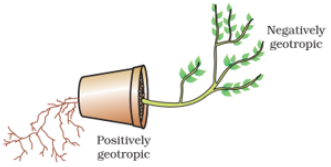
Environmental triggers such as light, or gravity will change the directions that plant parts grow in. These
directional, or tropic, movements can be either towards the stimulus or away from it. So, in two different kinds
of phototropic movement, shoots respond by bending towards light while roots respond by bending away from
it. How does this help the plant? Plants show tropism in response to other stimuli as well. The roots of a plant
always grow downwards while the shoots usually grow upwards and away from the earth. This upward and
downward growth of shoots and roots, respectively, in response to the pull of earth or gravity, is, obviously,
geotropism. If ‘hydro’ means water and ‘chemo’ refers to chemicals, what would ‘hydrotropism’ and ‘chemotropism’ mean? Can we think of examples of these kinds of directional growth movements? One
example of chemotropism is the growth of pollen tubes towards ovules, about which we will learn more when we examine the reproductive processes of living organisms.
Image

(a) Where does negative phototropism occur in plants?
(b) Phototropism in shoots is attributed due to which plant hormone?
(c) Tendrils exhibit/ twining of tendrils show which type of tropic movement?

OR

If the stem grows towards sunlight and the root grows just opposite to it, then what type of movement of the stem is it?
View full solution
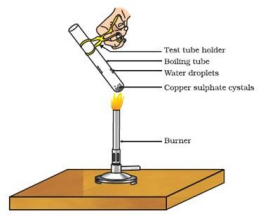
Copper sulphate crystal contains water of crystallisation when the crystal is heated the water is removed and salt
turns white. The crystal can be moistened again with water. The water of crystallisation is the fixed number of
water molecules present in 1 formula unit of copper sulphate. On heating gypsum at 373K, it loses water
molecules and became calcium sulphate hemihydrate.

Image

(a) If the crystal is moistened with water, then which colour of the crystal reappears?
(b) What is the commercial name of calcium sulphate hemihydrate?

OR

Five water molecules are present in one formula unit of copper sulphate.
View full solution

Generate a MODEL PAPER 10 paper free

Pick question groups from the list above, set marks and difficulty, and export a branded PDF with step-by-step answer keys. First 3 chapters free — no signup.

Download App