Questions

[3 Mark Questions]

🎯

Test yourself on this topic

8 questions · timed · auto-graded

Question 13 Marks
$i.$ A wire of resistance $2$ has been connected to a source of $50 V$ as its two ends. What is the current flowing
through the wire?
$ii.$ An electric kettle rated at $220 V, 2.2 kW$ works for $3h.$ Calculate the energy consumed and the current drawn.
Answer
$i.$ Zero, current flows due to potential difference and not due to potentials.
$ii.$ Energy consumed $($ in $kWh )=$ power $($ in $kW ) \times$ time $( h )$
$=2.2\ kW \times 3 h$
$=6.6\ kWh$
Power $=2.2 kW=2.2 \times 1,000 W=2,200 W$
But Power $=\text { Voltage } \times \text { Current }$
$2,200=220 \times I$
$I=\frac{2200}{220}=10 A$
View full question & answer
Question 33 Marks
Differentiate between virtual image formed by a concave mirror and of a convex mirror.
Answer
The virtual image formed by a concave mirror is always magnified whereas the virtual image formed by a convex mirror is diminished.
View full question & answer
Question 43 Marks
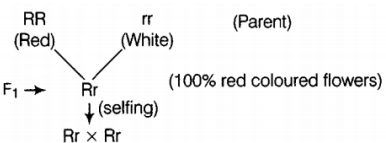
Two plants, A with white flowers and B with red flowers were crossed. The $F _1$ progeny shows all red flowersand $F _2$ has three red and one white. Categorise the trait as dominant and recessive
Answer
When two plants, A with white flowers and B with red flowers were crossed, In $F _1$ generation all the plants have red coloured flowers and in $F _2$ generation the ratio of red : white is 3 : 1.
The dominant trait is red colour in flowers.
The recessive trait is white colour in flowers.

Image
GametesRr
RRR(red)Rr(red)
rRr(red)rr(red)
View full question & answer
Question 53 Marks
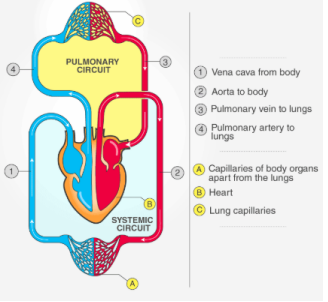
Explain how deoxygenated blood travels from body to lung for purification. Draw well-labelled diagram in support of your answer.
Answer
The deoxygenated blood is collected from the body tissues through the veins which further combine to form vena cava. This vena cava pours deoxygenated blood collected from the body tissues into the right auricle of the heart. From the right auricle, it goes to the right ventricle and from here the blood is pumped into the pulmonary artery which takes the deoxygenated blood from the heart to the lungs. In the alveoli of the lungs, the blood is oxygenated. This oxygenated blood is pumped into the pulmonary veins which pour the blood into the left auricle. From here the oxygenated blood is poured into the left ventricle. The left ventricle pushes the blood into the aorta which pumps the oxygenated blood into the body tissues and supplies oxygen through the tissues for various body functions.

Image

Figure: The double circulation of blood
View full question & answer
Question 63 Marks
$i.$ Distinguish between ionic and covalent compounds under the following properties:
$a.$ Strength of forces between constituent elements
$b.$ Solubility of compounds in water
$c.$ Electrical conduction in substances
$ii.$ Explain how the following metals are obtained from their compounds by the reduction process:
$a.$ Metal $M$ which is in the middle of the reactivity series.
$b.$ Metal $N$ which is high up in the reactivity series. Give one example of each type.
Answer
$i$. a. Ionic compounds have strong force of attraction between the oppositely charged ions $($e.g., $Na ^{+}$and $Cl ^{-}),$ so they are solids.
Covalent compounds have weak force of attraction between their molecules, so they are usually liquids or gases.
$b$. Ionic compounds are soluble in water but covalent compounds are insoluble in water.
$c$. Ionic compounds conduct electricity when dissolved in water or when melted because they contain ions $($charged particles$)$. But, covalent compounds like glucose do not conduct electricity because they do not contain ions.
$ii$. a. The metal M which is in the middle of the reactivity series $($such as iron, zinc, lead, copper, etc.$)$ is moderately reactive.
So, for obtaining such metals from their compounds, their sulphides and carbonates $($in which they are present in nature$)$ are first converted into their oxides by the process of roasting and calcination respectively. For example,
$\underset{\substack{\text { Zinc Sulphide }$
$\text { (Sulphideore) }}}{2 \ce{ZnS ( s )}+3 O _2(g)} \xrightarrow{\text { Heat }} \ce{2 ZnO ( s )+2 SO _2(g)}$
$\underset{\substack{\text { Zinc Carbonate }$
$\text { (Carbonate are) }}}{ \ce{ZnCO _3(s)}} \xrightarrow{\text { Heat }} \ce{ZnO ( s )+ CO _2(g)}$
The metal oxide $(MO)$ are then reduced to the corresponding metals by using suitable reducing agents such as carbon. For example, zinc metal from its oxide is obtained as follow:
$\underset{\text { Zinc oxide }}{ \ce{ZnO (s)}+C(s)} \rightarrow \underset{\text { Zinc }}{ \ce{Zn (s)}}+ \ce{CO ( g )}$
$b$. The metal N which is high up in the reactivity series $($such as sodium, magnesium, calcium, aluminium, etc.$),$ is very reactive and cannot be obtained from its compound by heating with carbon.
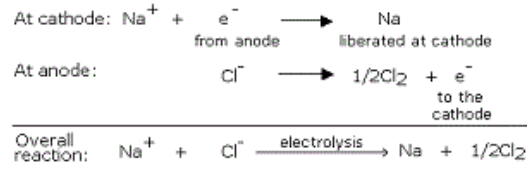
Therefore, such metals are obtained by electrolytic reduction of their molten salt.
For example, sodium is obtained by the electrolysis of molten sodium chloride $\ce{(NaCl)}$.

Image
View full question & answer
Question 73 Marks
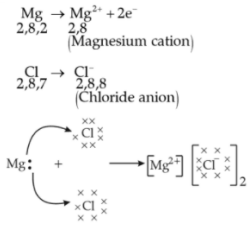
i. By the transfer of electrons, illustrate the formation of bond in magnesium chloride and identify the ions present in this compound.
ii. Ionic compounds are solids. Give reasons.
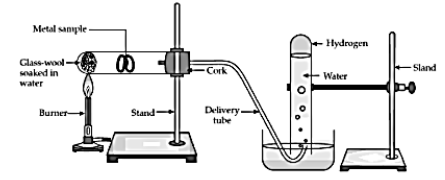
iii. With the help of a labelled diagram show the experimental set up of action of steam on a metal.
Answer
i. Formation of magnesium chloride - magnesium is a metal and chlorine is a non-metal. The magnesium atom loses 2 electrons to attain a stable configuration which results in the formation of magnesium cation $Mg ^{2+}$.
Similarly, the chlorine atom gains an electron to complete its octet and results in the formation of chloride anion $Cl ^{-}$. When magnesium reacts with chlorine, two electrons lost by magnesium atoms are gained by two chlorine atoms. $Mg ^{2+}$ and $Cl ^{-}$ being oppositely charged, attract each other and are held by strong electrostatic forces of attraction to exist as $MgCl _2$.

Image

ii. Due to the strong force of attraction between the metal with a positive charge and metal with a negative charge, ionic compounds are solid.
iii. Reaction with steam: Metals like iron, zinc and aluminum react with steam to form corresponding hydroxide and hydrogen gas.

Image
View full question & answer
Question 83 Marks
'M' is an element which may be one out of Cu, Fe, Al, Na. It shows the following properties:
(i) One of its ore is rich in $M _2 O _3$.
(ii) $M _2 O _3$ is not affected by water.
(iii) It corrodes easily.
(iv) It form to chlorides $M C l_2$ and $MCl _3$ . Identify 'M'.
Answer
(i) As the metal 'M' forms oxide $M _2 O _3$ it is trivalent. Out of the metals listed, only Fe and Al are trivalent.
(ii) $M _2 O _3$ is not affected by water, so 'M' can be out Fe of Ai or .
(iii) Fe and AL both corrode easily.
(iv) Out of AI and Fe , only Fe can form divalent chloride, so the element 'M' is Fe.
View full question & answer
[3 Mark Questions] - Science STD 10 Questions - Vidyadip