Question
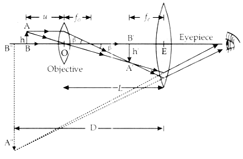
$i$. Draw a ray diagram showing the image formation by a compound microscope. Obtain the expression for total magnification when the image is formed at infinity.
$ii$. How does the resolving power of a compound microscope get affected, when
$1$. focal length of the objective is decreased.
$2$. the wavelength of light is increased ? Give reasons to justify your answer.
Answer

$i$. The ray diagram, showing image formation by a compound microscope, is given below ; $-$
Image
$ii.$ Linear Magnification due to objective lens is given by $=\frac{\tan \beta}{\tan \alpha}$
$\tan \beta=\frac{h^{\prime}}{L}=\frac{h}{f_o}$
$\frac{h^{\prime}}{h}=\frac{L}{f_0}$
$($where the distance between the second focal point of the objective and the first focal point of the eyepiece is called the tube length of the compound microscope and is denoted by $L)$
The eyepiece will act as a simple microscope, hence we may use the formula of magnification by a simple microscope for normal adjustment.
$m_e=\frac{D}{f_e}$
Total magnification, $m = m _{ o } \times m _{ e }$
$=\frac{L}{f_o} \times \frac{D}{f_e} d_{\min }$
$a$. From the equation, it is clear that resolving power increases when the focal length of the objective is decreased.
This is because the minimum separation, $d _{\min }$ decreases when f is decreased.
$b$. Resolving power decreases when the wavelength of light is increased.
​​​​​​​This is because the minimum separation, $d _{\text {min }}$ increases when $\lambda$ is increased.

Need a full question paper?

Generate a complete, print-ready paper with questions like this in minutes — across 16+ boards, with answer keys.

Start Generating Free

Similar questions

A group of hydrogen atoms are prepared in n = 4 states. List the wavelength that are emitted as the atoms make transitions and return to n = 2 states.
Calculate the Q-values of the following fusion reactions:
  1. $\text{ }^2_1\text{H}+\text{ }^2_1\text{H}\rightarrow\text{ }^3_1\text{H}+\text{ }^1_1\text{H}$
  2. $\text{ }^2_1\text{H}+\text{ }^2_1\text{H}\rightarrow\text{ }^3_2\text{H}+\text{n}$
  3. $\text{ }^2_1\text{H}+\text{ }^3_1\text{H}\rightarrow\text{ }^4_1\text{H}+\text{n}$
Atomic masses are
$\text{m}\big(\text{ }^2_1\text{H}\big)=2.014102\text{u}$
$\text{m}\big(\text{ }^3_1\text{H}\big)=3·016049\text{u}$
$\text{m}\big(\text{ }^3_2\text{H}\big)=3.016029\text{u}$
$\text{m}\big(\text{ }^4_2\text{He}\big)=4·002603\text{u}$
By giving example of bar magnet, explain its basic properties.
Two identical balls, each having a charge of $2.00 \times 10^{-7}C$ and a mass of $100g$, are suspended from a common point by two insulating strings each $50\ cm$ long. The balls are held at a separation $5.0\ cm$ apart and then released. Find,
  1. The electric force on one of the charged balls.
  2. The components of the resultant force on it along and perpendicular to the string.
  3. The tension in the string.
  4. The acceleration of one of the balls. Answers are to be obtained only for the instant just after the release.
Figure shows a heavy block kept on a frictionless surface and being pulled by two ropes of equal mass $m.$
 At $t = 0,$ the force on the left rope is withdrawn but the
force on the right end continues to act.
Let $F_1$ and $F_2$ be the magnitudes of the forces by the right rope and the left rope on the block respectively:
Find the diameter of the image of the moon formed by a spherical concave mirror of focal length $7.6m$. The diameter of the moon is $3450\ km$ and the distance between the earth and the moon is $3.8 \times 10^5\ km.$
A small bulb is placed at the bottom of a tank containing water to a depth of 80 cm. What is the area of the surface of water through which light from the bulb can emerge out? Refractive index of water is 1.33. (Consider the bulb to be a point source.)
Given below are some famous numbers associated with electromagnetic radiations in different contexts in physics. State the part of the electromagnetic spectrum to which each belongs.
  1. $21 \ cm \ ($wavelength emitted by atomic hydrogen in interstellar space$)$.
  2. $1057 MHz \ ($frequency of radiation arising from two close energy levels in hydrogen; known as Lamb shift$).$
  3. $2.7 K \ [$temperature associated with the isotropic radiation filling all space $-$ thought to be a relic of the ‘big $-$ bang’ origin of the universe$]$.
  4. $5890 \mathring A - 5896 \mathring A \ [$double lines of sodiu$]$
  5. $14.4 keV \ [$energy of a particular transition in ${57}Fe$ nucleus associated with a famous high resolution spectroscopic method $($Mössbauer spectroscopy$)].$
A double convex lens has focal length $25\ cm$. The radius of curvature of one of the surfaces is double of the other. Find the radii, if the refractive index of the material of the lens is $1.5$.
An apple falls from a tree. An insect in the apple finds that the earth is falling towards it with an acceleration $g.$ Who exerts the force needed to accelerate the earth with this acceleration $g$ ?