Question
Match the compounds/elements given in Column I with uses given in Column II.
 
Column I (Compound/element)
 
Column II (Use)
(i)
Lanthanoid oxide
(a)
Production of iron alloy
(ii)
Lanthanoid
(b)
Television screen
(iii)
Misch metal
(c)
Petroleum cracking
(iv)
Magnesium based alloy is constituent of
(d)
Lanthanoid metal + iron
(v)
Mixed oxides of lanthanoids are employed
(e)
Bullets
 
 
(f)
In X-ray screen

Answer

 
Column I (Compound/element)
 
Column II (Use)
(i)
Lanthanoid oxide
(b)
Television screen
(ii)
Lanthanoid
(a)
Production of iron alloy
(iii)
Misch metal
(d)
Lanthanoid metal + iron
(iv)
Magnesium based alloy is constituent of
(e)
Bullets
(v)
Mixed oxides of lanthanoids are employed
(c)
Petroleum cracking
Explanation:

Compound/ element- use
  1. Lanthanoid oxide /television screen
  2. Lanthanoid – production of iron alloy
  3. Misch metal- Lanthanoid metal + iron
  4. Magnesium based alloy- bullets
  5. Mixed oxide of lanthanoids are employed – petroleum cracking.

Need a full question paper?

Generate a complete, print-ready paper with questions like this in minutes — across 16+ boards, with answer keys.

Start Generating Free

Similar questions

  1. What may be the possible oxidation states of the transition metals with the following d electronic configurations in the ground state of their atoms:
$3d^34s^2, 3d^54s^2 $and $3d^6 4s^3$^. Indicate relative stability of oxidation states in each case.
  1. Write steps involved in the preparation of (i) $Na_2CrO_4 $from chromite ore and (ii) K_2MnO_4 from pyrolusite ore.
Calculate the depression in the freezing point of water when $10\ g$ of $CH_3CH_2CHClCOOH$ is added to $250\ g$ of water. $K_a = 1.4 \times 10^{–3},\ K_f = 1.86\ K\ kg\ mol^{–1}.$
Describe the reactions of carboxylic acids in which C-OH bond is broken.
a. i. How is the variability in oxidation states of transition metals different from that of the p-block elements?
ii. Out of $Cu ^{+}$and $Cu ^{2+}$, which ion is unstable in aqueous solution and why?
iii. Orange colour of $Cr _2 O _7{ }^{2-}$ ion changes to yellow when treated with an alkali. Why?
b. Chemistry of actinoids is complicated as compared to lanthanoids. Give two reasons.
  1. Complete the following chemical equations for reactions:
i. $\text{MnO}_{4(aq)}^{-}+\text{S}_{2}\text{O}_{3(aq)}^{2-}+\text{H}_{2}\text{O}_{(l)}\rightarrow$
ii. $\text{Cr}_{2}\text{O}^{-}_{7(aq)}+\text{H}_{2}\text{S}_{(g)}+\text{H}^{+}_{(aq)}\rightarrow$
  1. Give an explanation for each of the following, observations:
  1. The gradual decrease in size (actinoid contraction) from element to element is greater among the .actinoids than that among the lanthanoids (lanthanoid contraction).
  2. The greatest number of oxidation states are exhibited by the members in the middle of a transition series.
  3. With the same d-orbital configuration $(d^4) Cr^{2+}$ ion is a reducing agent but $Mn^{3+}$ ion is an oxidising agent.
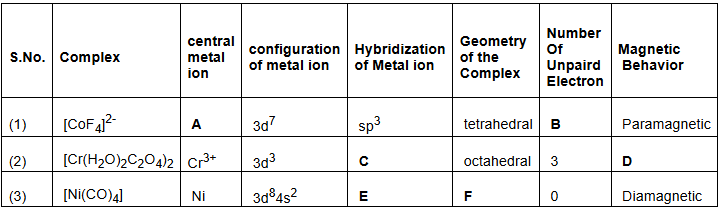
$(a).$ Using, Valence Bond Theory identify $A, B, C, D, E$ and $F$ in the following table:
Image
$(b).$ Write the ionic equations for the reaction of acidified $K_2Cr_2O_7$ with
$(i) \ H_2S$ and $(ii) \ FeSO_4$

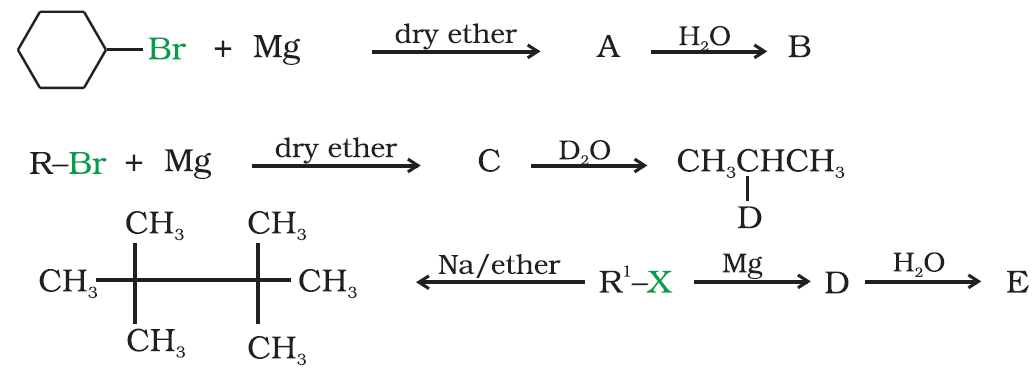
Identify A, B, C, D, E, R and $R^1$ in the following:
(i) Define the order of a reaction.
(ii) Explain the effect of concentration of reactant on the rate constant.
(iii) For a first order reaction, if the rate constant at 500 K and 600 K are $0.03 s^{-1}$ and $0.06 s^{-1}$ respectively, then calculate the activation energy.
$
\left[R=8.314 JK^{-1} mol^{-1}, \log 2=0.3010\right]
$
With the help of an example explain what is meant by pseudo first order reaction.
Discus in detail the following $C - H$ bond cleavage reactions of ether :
(i) Peroxide formation
(ii) Halogenation