Question
i. Show that for two complementary angles of projection of a projectile thrown with the same velocity, the horizontal ranges are equal.
ii. For what angle of projection of a projectile, is the range maximum?
iii. For what angle of projection of a projectile, are the horizontal range and maximum height attained by the projectile equal?
Need a full question paper?

Generate a complete, print-ready paper with questions like this in minutes — across 16+ boards, with answer keys.

Start Generating Free

Similar questions

For the harmonic travelling wave $\text{y}=2\cos2\pi(10\text{t}-0.0080\text{x}+3.5)$ where x and y are in cm and t is second. What is the phase difference between the oscillatory motion at two points separated by a distance of:
What is the phase difference between the oscillation of a particle located at x = 100cm at t = T and t = 5s?
The number of harmonic components in the oscillations are represented by, $\text{y}=4\cos^2$ at $\sin4\text{t}$. What are What are their corresponding angular frequencies?
The wavelengths of $\text{K}_\alpha$ and $\text{L}_\alpha$ X-rays of a material are 21.3pm and 141pm respectively. Find the wavelength of $\text{K}_\beta$ X-ray of the material.
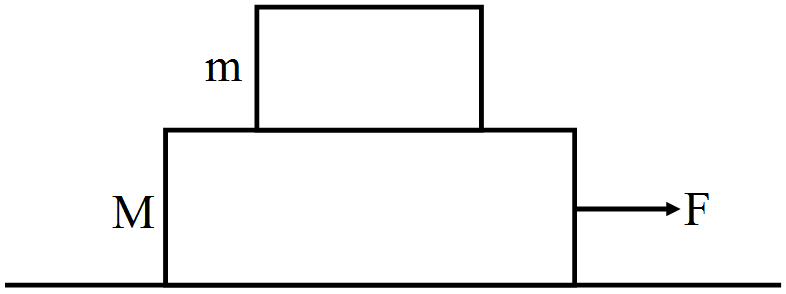
A block of mass m is kept over another block of mass M and the system rests on a horizontal surface figure. A constant horizontal force F acting on the lower block produces an acceleration $\frac{\text{F}}{2(\text{m+M})}$ in the system, the two blocks always move together.
  1. Find the coefficient of kinetic friction between the bigger block and the horizontal surface.
  2. Find the frictional force acting on the smaller block.
  3. Find the work done by the force of friction on the smaller block by the bigger block during a displacement d of the system.

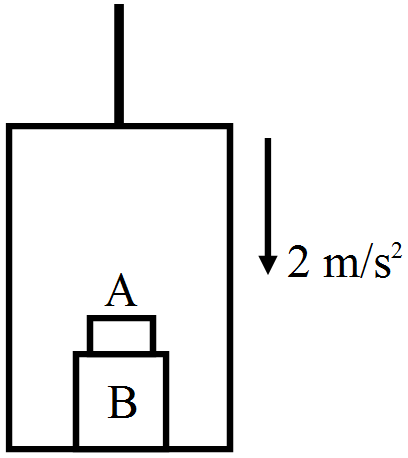
The elevator shown in figure is descending with an acceleration of 2m/s2. The mass of the block A is 0.5kg. What force is exerted by the block A on the block B?

A rubber string 10m long is suspended from a rigid support at its one end. Calculate the extension in the string due to its own weight. The density of rubber is 1.5 × 10³ kg/ m3 and Young's modulus for the rubber is 5 × 10⁶N/ m2.
The breaking stress for a metal is 7.8 × 10⁹N/ m2. Calculate the maximum length of the wire made of this metal which may be suspended without breaking. The density of metal = 7.8 × 10³kg/ m3.
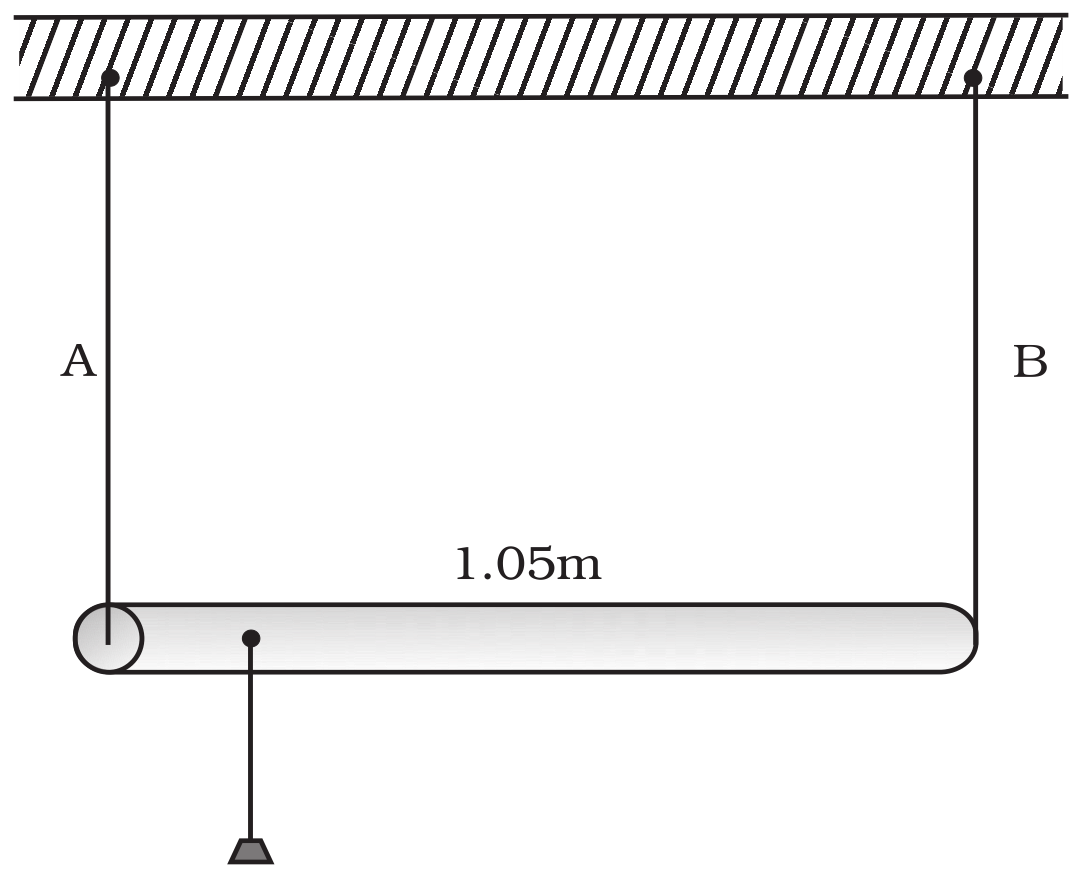
A rod of length 1.05m having negligible mass is supported at its ends by two wires of steel (wire A) and aluminium (wire B) of equal lengths as shown in Fig. The cross-sectional areas of wires A and B are 1.0mm2 and 2.0mm2 , respectively. At what point along the rod should a mass m be suspended in order to produce (a) equal stresses and (b) equal strains in both steel and aluminium wires.

Derive the formula for centripetal acceleration of a particle moving with constant speed on a plane circular path. Or Derive the formula of acceleration for a particle moving with uniform speed on a circular path and tell its direction.
An object of mass m is raised from the surface of the earth to a height equal to the radius of the earth, that is, taken from a distance R to 2R from the centre of the earth. What is the gain in its potential energy?
Explain the difference between harmonic motion and simple harmonic motion. Explain the characteristics and types of simple harmonic motion. Also write differential equations with examples.