Questions

5 Marks Questions

Take a timed test

6 questions · self-marked practice — reveal the answer and mark yourself.

Question 15 Marks
i. What is projectile motion?
ii. The maximum range of projectile is $\frac{2}{\sqrt{3}}$ times actual range. What is the angle of projection for the actual range?
iii. Two balls are thrown with the same initial velocity at angles $\alpha$ and $\left(90^{\circ}-\alpha\right)$ with the horizontal. What will be the ratio of the maximum heights attained by them? When will this ratio be equal to 1 ?
View full question & answer
Question 25 Marks
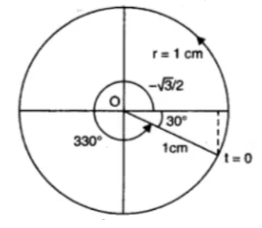
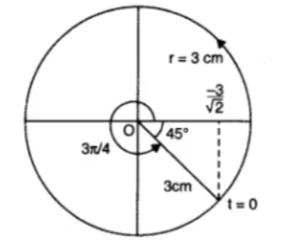
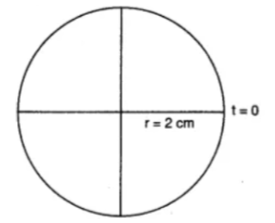
Plot the corresponding reference circle for each of the following simple harmonic motions. Indicate the initial $(t=0)$ position of the particle, the radius of the circle, and the angular speed of the rotating particle. For simplicity, the sense of rotation may be fixed to be anticlockwise in every case: ( $x$ is in cm and t is in s ).
a. $x=-2 \sin \left(3 t+\frac{\pi}{3}\right)$
b. $x=\cos \left(\frac{\pi}{6}-t\right)$
c. $x=3 \sin \left(2 \pi t+\frac{\pi}{4}\right)$
d. $x=2 \cos \pi t$
View full question & answer
Question 35 Marks
Using the correspondence of S.H.M. and uniform circular motion, find displacement, velocity, amplitude, time period and frequency of a particle executing S.H.M?
Answer
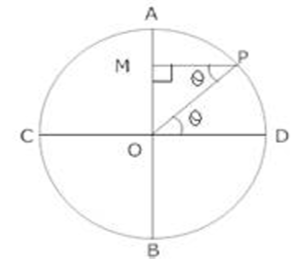
If initially at $t =0$ particle was at D
Then at time t Particle is at point P
Image
$\begin{aligned} & \text { i. Then draw a perpendicular From } P \text { on } AB \text {, } \\ & \text { If the displacement } OM = Y \\ & \text { Ratios of circle of reference }=\text { Amplitude }= a \\ & \text { then In } \triangle OMP , \angle POD =\angle OPM =\theta(\because \text { Alternate Angles }) \\ & \sin \theta=\frac{O M}{O P}\end{aligned}$
$\begin{aligned} & \Rightarrow \sin \theta=\frac{y}{a}, \text { 'a' being radius of the above circle. } \\ & \Rightarrow y=a \sin \theta \\ & \text { Again } \theta=\omega t \\ & \text { So, } y=a \sin \omega t\end{aligned}$
ii. Velocity, $v=\frac{d y}{d t}$
$
\begin{aligned}
& \Rightarrow v=\frac{d}{d t}(a \sin \omega t) \\
& \Rightarrow v=a \omega \cos \omega t
\end{aligned}
$
$
\text { again } \cos \theta=\sqrt{1-\sin ^2 \theta}
$
So, $v=a \omega \times \sqrt{1-\sin ^2 \omega t}$
From equation of displacement : $\sin \omega t=\frac{y}{a}$
So, $v=a \omega \times \sqrt{1-\frac{y^2}{a^2}}$
$\Rightarrow v=a w \sqrt{\frac{a^2-y^2}{a^2}}$
$v=\omega \sqrt{a^2-y^2}$
iii. Acceleration : $f=\frac{d v}{d t}$
$
\begin{aligned}
& \Rightarrow f=a \omega \times \omega(-\sin \omega t) \\
& \Rightarrow f=-\omega^2 a \sin \omega t \Rightarrow f=-\omega^2 y
\end{aligned}
$
iv. Time Period, $T=\frac{2 \pi}{\omega}$
v. freuency $=\frac{1}{T}=\frac{\omega}{2 \pi}$
View full question & answer
Question 45 Marks
Calculate the moment of inertia of uniform circular disc of mass 500 g , radius 10 cm about
i. diameter of the disc
ii. the axis tangent to the disc and parallel to its diameter and
iii. the axis through the centre of the disc and perpendicular to its plane.
Answer
i. M.I. of the disc about any diameter,
$
I_d=\frac{1}{4} M R^2=\frac{1}{4} \times 500 \times(10)^2=12500 g cm^2
$
ii. By theorem of parallel axes, M.I. of the disc about a tangent parallel to the diameter of the disc,
$
\begin{aligned}
& I=I_{d}+MR^2=I=I_d+M R^2=\frac{5}{4} M R^2=\frac{5}{4} \times 500 \times(10)^2 \\
& =62500 g cm^2
\end{aligned}
$
iii. M.I. of the disc about an axis through its centre and perpendicular to its plane,
$
\begin{aligned}
& I=\frac{1}{2} M R^2=\frac{1}{2} \times 500 \times(10)^2 \\
& =25000 g cm^2
\end{aligned}
$
View full question & answer
Question 55 Marks
A tube of length $L$ is filled completely with an incompressible liquid of mass $M$ and closed at both the ends. The tube is then rotated in a horizontal plane about one of its ends with a uniform angular velocity $\omega$. Determine the force exerted by the liquid at the other end.
Answer
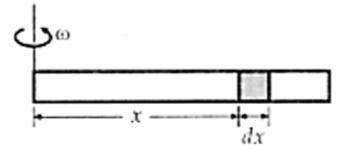
Consider a small element of the liquid of length dx at a distance x from one end. 
Image
Mass of the small element $=\frac{M}{L} d x$
Centripetal force associated with the element
$
d F=\left(\frac{M}{L} d x\right) x \omega^2\left[\because F=m r \omega^2\right]
$
Force exerted by the liquid = Total centripetal force at the other end
$
\begin{aligned}
& F=\int d F=\int_0^L \frac{M}{L} \omega^2 x d x=\frac{M}{L} \omega^2\left[\frac{x^2}{2}\right]_0^L \\
& =\frac{M}{L} \omega^2 \frac{L^2}{2}=\frac{1}{2} M \omega^2 L
\end{aligned}
$
View full question & answer
Question 65 Marks
i. Show that for two complementary angles of projection of a projectile thrown with the same velocity, the horizontal ranges are equal.
ii. For what angle of projection of a projectile, is the range maximum?
iii. For what angle of projection of a projectile, are the horizontal range and maximum height attained by the projectile equal?
View full question & answer
5 Marks Questions - Physics STD 11 Science Questions - Vidyadip