Question
$i$ . Using Bohr's second postulate of quantisation of orbital angular momentum show that the circumference of the electron in the nth orbital state in hydrogen atom is $n-$ times the de $-$ Broglie wavelength associated with it.
$ii$ . The electron in hydrogen atom is initially in the third excited state. What is the maximum number of spectral lines which can be emitted when it finally moves to the ground state?
Answer

$i$. Only those orbits are stable for which the angular momentum of revolving electron is an integral multiple of $\left(\frac{h}{2 \pi}\right)$ where $h$ is the planck's constant.
According to Bohr's second postulate
$m v r_n=n \frac{h}{2 \pi} $
$\Rightarrow 2 \pi r_n=\frac{n h}{m v}$
But $ \frac{h}{m v}=\frac{h}{p}=\lambda \ ($By de Broglie hypothesis$)$
$\therefore 2 \pi r_n=n \lambda$
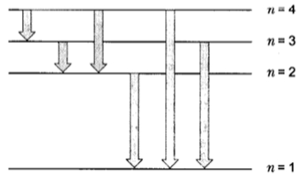
$ii$ . For third excited state $, n = 4$
For ground state $, n = 1$
Hence possible transitions are
$ n _{ i }=4 \text { to } n _{ f }=3,2,1$
$n _{ i }=3 \text { to } n _{ f }=2,1$
$n _{ i }=2 \text { to } n _{ f }=1$
Image
Total number of transitions $= 6$
$ E _C- E _{ R }=\frac{h c}{\lambda_1} \ldots( i )$
$E _{ B }- E _{ A }=\frac{h c}{\lambda_2} \ldots \text { (ii) }$
$E _{ C }- E _{ A }=\frac{h c}{\lambda_a} \ldots \text { (iii) }$
Adding $(i)$ and $(ii),$ we have
$E _{ C }- E _{ A }=\frac{h c}{\lambda_1}+\frac{h c}{\lambda_2} \ldots (iv)$
From $(iii)$ and $(iv),$ we have
$\frac{h c}{\lambda_3}=\frac{h c}{\lambda_1}+\frac{h c}{\lambda_2} $
$\Rightarrow \frac{1}{\lambda_3}=\frac{1}{\lambda_1}+\frac{1}{\lambda_2}$
$\lambda_3=\frac{\lambda_1 \lambda_2}{\lambda_1+\lambda_2}$


Need a full question paper?

Generate a complete, print-ready paper with questions like this in minutes — across 16+ boards, with answer keys.

Start Generating Free

Similar questions

A block is projected along a rough horizontal road with a speed of 10m/s. If the coefficient of kinetic friction is 0.10, how far will it travel before coming to rest?
A charge of $3.14 \times 10^{-6}C$ is distributed uniformly over a circular ring of radius 20.0cm. The ring rotates about its axis with an angular velocity of 60.0 rad/s. Find the ratio of the electric field to the magnetic field at a point on the axis at a distance of 5.00cm from the centre.
A proton has spin and magnetic moment just like an electron. Why then its effect is neglected in magnetism of materials?
A boy is holding a smooth, hollow and non-conducting pipe vertically with charged spherical ball of mass 10 g carrying a charge of +10 mC inside it which is free to move along the axis of the pipe. The boy is moving the pipe from East to West direction in the presence of magnetic field of 2T. With what minimum velocity, should the boy move the pipe such that the ball does not move along the axis. Also determine the direction of the magnetic field.
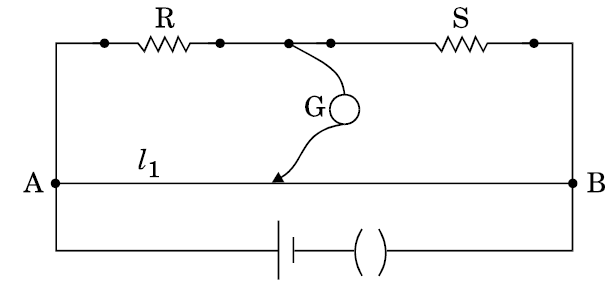
  1. Write the principle of working of a metre bridge.
  2. In a metre bridge, the balance point is found at a distance $l_1$ with resistances R and S as shown in the figure.

An unknown resistance X is now connected in parallel to the resistance S and the balance point is found at a distance $l_2$. Obtain a formula for X in terms of $l_1$, $l_2$ and S.
Explain threshold frequency and stopping potential.###Define the following with respect to photoelectric effect :
(i) Work function (ii) Stopping potential
A short bar magnet placed in a horizontal plane has its axis aligned along the magnetic north-south direction. Null points are found on the axis of the magnet at 14 cm from the centre of the magnet. The earth’s magnetic field at the place is 0.36 G and the angle of dip is zero. What is the total magnetic field on the normal bisector of the magnet at the same distance as the null–point (i.e., 14 cm) from the centre of the magnet? (At null points, field due to a magnet is equal and opposite to the horizontal component of earth’s magnetic field.)
Obtain the relationship between object distance $(u),$ image distance $(v)$ and focal length $(f)$ for a concave mirror.$\#\#\#$ Obtain $\frac{1}{f}=\frac{1}{v}+\frac{1}{u}$ formula for a concave mirror.
(a) A comb run through one's dry hair attracts small bits of paper. Why?
What happens if the hair is wet or if it is a rainy day? (Remember, a paper does not conduct electricity.)
(b) Ordinary rubber is an insulator. But special rubber tyres of aircraft are made slightly conducting. Why is this necessary?
(c) Vehicles carrying inflammable materials usually have metallic ropes touching the ground during motion. Why?
(d) A bird perches on a bare high power line, and nothing happens to the bird. A man standing on the ground touches the same line and gets a fatal shock. Why?
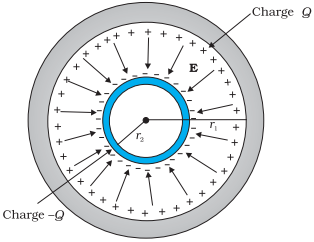
A spherical capacitor consists of two concentric spherical conductors, held in position by suitable insulating supports (2.36). Show
that the capacitance of a spherical capacitor is given by $\text{C}=\frac{{4}\pi\in_{0}\text{r}_1\text{r}_2}{\text{r}_1-\text{r}_2}$ where $r_1$ and $r_2$ are the radii of outer and inner spheres, respectively.