Questions

3 Marks Question

Take a timed test

8 questions · self-marked practice — reveal the answer and mark yourself.

Question 13 Marks
$i.$ Define the term self-inductance and write its $S.I$. unit.
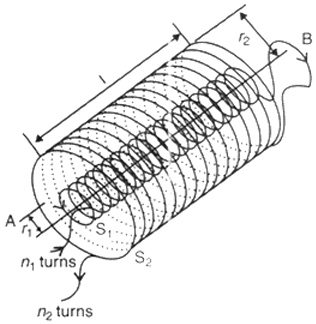
$ii$. Obtain the expression for the mutual inductance of two long co $-$ axial solenoids $S_1$ and $S_2$ wound one over the other, each of length $L$ and radii $r_1$ and $r_2$ and $n_1$ and $n_2$ number of turns per unit length, when a current $I$ is set up in the outer solenoid $S _2$.
Answer
$i.$ Self $-$ Inductance is the property by which an opposing induced emf is produced in a coil due to a change in current, or magnetic flux, linked with the coil.
$ii$. In this question, a long co $-$ axial solenoids $S_1$ and $S_2$ wound one over the other, each of length $L$ and radii $r_1$ and $r_2$ and $n_1$ and $n _2$ number of turns per unit length, when a current $I$ is set up in the outer solenoid $S _2$.
Image
Let a current $l_2$ flow in the secondary coil
$\therefore B _2=\frac{\mu_0 N_2 i_2}{t}$
$\therefore$ Flux linked with the primary coil $=\frac{\mu_0 N_2 N_1 A_1 i_2}{l}$
$= M _{12} i _2$
Hence, $M _{12}=\frac{\mu_0 N_2 N_1 A_2}{l}$
$\mu_0 n_2 n_1 A_1 l\left(n_1=\frac{N_1}{l} ; n_2=\frac{N_2}{l}\right)$
View full question & answer
Question 23 Marks
i. Will the earth's magnetic field induce current in an artificial satellite with a metal surface that is in orbit around the equator? Around the poles?
ii. If so how would these currents affect the motion of the satellite?
Answer
i. There will be no induced currents in the metal of the satellite, which is orbiting in the equatorial plane. It is because the magnetic flux does not change through the metal of the satellite in such an orbit. In other orbits (including orbit around the poles), the value of the magnetic field will change both in magnitude and direction. Due to this, the magnetic flux through the satellite will change and hence induced currents will be produced in the metal of the satellite.
ii. The induced currents in the metal of the satellite will produce magnet. It will experience a small magnetic interaction with earth so that the force on the satellite will not be purely gravitational. Therefore, there will be a deflection from the gravitational field alone. Part of the effect of interaction would cause the satellite to lose energy, dissipated in the form of heat. Paradoxically, if it loses energy, it will speed up. S
View full question & answer
Question 33 Marks
In a diffraction pattern due to a single slit, how will the angular width of central maximum change, if
a. Orange light is used in place of green light,
b. the screen is moved closer to the slit,
c. the slit width is decreased?
Justify your answer in each case.
Answer
angular width of central maxima of a single slit diffraction is given as $2 \theta=\frac{2 \lambda}{a}$
a. As $\lambda$ increases (orange light has greater wave length) diffraction angle $2 \theta$ will also increase.
b. Increasing or decreasing closeness of screen and slit does not affect angular width.
c. If a (slit width) decreases, $2 \theta$ will increase as $2 \theta \propto \frac{1}{a}$
View full question & answer
Question 43 Marks
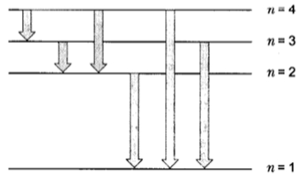
$i$. Using Bohr's second postulate of quantisation of orbital angular momentum show that the circumference of the electron in the nth orbital state in hydrogen atom is $n-$ times the de $-$ Broglie wavelength associated with it.
$ii.$ The electron in hydrogen atom is initially in the third excited state. What is the maximum number of spectral lines which can be emitted when it finally moves to the ground state?
Answer
$i$. Only those orbits are stable for which the angular momentum of revolving electron is an integral multiple of $\left(\frac{h}{2 \pi}\right)$ where $h$ is the planck's constant.
According to Bohr's second postulate
$m v r_n=n \frac{h}{2 \pi} $
$\Rightarrow 2 \pi r_n=\frac{n h}{m v}$
$\text { But } \frac{h}{m v}=\frac{h}{p}=\lambda \ ($By de Broglie hypothesis$)$
$\therefore 2 \pi r_n=n \lambda$
$ii$. For third excited state $ ,n = 4$
For ground state $,n = 1$
Hence possible transitions are
$ n _{ i }=4 $ to $ n _{ f }=3,2,1$
$n _{ i }=3 $  to $n _{ f }=2,1$
$n _{ i }=2 $ to $ n _{ f }=1$
Image
Total number of transitions $= 6$
$ E _C- E _{ R }=\frac{h c}{\lambda_1} \ldots( i )$
$E _{ B }- E _{ A }=\frac{h c}{\lambda_2} \ldots \text { (ii) }$
$E _{ C }- E _{ A }=\frac{h c}{\lambda_a} \ldots \text { (iii) }$
Adding $(i)$ and $(ii),$ we have
$E _{ C }- E _{ A }=\frac{h c}{\lambda_1}+\frac{h c}{\lambda_2} \ldots (iv)$
From $(iii)$ and $(iv),$ we have
$\frac{h c}{\lambda_3}=\frac{h c}{\lambda_1}+\frac{h c}{\lambda_2} $
$\Rightarrow \frac{1}{\lambda_3}=\frac{1}{\lambda_1}+\frac{1}{\lambda_2}$
$\lambda_3=\frac{\lambda_1 \lambda_2}{\lambda_1+\lambda_2}$

 
View full question & answer
Question 53 Marks
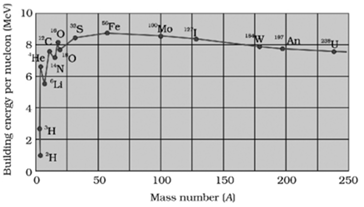
Draw a graph showing the variation of binding energy per nucleon with mass number of different nuclei. Write any two salient features of the curve. How does this curve explain the release of energy both in the processes of nuclear fission and fusion?
Answer
The slope of the graph (after appropriate adjustment of the units) would equal $h_{ e }$ - Since ' $h$ ' is known, one can calculate $c$. thus c = $3.008 \times 10^8 m / s$
Image

Salient feature of B.E. curve
i. B.E/nucleon is pratically constant i.e. independent of the atomic number for nuclei of middle mass number (30 < A < 17)
ii. Binding energy per nucleon is lower for both light nuclei (A < 30) and heavy nuclei (A > 70).
Very heavy nucleus has lower B.E./nucleon will undergo fission and split into two medium sized nuclei with large B.E./nucleon and release tremendous amount of energy (Fission process)
When two very light nuclei, having low binding energy per nucleon combine together and form a medium sized nuclei of higher B.E. per nucleon releases enormous amount of energy (Fusion process)
View full question & answer
Question 63 Marks
Answer
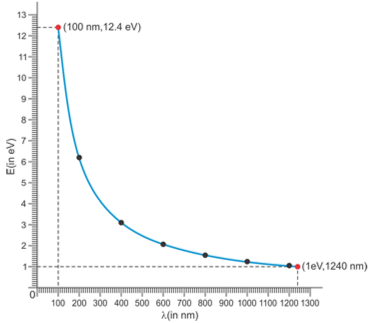
One can calculate the values of $\frac{1}{\lambda}$ and plot a graph between $E$ (photon energy in eV ) and $\frac{1}{\lambda}$ (in $nm ^{-1}$ ). The resulting straight line graph can be used to :
Image

a. Read the value of E, energy corresponding to 100 nm = 12.4 eV
b. The wavelength corresponding to energy of 1 eV is 1240 nm.
c. We have $E=\frac{h c}{\lambda}$
View full question & answer
Question 73 Marks
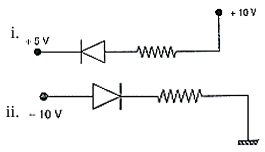
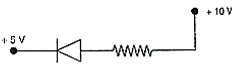
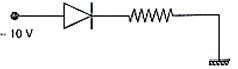
Explain, with the help of a circuit diagram, how the thickness of depletion layer in a p-n junction diode changes when it is forward biased. In the following circuits which one of the two diodes is forward biased and which is reverse biased?
Image
Answer
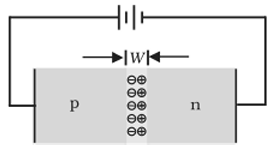
When an external voltage V is applied across a semiconductor diode such that p-side is connected to the positive terminal of the battery and n-side to the negative terminal [Fig.], it is said to be forward biased.
Image

The applied voltage mostly drops across the depletion region and the voltage drop across the p-side and n-side of the junction is negligible. (This is because the resistance of the depletion region – a region where there are no charges – is very high compared to the resistance of n-side and p-side.) The direction of the applied voltage (V) is opposite to the built-in potential $V_0$. As a result, the depletion layer width decreases [Fig.]
i. In this case, the $p$-side is at +10 V , whereas the $n$-side is at +5 V . As, $V_p>V_n$, hence the diode is forward biased.
Image

ii. In this case, the p-side is at -10 V , whereas the n -side is at 0 V . As, $V _{ p }< V _{ n }$, hence the diode is reverse biased.
Image
View full question & answer
Question 83 Marks
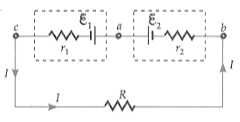
In Figure, $\varepsilon_1$ and $\varepsilon_2$ are respectively 2.0 V and 4.0 V and the resistances $r _1, r _2$ and R are respectively $1.0 \Omega$ $2.0 \Omega$ and $5.0 \Omega$. Calculate the current in the circuit. Also, calculate:
i. potential difference between the points b and a,
ii. potential difference between a and c.
Image
Answer
As EMFs $\varepsilon_1$ and $\varepsilon_2$ are opposing each other and $\varepsilon_2>\varepsilon_1$, so Net emf $=\varepsilon_2-\varepsilon_1=4-2=2 V$
This emf sends circuit I in the anticlockwise direction.
Total resistance $= R + r _1+ r _2=5+1+2=8 \Omega$
Current in the circuit $=\frac{\text { Net emf }}{\text { Total resistance }}=\frac{2}{8}=0.25 A$
i. Current inside the cell $\varepsilon_2$, so flows from -ve to +ve terminal, so the terminal p.d. of this cell is
$V _{ a }- V _{ b }=\varepsilon_2- Ir _2=4.0-0.25 \times 2.0=3.5 V$
ii. Current inside the cell $\varepsilon_1$ flows from +ve to -ve terminal. Hence the terminal p.d. of this cell is
$V _{ a }- V _{ b }=\varepsilon_1+ Ir _1=2.0+0.25 \times 1.0=2.25 V$

View full question & answer