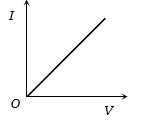
$I-V$ characteristic of a copper wire of length $L$ and area of cross-section $A$ is shown in figure. The slope of the curve becomes
Easy


Download our appand get started for free
Experience the future of education. Simply download our apps or reach out to us for more information. Let's shape the future of learning together!No signup needed.*
Similar Questions
- 1In a wire of circular cross-section with radius $r$, free electrons travel with a drift velocity $V$ when a current $I$ flows through the wire. What is the current in another wire of half the radius and of the same material when the drift velocity is $2V$View Solution
- 2Resistance in the two gaps of a meter bridge are $10\, ohm$ and $30\, ohm$ respectively. If the resistances are interchanged the balance point shifts by.............. $cm$View Solution
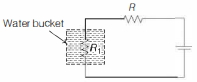
- 3View SolutionThe circuit below is used to heat water kept in a bucket. Assuming heat loss only by Newton's law of cooling, the variation in the temperature of the water in the bucket as a function of time is depicted by
- 4Two batteries with e.m.f $12\ V$ and $13\ V$ are connected in parallel across a load resistor of $10\,\Omega$ . The internal resistances of the two batteries are $1\,\Omega$ and $2\,\Omega$ respectively. The voltage across the load lies betweenView Solution
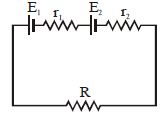
- 5Under what conditions current passing through a resistance $R$ can be increased by short circuiting the battery of emf $E_2$. The internal resistances of the two batteries are $r_1$ and $r_2$ respectivelyView Solution
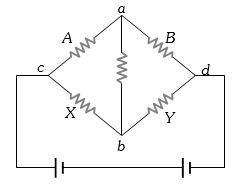
- 6In the Wheatstone's bridge (shown in figure) $X = Y$ and $A > B$. The direction of the current between ab will beView Solution
- 7In a potentiometer arrangement, a cell gives a balancing point at $75\, cm$ length of wire. This cell is now replaced by another cell of unknown emf. If the ratio of the emf's of two cells respectively is $3: 2$, the difference in the balancing length of the potentiometer wire in above two cases will be.........$cm .$View Solution
- 8A bulb has specification of one kilowatt and $250\, volts$, the resistance of bulb is .................. $\Omega$View Solution
- 9View SolutionLamps used for household lighting are connected in
- 10The electric current through a wire varies with time as $I=I_0+\beta t$. where $I_0=20 \mathrm{~A}$ and $\beta=3 \mathrm{~A} / \mathrm{s}$. The amount of electric charge crossed through a section of the wire in $20 \mathrm{~s}$ is :View Solution