Question
Identify A and B in each of the following processes:
  1. $\text{CH}_{3}\text{CH}_{2}\text{Cl}\xrightarrow{\text{NaCN}}\text{A}\xrightarrow[\text{Ni/H}_{2}]{\text{reduction}}\text{B}$.
  2. $\text{C}_{6}\text{H}_{5}\text{NH}_{2}\xrightarrow{\text{NaNO}_{2}/\text{HCl}}\text{A}\xrightarrow[\text{OH}^{-}]{\text{C}_{6}\text{H}_{5}\text{NH}_{2}}\text{B}$.

Answer

  1. $\text{A} = \text{CH}_3–\text{CH}_2–\text{CN},\ \text{B} = \text{CH}_3\text{CH}_2\text{CH}_2\text{NH}_3.$

Need a full question paper?

Generate a complete, print-ready paper with questions like this in minutes — across 16+ boards, with answer keys.

Start Generating Free

Similar questions

  1. Write chemical equations to illustrate the following name bearing reactions:
  1. Cannizzaro’s reaction.
  2. Hell-Volhard-Zelinsky reaction.
Write the structure of the monomers of the following polymer:
  1. PVC.
  2. Polypropene.
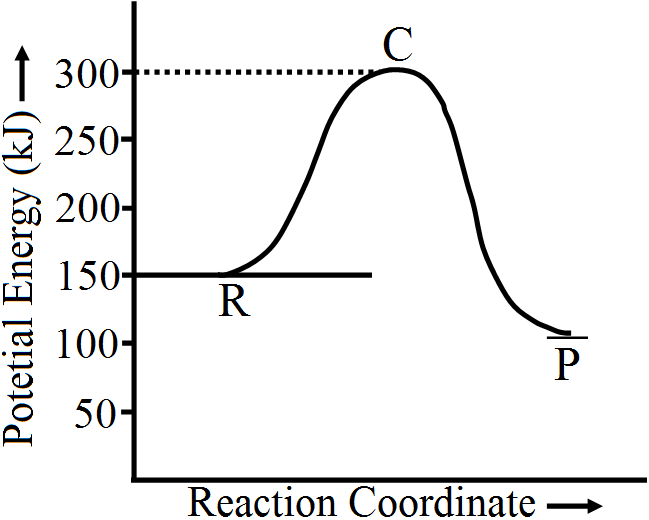
Answer the following questions on the basis of the given plot of potential energy vs reaction coordinate:
  1. What is the threshold energy for the reaction?
  2. What is the activation energy for forward reaction?
  3. What is the activation energy for backward reaction?
  4. What is enthalpy change for the forward reaction?
A sample of drinking water was found to be severely contaminated with chloroform $(CHCl_3)$ supposed to be a carcinogen. The level of contamination was $15$ ppm (by mass):
  1. Express this in percent by mass.
  2. Determine the molality of chloroform in the water sample.
A first order reaction has a rate constant of $0.0051$ min$^{–1}.$ If we begin with $0.10\ M$ concentration of the reactant, what concentration of reactant will remain in solution after $3$ hours?
Calculate the osmotic pressure in pascals exerted by a solution prepared by dissolving $1.0\ g$ of polymer of molar mass $185,000$ in $450$ mL of water at $37^\circ C.$
Nitric oxide, $NO$, reacts with oxygen to produce nitrogen dioxide.
$\text{2NO(g)+O}_2(\text{g)}\rightarrow\text{2NO}_2\text{(g)}$
The rate law for this reaction is:
$\text{Rate = k}[\text{NO]}^2[\text{O]}_2$
Propose a machanism for the reaction.
Explain the Common and IUPAC nomencluture of haloalkane and haloarene compounds with examples.
In NaCl crystal, $Cl^-$ ions are in fcc arrangement. Calculate the number of $Cl^-$ ions in its unit cell.
Why are vitamin A and vitamin C essential to us? Give their important sources.