Question

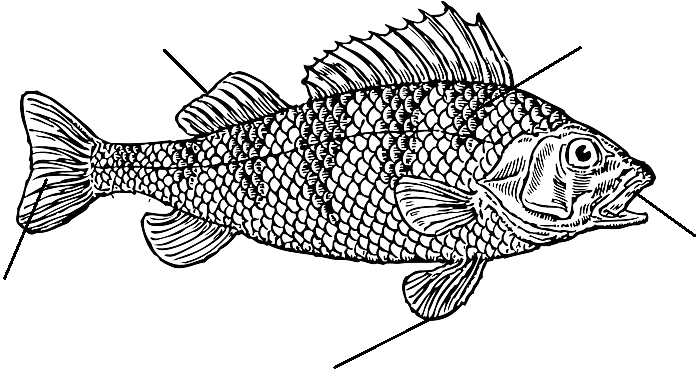
  1. Identify the figure and write down its class.
  2. Label $A, B, C,$ and $D.$
  3. What if its respiratory organs$?$
  4. What type of adaptation this creature has$?$
  5. What type of endoskeleton it has$?$

Answer

  1. Bony fish; Class- Osteichthyes (Phylum Chordata).
  2. $A-$mouth; $B-$Dorsal fin; $C-$Pelvic fin; $D-$Caudal fin; $E-$Scales.
  3. Gills.
  4. It has adaptation to live in water and to swim (i.e. stream-lined body, fins and tail for swimming, slimy and scale covered body, gills for aquatic breathing).
  5. Bony endoskeleton.

Need a full question paper?

Generate a complete, print-ready paper with questions like this in minutes — across 16+ boards, with answer keys.

Start Generating Free

Similar questions

Explain the following:
  1. Eutrophication.
  2. Biomagnification.
Describe the Rutherford’s model of an atom. State one drawback of Rutherford’s model of the atom.
The atom of an element $X$ contains $17$ protons, $17$ electrons and $18$ neutrons whereas the atom of an element $Y$ contains $11$ protons, $11$ electrons and $12$ neutrons.
  1. What type of ion will be formed by an atom of element $X?$ Write the symbol of ion formed.
  2. What will be the number of $(i)$ protons $(ii)$ electrons, and $(iii)$ neutrons, in the ion formed from $X?$
  3. What type of ion will be formed by an atom of element $Y?$ Write the symbol of ion formed.
  4. What will be the number of $(i)$ protons $(ii)$ electrons, and $(iii)$ neutrons, in the ion formed from $Y?$
  5. What is the atomic mas of $(i) X,$ and $(ii) Y?$
  6. What could the elements $X$ and $Y$ be$?$
Describe the method of separating a mixture containing common salt, sand and ammonium chloride.
Distinguish between longitudinal and transverse waves.
A train travels the first $15km$ at a uniform speed of $30 km/h;$ the next $75km$ at a uniform speed of 50km/h; and the last 10km at a uniform speed of $20km/h.$ Calculate the average speed for the entire train journey.
$i.$ A person weighs $110.84 N$ on the moon, whose acceleration due to gravity is $1/6$ of that the earth. If the value of g on the earth is $9.8 m/s^2,$ then calculate
$a. g$ on the moon
$b.$ mass of person on the moon
$c.$ weight of person on the earth
$ii.$ How does the value of g on the earth is related to the mass of the earth and its radius? Derive it.
The electronic configuration of an element $Z$ is $2, 8, 8.$
  1. What is the atomic number of the element$?$
  2. State whether element $Z$ is a metal or a non-metal.
  3. What type of ion (if any) will be formed by an atom of element $Z?$ Why$?$
  4. What is special about the outermost electron shell or the atom of this element$?$
  5. Give the name and symbol of element $Z.$
  6. Name the group of elements to which $Z$ belongs.
Describe the structure and functions of epithelium.
What are tendons and ligaments? Differenitate between the two.