Suppose the circuit in Exercise 7.18 has a resistance of $15\Omega.$ Obtain the average power transferred to each element of the circuit, and the total power absorbed
Exercise
Download our app for free and get started
Here,
Reistance, $\text{R}=15\Omega$
$\therefore\ \text{Impedance},\ \text{Z}=\sqrt{\text{R}^2+\Big(\omega\text{L}-\frac{1}{\omega\text{C}}\Big)^2}$
$\text{Z}=\sqrt{15^2+\Big(2\pi\times50\times80\times10^{-3}-\frac{1}{2\pi\times50\times60\times10^{-6}}\Big)^2}$
$=\sqrt{225+779.5}\Omega=31.7\Omega$
$\therefore\ \text{I}_{\text{rms}}=\frac{\text{V}_{\text{rms}}}{\text{Z}}=\frac{230}{31.7}=7.255\text{A}$
Average power transferred to inductor, $\text{L}=\text{E}_{\text{v}}\text{I}_{\text{v}}\cos\frac{\pi}{2}=0$
Average power transferred to capacitor $=\text{E}_{\text{v}}\text{I}_{\text{v}}\cos\Big(\frac{-\pi}{2}\Big)=0$
Average power transferred to $R = I^2rms \times R$
$= (7.255)^2 \times 15$
$= 789.5W.$
Reistance, $\text{R}=15\Omega$
$\therefore\ \text{Impedance},\ \text{Z}=\sqrt{\text{R}^2+\Big(\omega\text{L}-\frac{1}{\omega\text{C}}\Big)^2}$
$\text{Z}=\sqrt{15^2+\Big(2\pi\times50\times80\times10^{-3}-\frac{1}{2\pi\times50\times60\times10^{-6}}\Big)^2}$
$=\sqrt{225+779.5}\Omega=31.7\Omega$
$\therefore\ \text{I}_{\text{rms}}=\frac{\text{V}_{\text{rms}}}{\text{Z}}=\frac{230}{31.7}=7.255\text{A}$
Average power transferred to inductor, $\text{L}=\text{E}_{\text{v}}\text{I}_{\text{v}}\cos\frac{\pi}{2}=0$
Average power transferred to capacitor $=\text{E}_{\text{v}}\text{I}_{\text{v}}\cos\Big(\frac{-\pi}{2}\Big)=0$
Average power transferred to $R = I^2rms \times R$
$= (7.255)^2 \times 15$
$= 789.5W.$

Download our appand get started for free
Experience the future of education. Simply download our apps or reach out to us for more information. Let's shape the future of learning together!No signup needed.*
Similar Questions
- 1View Solution
- A screen is placed at a distance of 100 cm from an object. The image of the object is formed on the screen by a convex lens for two different locations of the lens separated by 20 cm. Calculate the focal length of the lens used.
- A converging lens is kept coaxially in contact with a diverging lens - both the lenses being of equal focal length. What is the focal length of the combination?
- 2The figure shows a series LCR circuit with L = 5.0 H, C = 80 $\mu$F, R = 40 W connected to a variable frequency 240V source. CalculateView Solution
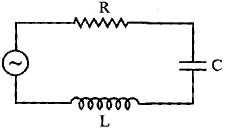
- The angular frequency of the source which drives the circuit at resonance.
- The current at the resonating frequency.
- The rms potential drop across the capacitor at resonance.
- 3View Solution
- What are the three basic units in communication systems? Write briefly the function of each of these.
- Write any three applications of the internet used in communication systems.
- 4View SolutionExplain why the reactance provided by a capacitor to an alternating current decreases with increasing frequency.
- 5View SolutionAn object is placed 15 cm in front of a convex lens of focal length 10 cm. Find the nature and position of the image formed. Where should a concave mirror of radius of curvature 20 cm be placed so that the final image is formed at the position of the object itself?
- 6A resistance R and a capacitor C are connected in series to a source $\text{V}=\text{V}_0\sin\omega\text{t}.$View Solution
Find:- The peak value of the voltage across the (i) resistance and (ii) capacitor.
- The phase difference between the applied voltage and current. Which of them is ahead?
- 7View SolutionCompare and explain three distinguishing features observed in Young’s double slit interference pattern with those seen for a coherently illuminated single slit producing diffraction pattern.
- 8View SolutionA 600 pF capacitor is charged by a 200 V supply. It is then disconnected from the supply and is connected to another uncharged 300 pF capacitor. Calculate how much electrostatic energy is lost in the process. What is the source of energy loss?
- 9Two capacitors of capacitance $10\mu\text{F}$ and $20 \mu\text{F}$ are connected in series with a 6 V battery. After the capacitors are fully charged, a slab of dielectric constant (K) is inserted between the plates of the two capacitors. How will the following be affected after the slab is introduced:View Solution
- The electric field energy stored in the capacitors.
- The charges on the two capacitors.
- The potential difference between the plates of the capacitors.
- 10View SolutionIn the given diagram, a coil B is connected to low voltage bulb L and placed parallel to another coil A as shown. Explain the following observations:
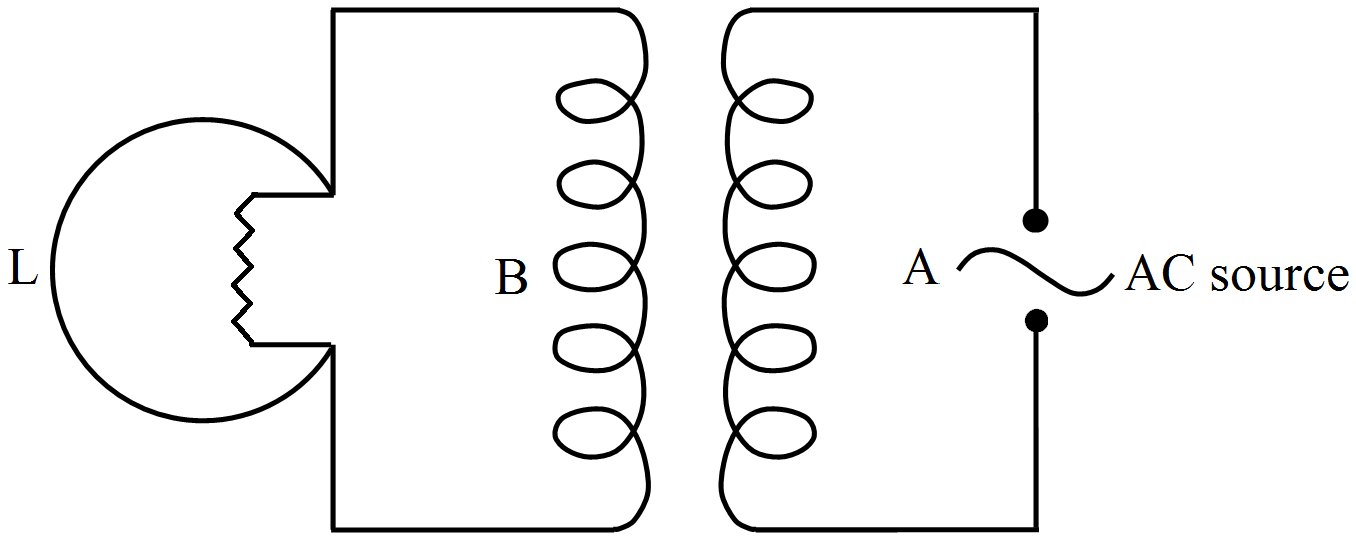
- Bulb lights.
- Bulb gets dimmer if the coil B moves upwards.