Question
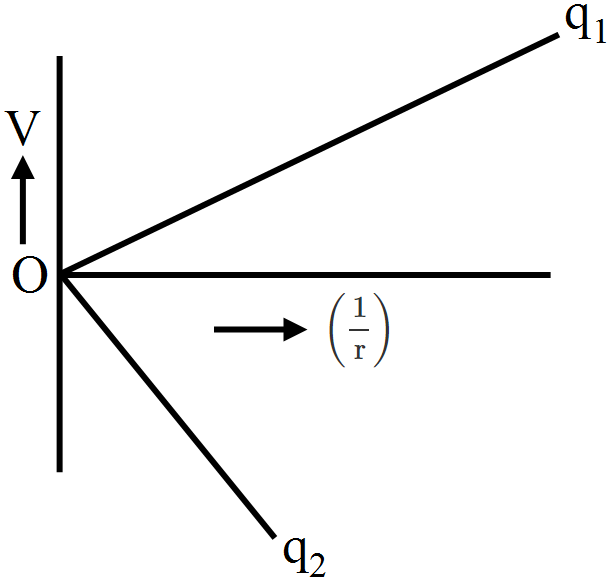
The two graphs are drawn below, show the variations of electrostatic potential (V) $\frac{1}{\text{r}}$ (r being the distance of field point from the point charge) for two point charges $q_1$ and $q_2.$​​​​​​​
  1. What are the signs of the two charges?
  2. Which of the two charges has the larger magnitude and why?
​​​​​​​​​​​​​​

Answer

  1. The potential due to positive charge is positive and due to negative charge, it is negative, so, is $q_1$ positive and $q_2$​​​​​​​ is negative.
$\text{V}=\frac{1}{4\pi\varepsilon_0}\frac{\text{q}}{\text{r}}$
  1. The graph between V and $\frac{1}{\text{r}}$ is a straight line passing through the origin with slope $\frac{\text{q}}{4\pi\varepsilon_0},$
As the magnitude of slope of the line due to charge $q_2$ is greater than that due to $q_1, q_2$ has larger magnitude.

Need a full question paper?

Generate a complete, print-ready paper with questions like this in minutes — across 16+ boards, with answer keys.

Start Generating Free

Similar questions

Explain Ohm's law. State factors on which the resistance of any conductor depends. Define specific resistance and state its relation with the conductivity.
A proton is projected with a velocity of $3 \times 10^6\ ms^{-1}$ perpendicular to a uniform magnetic field of 0.6T. Find the acceleration of the proton.
Show that it is not possible for a photon to be completely absorbed by a free electron.
A long, cylindrical tube of inner and outer radii a and b carries a current i distributed uniformly over its cross section. Find the magnitude of the magnetic field at a point (a) just inside the tube (b) just outside the tube.
A short magnet is moved along the axis of a conducting loop. Show that the loop repels the magnet if the magnet is approaching the loop and attracts the magnet if it is going away from the loop.
A point source emitting light uniformly in all directions is placed 60cm above a table-top. The illuminance at a point on the table-top, directly below the source, is 15 lux. Find the illuminance at a point on the table-top 80cm away from the first point.
A closely wound solenoid of 2000 turns and area of cross-section $1.6 \times 10^{–4} m2,$ carrying a current of 4.0 A, is suspended through its centre allowing it to turn in a horizontal plane.
  1. What is the magnetic moment associated with the solenoid?
  2. What is the force and torque on the solenoid if a uniform horizontal magnetic field of $7.5 \times 10^{–2}\ T$ is set up at an angle of 30º with the axis of the solenoid?
$a.$ Write the relationship between mobility and drift velocity in a current carrying conductor.
$b.$ Two aluminium wires have their lengths in the ratio $2 : 3$ and radii in the ratio $1 : 3.$ These are connected in parallel across a battery of emf $E$ and of negligible internal resistance. Find the ratio of drift velocities of the electrons in the two wires.
How does the resolving power of a compound microscope get affected on:
  1. Decreasing the diameter of its objective?
  2. Increasing the focal length of its objective?
Does the force on a charge due to another charge depend on the charges present nearby?