Two masses $m_1$ and $m_2$ connected by a spring of spring constant $k$ rest on a frictionless surface. If the masses are pulled apart and let go, the time period of oscillation is
KVPY 2010, Diffcult
Download our app for free and get started
(a)
Let displacements of masses $m_1$ and $m_2$ are $x_1$ and $x_2$, respectively.
Total elongation of spring is $x=x_1+x_2$.
So, when spring snaps back, pull on each of mass is
$F=-k x$
Hence, by second law equation for $m_1$ and $m_2$ are
$m_1 a _1=-k x \Rightarrow m_1 \frac{d^2 x_1}{d t^2}=-k x$
and $m_2 a_2=-k x \Rightarrow m_2 \frac{d^2 x_2}{d t^2}=-k x$
Now, from $x=x_1+x_2$, we have
$\frac{d^2 x}{d t^2}=\frac{d^2 x_1}{d t^2}+\frac{d^2 x_2}{d t^2}$
$\Rightarrow \quad \frac{d^2 x}{d t^2}=\frac{-k}{m_1} x+\frac{-k}{m_2} x$
$\Rightarrow \quad \frac{d^2 x}{d t^2}=-k\left(\frac{1}{m_1}+\frac{1}{m_2}\right) x$
Hence, time period of oscillation is
$T=\frac{2 \pi}{\omega}=2 \pi \sqrt{\frac{1}{k}\left(\frac{m_1 m_2}{m_1+m_2}\right)}$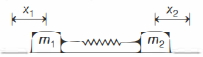

Download our appand get started for free
Experience the future of education. Simply download our apps or reach out to us for more information. Let's shape the future of learning together!No signup needed.*
Similar Questions
- 1A pendulum with time period of $1\, s$ is losing energy due to damping. At certain time its energy is $45\, J$. If after completing $15\,oscillations$ , its energy has become $15\, J$, its damping constant (in $s^{-1}$ ) isView Solution
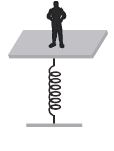
- 2A man weighing $60\ kg$ stands on the horizontal platform of a spring balance. The platform starts executing simple harmonic motion of amplitude $0.1\ m$ and frequency $\frac{2}{\pi } Hz$. Which of the following staements is correctView Solution
- 3Column $I$ gives a list of possible set of parameters measured in some experiments. The variations of the parameters in the form of graphs are shown in Column $II$. Match the set of parameters given in Column $I$ with the graph given in Column $II$. Indicate your answer by darkening the appropriate bubbles of the $4 \times 4$ matrix given in the $ORS$.View Solution
Column $I$ Column $II$ $(A)$ Potential energy of a simple pendulum (y axis) as a function of displacement ( $\mathrm{x}$ axis) $Image$ $(B)$ Displacement (y axis) as a function of time (x axis) for a one dimensional motion at zero or constant acceleration when the body is moving along the positive $\mathrm{x}$-direction $Image$ $(C)$ Range of a projectile (y axis) as a function of its velocity ( $\mathrm{x}$ axis) when projected at a fixed angle $Image$ $(D)$ The square of the time period (y axis) of a simple pendulum as a function of its length ( $\mathrm{x}$ axis) $Image$ 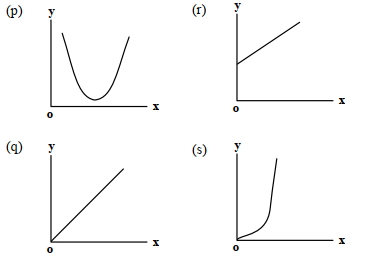
- 4Equations $y = 2A \cos ^2 \omega \,t$ and $y = A (\sin \omega t + \cos \omega t )$ represent the motion of two particles.View Solution
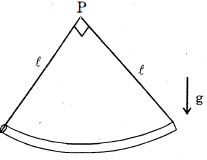
- 5A circular arc of mass $m$ is connected with the help of two massless strings as shown in the figuw in vertical plane. About point $P$, small oscillations are given in the plane of the arc. Time period of the oscillations of $SHM$ will beView Solution
- 6View SolutionThe effective spring constant of two spring system as shown in figure will be
- 7The instantaneous displacement of a simple pendulum oscillator is given by $x = A\cos \left( {\omega t + \frac{\pi }{4}} \right)$. Its speed will be maximum at timeView Solution
- 8Amplitude of a wave is represented by $A = \frac{c}{{a + b - c}}$ Then resonance will occur whenView Solution
- 9The frequency of oscillations of a mass $m$ connected horizontally by a spring of spring constant $k$ is $4 Hz$. When the spring is replaced by two identical spring as shown in figure. Then the effective frequency is,View Solution
- 10The displacement of a particle moving in $S.H.M.$ at any instant is given by $y = a\sin \omega t$. The acceleration after time $t = \frac{T}{4}$ is (where $T$ is the time period)View Solution