MCQ
Identify the function which represents a periodic motion.
  • A
    $e ^{-\omega t}$
  • B
    $e ^{{\omega t }}$
  • C
    $\log _{ e }(\omega t )$
  • $\sin \omega t+\cos \omega t$

Answer

Correct option: D.
$\sin \omega t+\cos \omega t$
d
For periodic function

$f(t)=f(t+T)$

where $T$ is time period of function

$\sin (\omega t+2 \pi)+\cos (\omega t+2 \pi)$

$=\sin \omega t+\cos \omega t$

Need a full question paper?

Generate a complete, print-ready paper with questions like this in minutes — across 16+ boards, with answer keys.
Start Generating Free

Similar questions

A diatomic gas initially at $18^o C$ is compressed adiabatically to one-eighth of its original volume. The temperature after compression will be
A physical quantity $Q$ is found to depend on quantities $a, b, c$ by the relation $Q=\frac{a^4 b^3}{c^2}$. The percentage error in $a$, $b$ and $c$ are $3 \%, 4 \%$ and $5 \%$ respectively. Then, the percentage error in $\mathrm{Q}$ is :
One likes to sit under sunshine in winter season, because
A capacitor of capacitance $500\mu\text{F}$ is connected to a battery through a $10\text{k}\Omega$ resistor. The charge stored in the capacitor in the first 5s is larger than the charge stored in the next:
  1. 5s
  2. 50s
  3. 500s
  4. 500
If the liquid in a U-tube of cross-section A rises to a height $h$. Then the period of oscillatory motion of the fluid is T. Liquid in a U-tube of cross section $\frac{A}{2}$ If you fill up to the height and make it oscillate then the time period will be :
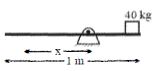
A mass $M= 40\  kg$ is fixed at the very edge of a long plank of mass $80\  kg$ and length $1\ m$ which is pivoted such that it is in equilibrium. How far (approx.) from the pivot should a mass of $100\  kg$ be attached so that the plank starts rotating with an angular acceleration of $1\ rad/s^2$?
If a force of constant magnitude acts in direction perpendicular to the motion of a particle, then its
A particle is tied to $20\, cm$ long string. It performs circular motion in vertical plane. What is the angular velocity of string when the tension in the string at the top is zero  ........ $rad/sec$
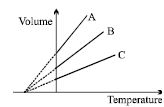
The expansion of an ideal gas of mass $m$ at a constant pressure $P$ is given by the straight line $B$. Then the expansion of the same ideal gas of mass $2\, m$ at a pressure $2\,P$ is given by the straight line
The correct relation between the degree of freedom $f$ and the ratio of specific heat $\gamma$ is