- AIn $(Si_3O_9)^{6-}$, tetrahedral $SiO_4$ units share two oxygen atoms
- ✓Trialkylchlorosilane on hydrolysis gives $R_3SiOH$.
- C$SiCl_4$ undergoes hydrolysis to give $H_4SiO_4$
- D$(Si_3O_9)^{6-}$ has cyclic structure.
$\begin{matrix}
\,\,\,R\,\,\,\,\,\,\,\,\,\,\,\,\,\,\,\,\,R\, \\
\,|\,\,\,\,\,\,\,\,\,\,\,\,\,\,\,\,\,\,\,\,|\, \\
R-Si-O-Si-R \\
|\,\,\,\,\,\,\,\,\,\,\,\,\,\,\,\,\,\,\,\,\,| \\
R\,\,\,\,\,\,\,\,\,\,\,\,\,\,\,\,\,R \\
\end{matrix}$
Generate a complete, print-ready paper with questions like this in minutes — across 16+ boards, with answer keys.
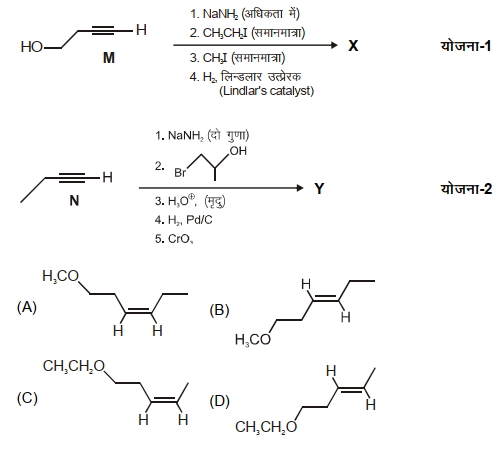
$1.$ The product $X$ is
mcq $Image$
$2.$ The correct statement with respect to product $Y$ is :
$(A)$ It gives a positive Tollens test and is a functional isomer of $X$.
$(B)$ It gives a positive Tollens test and is a geometrical isomer of $X$.
$(C)$ It gives a positive iodoform test and is a functional isomer of $X$.
$(D)$ It gives a positive iodoform test and is a geometrical isomer of $X$.
Give the answer question $1$ and $2.$
(Note: Degree of dissociation ( $\alpha$ ) of weak acid and weak base is $<<1$; degree of hydrolysis of salt $<<1 ;\left[ H ^{+}\right]$represents the concentration of $H ^{+}$ions)
| $LIST-I$ | $LIST-II$ |
|
$P$ $(10 mL $of $0.1 M NaOH +20 mL$ $of 0.1 M $ acetic acid) diluted to $60 mL$ |
$1$ the value of $\left[ H ^{+}\right]$does not change on dilution |
|
$Q $ $(20 mL $ of $ 0.1 M NaOH +20 mL $of $0.1 M $ acetic acid) diluted to $ 80 mL$ |
$2$ the value of $\left[ H ^{+}\right]$changes to half of its initial value on dilution the value of $\left[ H ^{+}\right]$changes to two times of its initial value on dilution |
|
$R$ $(20 mL $ of $ 0.1 M HCl +20 mL$of $0.1 M$ ammonia solution) diluted to $80 mL$ |
$3$ the value of $\left[ H ^{+}\right]$changes to $1 / \sqrt{2}$ times of its initial value on dilution |
|
$S$ $10 mL$ saturated solution of Ni $( OH )_2$in equilibrium with excess solid Ni $( OH )_2$ s diluted to $20 mL$ (solid Ni $( OH )_2$ is still present afterdilution). |
$4$the value of $\left[ H ^{+}\right]$changes to $\sqrt{2}$ times of its initial value on dilution |
| $5$ the value of $\left[ H ^{+}\right]$changes to $\sqrt{2}$ times of its initial value on dilution |
Match each process given in $LIST-I$ with one or more effect(s) in $LIST-II$. The correct option is