Question
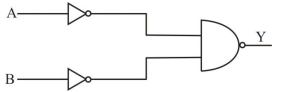
Identify the logic operation performed by the given circuit.

Answer

$\mathrm{Y}=\overline{\overline{\mathrm{A}} \cdot \overline{\mathrm{B}}}=\overline{\overline{\mathrm{A}}}+\overline{\overline{\mathrm{B}}}=\mathrm{A}+\mathrm{B}$

(De-Morgan's law)

Need a full question paper?

Generate a complete, print-ready paper with questions like this in minutes — across 16+ boards, with answer keys.
Start Generating Free

Similar questions

A ball of relative density $0.8$ falls into water from a height of $2$ $m$. The depth to which the ball will sink is ........ $ m$ (neglect viscous forces) :
To convert a galvanometer into a ammeter, one needs to connect a
A thin convex lens made from crown glass $\left( {\mu = \frac{3}{2}} \right)$ has focal length $f$. When it is measured in two different liquids having refractive indices $\frac{4}{3}$ and $\frac{5}{3}$ it has the focal lengths $f_1$ and $f_2$ respectively. The correct relation between the focal lengths is:
${O^{ + + }},\;{C^ + },\;H{e^{ + + }}$ and ${H^ + }$ ions are projected on the photographic plate with same velocity in a mass spectrograph. Which one will strike farthest
Two resistors are connected $(a)$ in series $(b)$ in parallel. The equivalent resistance in the two cases are $9$ $ohm$ and $2$ $ohm$ respectively. Then the resistances of the component resistors are
A particle is moving on a circular path of radius $r$ with uniform speed $v$. What is the displacement of the particle after it has described an angle of $60^o$ ?
One mole of a monoatomic ideal gas is expanded by a process described by $p V^3=C$, where $C$ is a constant. The heat capacity of the gas during the process is given by ( $R$ is the gas constant)
A coin placed on a rotating table just slips if it is placed at a distance $4r$ from the centre. On doubling the angular velocity of the table, the coin will just slip when at a distance from the centre equal to
Imagine a world where free magnetic charges exist. In this world, a circuit is made with a $U$-shape wire and a rod free to slide on it. A current carried by free magnetic charges can flow in the circuit. When the circuit is placed in a uniform electric field $E$ perpendicular to the plane of the circuit and the rod is pulled to the right with a constant speed $v$, the magnetic emf in the current and the direction of the corresponding current, arising because of changing electric flux will be ( $l$ is the length of the rod and $c$ is speed of light)
What will be the resultant magnetic field at origin due to four infinite length wires. If each wire produces magnetic field '$B$' at origin