A coin placed on a rotating table just slips if it is placed at a distance $4r$ from the centre. On doubling the angular velocity of the table, the coin will just slip when at a distance from the centre equal to
Medium


Download our appand get started for free
Experience the future of education. Simply download our apps or reach out to us for more information. Let's shape the future of learning together!No signup needed.*
Similar Questions
- 1The coefficient of friction between a body and the surface of an inclined plane at $45^°$ is $0.5.$ If $g = 9.8\,m/{s^2}$, the acceleration of the body downwards in $m/{s^2}$ isView Solution
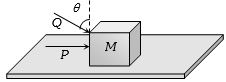
- 2A block of mass $m$ lying on a rough horizontal plane is acted upon by a horizontal force $P$ and another force $Q$ inclined at an angle $\theta $ to the vertical. The block will remain in equilibrium, if the coefficient of friction between it and the surface isView Solution
- 3The upper half of an inclined plane of inclination $\theta$ is perfectly smooth while lower half is rough. A block starting from rest at the top of the plane will again come to rest at the bottom, if the coefficient of friction between the block and lower half of the plane is given byView Solution
- 4$A$ block placed on a rough inclined plane of inclination $(\theta =30^o)$ can just be pushed upwards by applying $a$ force $"F"$ as shown. If the angle of inclination of the inclined plane is increased to $(\theta = 60^o)$, the same block can just be prevented from sliding down by application of a force of same magnitude. Thecoefficient of friction between the block and the inclined plane isView Solution

- 5A car is moving on a circular level road of curvature $300\,metres.$ If the coefficient of friction is $0.3$ and acceleration due to gravity is $10\,m/s^2,$ the maximum speed the car can have is ........ $km/hr$View Solution
- 6View SolutionWhen a body is moving on a surface, the force of friction is called
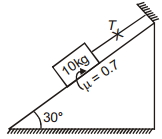
- 7The tension $T$ in the string shown in figure is ..................... $N$View Solution
- 8View SolutionThe limiting friction between two bodies in contact is independent of
- 9A vehicle of mass $200\,kg$ is moving along a levelled curved road of radius $70\,m$ with angular velocity of $0.2\,rad / s$. The centripetal force acting on the vehicle is $.........\,N$View Solution
- 10The retarding acceleration of $7.35\, ms^{-2}$ due to frictional force stops the car of mass $400\, kg$ travelling on a road. The coefficient of friction between the tyre of the car and the road isView Solution