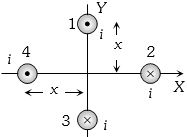
What will be the resultant magnetic field at origin due to four infinite length wires. If each wire produces magnetic field '$B$' at origin
Diffcult
Download our app for free and get started
(c) Direction of magnetic field ($B_1, B_2, B_3\, and \,B_4$) at origin due to wires $1$, $2$, $3$ and $4$ are shown in the following figure.
${B_1} = {B_2} = {B_3} = {B_4} = \frac{{{\mu _0}}}{{4\pi }}.\frac{{2i}}{x} = B$. So net magnetic field at origin $O$
${B_{net}} = \sqrt {{{({B_1} + {B_3})}^2} + {{({B_2} + {B_4})}^2}} $$ = \sqrt {{{(2B)}^2} + {{(2B)}^2}} = 2\sqrt 2 \,B$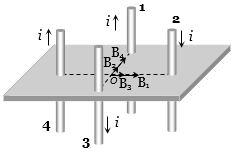

Download our appand get started for free
Experience the future of education. Simply download our apps or reach out to us for more information. Let's shape the future of learning together!No signup needed.*
Similar Questions
- 1On connecting a battery to the two corners of a diagonal of a square conductor frame of side $a$ the magnitude of the magnetic field at the centre will beView Solution
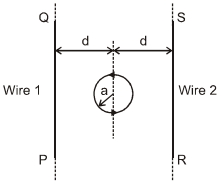
- 2The figure shows a circular loop of radius a with two long parallel wires (numbered $1$ and $2$) all in the plane of the paper. The distance of each wire from the centre of the loop is $d$. The loop and the wires are carrying the same current $I$. The current in the loop is in the counterclockwise direction if seen from above.$Image$View Solution
$1.$ When $d \approx$ a but wires are not touching the loop, it is found that the net magnetic filed on the axis of the loop is zero at a height $h$ above the loop. In that case
$(A)$ current in wire $1$ and wire $2$ is the direction $P Q$ and $R S$, respectively and $h \approx a$
$(B)$ current in wire $1$ and wire $2$ is the direction $PQ$ and $SR$, respectively and $h \approx a$
$(C)$ current in wire $1$ and wire $2$ is the direction $PQ$ and $SR$, respectively and $h \approx 1.2 a$
$(D)$ current in wire $1$ and wire $2$ is the direction $PQ$ and $RS$, resepectively and $h \approx 1.2 a$
$2.$ Consider $d \gg a$, and the loop is rotated about its diameter parallel to the wires by $30^{\circ}$ from the position shown in the figure. If the currents in the wires are in the opposite directions, the torque on the loop at its new position will be (assume that the net field due to the wires is constant over the loop)
$(A)$ $\frac{\mu_0 I^2 a^2}{d}$ $(B)$ $\frac{\mu_0 I^2 a^2}{2 d}$ $(C)$ $\frac{\sqrt{3} \mu_0 I^2 a^2}{d}$ $(D)$ $\frac{\sqrt{3} \mu_0 I^2 a^2}{2 d}$
Give the answer question $1$ and $2.$
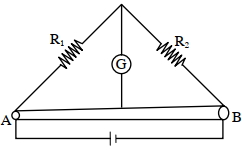
- 3Two resistances $R_1=X \Omega$ and $R_2=1 \Omega$ are connected to a wire $A B$ of uniform resistivity, as shown in the figure. The radius of the wire varies linearly along its axis from $0.2 mm$ at $A$ to $1 mm$ at $B$. A galvanometer ($G$) connected to the center of the wire, $50 cm$ from each end along its axis, shows zero deflection when $A$ and $B$ are connected to a battery. The value of $X$ is. . . . .View Solution
- 4A cell of emf $90\,V$ is connected across series combination of two resistors each of $100\,\Omega$ resistance. A voltmeter of resistance $400\,\Omega$ is used to measure the potential difference across each resistor. The reading of the voltmeter will be $.........\,V$View Solution
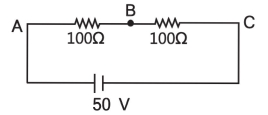
- 5Consider the diagram shown below. A voltmeter of resistance $150\,\Omega$ is connected across $A$ and $B$. The potential drop across $B$ and $C$ measured by voltmeter is $...........\,V$View Solution
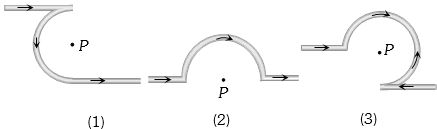
- 6The magnetic field at the centre of a circular coil of radius $r$ is $\pi $ times that due to a long straight wire at a distance $r$ from it, for equal currents. Figure here shows three cases : in all cases the circular part has radius $r$ and straight ones are infinitely long. For same current the $B$ field at the centre $P$ in cases $1$, $2$, $ 3$ have the ratioView Solution
- 7A coaxial cable consists of an inner wire of radius $'a'$ surrounded by an outer shell of inner and outer radii ' ${b}$ ' and '$c$' respectively. The inner wire carries an electric current is, which is distributed uniformly across cross-sectional area. The outer shell carries an equal current in opposite direction and distributed uniformly. What will be the ratio of the magnetic field at a distance ${x}$ from the axis when $(i)$ ${x}<{a}$ and $(ii)$ ${a}<{x}<{b}$ ?View Solution
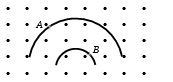
- 8Two particles $A$ and $B$ of masses ${m_A}$ and ${m_B}$ respectively and having the same charge are moving in a plane. A uniform magnetic field exists perpendicular to this plane. The speeds of the particles are ${v_A}$ and ${v_B}$ respectively, and the trajectories are as shown in the figure. ThenView Solution
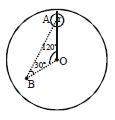
- 9The figure shows the cross section of a long cylindrical conductor through which an axial hole of radius $r$ is drilled with its centre at point $A$ . $O$ is the centre of the conductor. If an identical hole were to be drilled centred at point $B$ while maintaining the same current density the magnitude of magnetic field at $O$View Solution
- 10View SolutionFrom Ampere's circuital law for a long straight wire of circular cross-section carrying a steady current, the variation of magnetic field in the inside and outside region of the wire is :