MCQ
Identify the type of materials which develop electric currents in them, when an electric field is applied.
  • A
    Elastomers
  • Conductors
  • C
    Insulators
  • D
    Polymers

Answer

Correct option: B.
Conductors
When an electric field is applied across the ends of conductors, the electrons begin to move under the action of the electric field. The flow of electrons constitutes electric current through the conductor.

Need a full question paper?

Generate a complete, print-ready paper with questions like this in minutes — across 16+ boards, with answer keys.
Start Generating Free

Similar questions

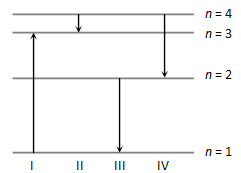
The diagram shows-the energy levels for an electron in a certain atom. Which transition shown represents the emission of a photon with the most energy

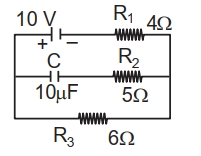
In an electrical circuit drawn below the amount of charge stored in the capacitor is___ $\mu \mathrm{C}$.
Resistors of 1, 2, 3 ohm are connected in the form of a triangle. If a 1.5 volt cell of negligible internal resistance is connected across 3 ohm resistor, the current flowing through this resistance will be
What will be the angle of diffracting for the first minimum due to Fraunhoffer diffraction with sources of light of wave length $550 \,nm$ and slit of width $0.55\, mm$
A person has been using spectacles of power- $1.0$ diopter for distant vision and a separate reading glass of power $2.0$ diopters. What is the least distance of distinct vision for this person $.......cm$
The maximum current that flows through a fuse wire before it blows out varies with its radius as
The refractive index of a converging lens is $1.4.$ What will be the focal length of this lens if it is placed in a medium of same refractive index ? (Assume the radii of curvature of the faces of lens are $R _{1}$ and $R _{2}$ respectively)
$n$ identical cells are joined in series with two cells $A$ and $B$ with reversed polarities. $emf$ of each cell is $E$ and internal resistance is $r$. Potential difference across cell $A$ and $B$ is : $(n > 4)$
The image of an extented object, placed perpendicular to the principal axis of a mirror, will be erect if

$(a)$ The object and image both are real

$(b)$ The object and image both are virtual

$(c)$ The object is real but the image is virtual

$(d)$ The object is virtual but the image is real

A proton is accelerated through $225 \,V$. Its de Broglie wavelength is ........ $nm$