If a $0.1\%$ increase in length due to stretching, the percentage increase in its resistance will be ............ $\%$
Easy
Download our app for free and get started
(a) $R \propto {l^2}$ $\Rightarrow $ $\frac{{\Delta R}}{R} = \frac{{2\Delta l}}{l}$
$\Rightarrow $ $\frac{{\Delta {R_0}}}{R}\% = 2 \times 0.1 = 0.2\% $

Download our appand get started for free
Experience the future of education. Simply download our apps or reach out to us for more information. Let's shape the future of learning together!No signup needed.*
Similar Questions
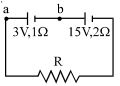
- 1Two batteries one of the $\mathrm{emf}$ $3\,V$, internal resistance $1$ ohm and the other of $\mathrm{emf}$ $15\, V$, internal resistance $2$ $\mathrm{ohm}$ are connected in series with a resistance $R$ as shown. If the potential difference between $a$ and $b$ is zero the resistance of $R$ in $\mathrm{ohm}$ isView Solution
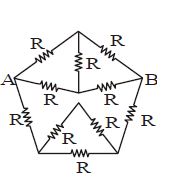
- 2The effective resistance between $A$ and $B$ of the shown network, where resistance of each resistor is $R$ , isView Solution
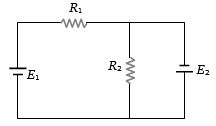
- 3Two resistances ${R_1}$ and ${R_2}$ are joined as shown in the figure to two batteries of $e.m.f.$ ${E_1}$ and ${E_2}$. If ${E_2}$ is short-circuited, the current through ${R_1}$ isView Solution
- 4A potentiometer having the potential gradient of $2\, mV/cm$ is used to measure the difference of potential across a resistance of $10 \,\Omega$. If a length of $50\, cm$ of the potentiometer wire is required to get the null point, the current passing through the $10 \,\Omega$ resistor is (in $mA$)View Solution
- 5Two electric lamps of $40\, watt$ each are connected in parallel. The power consumed by the combination will be ........... $watt$View Solution
- 6View SolutionOn increasing the temperature of a conductor, its resistance increases because
- 7When a wire of uniform cross-section $a$, length $l$ and resistance $R$ is bent into a complete circle, resistance between any two of diametrically opposite points will beView Solution
- 8Dimensions of a block are $1\,cm \times 1\,cm \times 100\,cm$. If specific resistance of its material is $3 \times {10^{ - 7}}\,ohm - m$, then the resistance between the opposite rectangular faces isView Solution
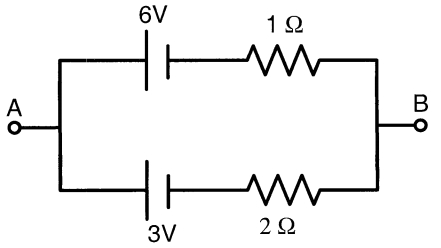
- 9Two batteries of different emfs and different internal resistances are connected as shown. The voltage across $A B$ in volts isView Solution
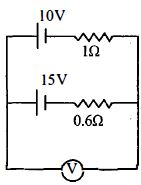
- 10A $10\,V$ battery with internal resistance $1\,\Omega $ and a $15\,V$ battery with internal resistance $0.6\,\Omega $ are connected in parallel to a voltmeter (see figure). The reading in the voltmeter will be close to ................ $V$View Solution