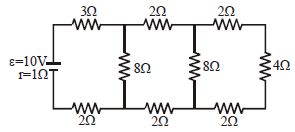
In the circuit shown, the cell has $emf = 10\,V$ and internal resistance $= 1\, \Omega$ :-
Diffcult
Download our app for free and get started
Equivalent resistance $\mathrm{R}_{\mathrm{eq}}=10 \,\Omega$ so curent passing through battery and $3\, \Omega$ resistance is
$\mathrm{i}=\frac{10}{10}=\mathrm{A}$
and current passing through $4\, \Omega$ is $0.25 \mathrm{\,A}$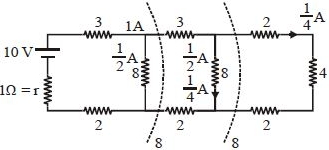

Download our appand get started for free
Experience the future of education. Simply download our apps or reach out to us for more information. Let's shape the future of learning together!No signup needed.*
Similar Questions
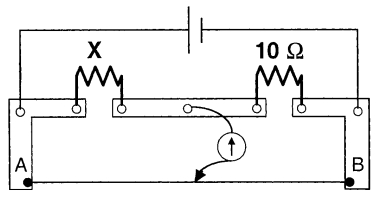
- 1A meter bridge is set-up as shown, to determine an unknown resistance ' $X$ ' using a standard $10$ ohm resistor. The galvanometer shows null point when tapping-key is at $52 \ cm$ mark. The end-corrections are $1 \ cm$ and $2 \ cm$ respectively for the ends $A$ and $B$. The determined value of ' $X$ ' isView Solution
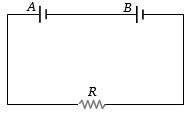
- 2Two batteries $A$ and $B$ each of $e.m.f.$ $2\, V$ are connected in series to an external resistance $R = 1 \,ohm$. If the internal resistance of battery $A$ is $1.9\, ohms$ and that of $B$ is $0.9\, ohm$, what is the potential difference between the terminals of battery $A$ ............. $V$View Solution
- 3An insulating pipe of cross-section area $'A'$ contains an electrolyte which has two types of ions $\rightarrow$ their charges being $-e$ and $+2e$. $A$ potential difference applied between the ends of the pipe result in the drifting of the two types of ions, having drift speed $= v$ ($-ve$ ion) and $v/4$ ($+ve$ ion). Both ions have the same number per unit volume $= n$. The current flowing through the pipe isView Solution
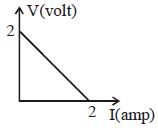
- 4Potential difference across a cell and current through a cell is shown in graph. A battery consists of such identical $40$ cells. Max current supplied by the battery through a load of $2.5\,\Omega $ equal to .............. $A$View Solution
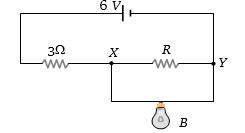
- 5In the following circuit, bulb rated as $1.5\, V$, $0.45\, W$. If bulbs glows with full intensity then what will be the equivalent resistance between $X$ and $Y$ ............. $\Omega$View Solution
- 6When two resistance are connected in parallel then the equivalent resistance is $\frac {6}{5}\Omega $ . When one of the resistance is removed then the effective resistance is $2\, \Omega $. The resistance of the wire removed will be ................ $\Omega$View Solution
- 7View SolutionThe relaxation time in conductors
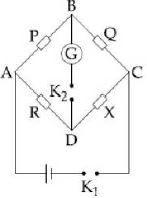
- 8In a Wheatstone bridge (see figure) Resistance $P$ and $Q$ are approximately equal. When $R = 400\,\Omega ,$ the bridge is balanced. On interchanging $P$ and $Q,$ the value of $R,$ for balance is $405\,\Omega .$ The value of $X$ is close to ................. $ohm$View Solution
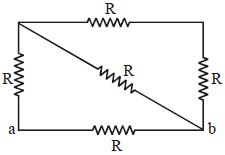
- 9Find out the equivalent resistance between the points $a$ and $b$View Solution
- 10$10$ wires (same length, same area, same material) are connected in parallel and each has $1$ $\Omega$ resistance, then the equivalent resistance will be .............. $\Omega$View Solution