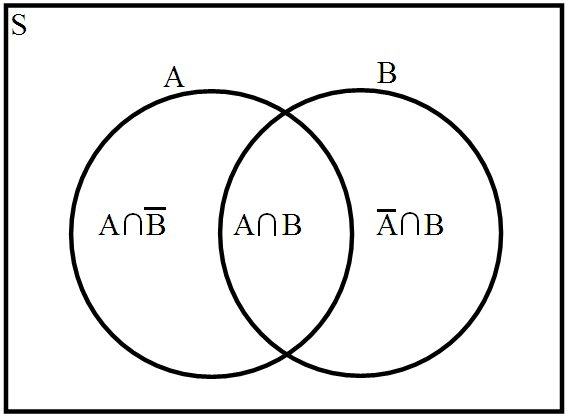
If A and B are two events, then $\text{P}(\overline{\text{A}}\cap\text{B})=$


Download our appand get started for free
Experience the future of education. Simply download our apps or reach out to us for more information. Let's shape the future of learning together!No signup needed.*
Similar Questions
- 1View SolutionChoose the correct answer from the given four options.
In a college, 30% students fail in physics, 25% fail in mathematics and 10% fail in both. One student is chosen at random. The probability that she fails in physics if she has failed in mathematics is: - 2Mark the correct alternative in the following question:View Solution
Suppose a random variable X follows the binomial distribution with parameters n and p, where 0 < p < 1. If $\frac{\text{P(X = r})}{\text{P(X = n} -\text{r})}$ is independent of n and r, then p equals: - 3View SolutionDifference between sample space and subset of sample space is considered as:
- 4Two persons $A$ and $B$ take turns in throwing a pair of dice.The first person to throw $9$ from both dice will be awarded the prize. If $A$ throws first, then the probability that $B$ wins the game is.View Solution
- 5If A and B are two events such that $\text{A}\subset\text{B}$ and $\text{P}(\text{B})\neq0,$ then which of the following is correct?View Solution
- 6Let $X$ denote the number of times heads occur in $n$ tosses of a fair coin. If $P(X = 4), P(X = 5)$ and $P(X = 6)$ are in $AP,$ the value of $n$ is:View Solution
- 7A random variable has the following probability distribution:View Solution
$X = x_i$ $0$ $1$ $2$ $3$ $4$ $5$ $6$ $7$ $P(X = X_i)$ $0$ $2p$ $2p$ $3p$ $p^2$ $2p^2$ $7p^2$ $2p$ - 8If A and B are two independent events such that P(A) = 0.3 and $\text{P}(\text{A}\cup\text{B})=0.5,$ then P(A|B) - P(B|A) =View Solution
- 9If the events A and B are independent, then $\text{P}(\text{A}\cap\text{B})$ is equal to,View Solution
- 10$\int\limits^1_0\sqrt{\text{x}(1-\text{x})}\text{ dx}$ equals:View Solution