MCQ
If $A$ and $B$ are two given sets, then $A \cap {(A \cap B)^c}$ is equal to
  • A
    $A$
  • B
    $B$
  • C
    $\phi $
  • $A \cap {B^c}$

Answer

Correct option: D.
$A \cap {B^c}$
d
(d) $A \cap {(A \cap B)^c} = A \cap ({A^c} \cup {B^c})$

= $(A \cap {A^c}) \cup (A \cap {B^c})$ = $\phi \cup (A \cap {B^c}) = A \cap {B^c}$.

Need a full question paper?

Generate a complete, print-ready paper with questions like this in minutes — across 16+ boards, with answer keys.
Start Generating Free

Similar questions

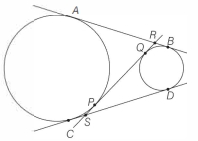
Suppose $S_1$ and $S_2$ are two unequal circles, $A B$ and $C D$ are the direct common tangents to these circles. A transverse common tangent $P Q$ cuts $A B$ in $R$ and $C D$ in $S$. If $A B=10$, then $R S$ is
The pedal points of a perpendicular drawn from origin on the line $3x + 4y - 5 = 0$, is
The variance of the first $n$ natural numbers is
Let $x=2$ be a root of the equation $x^2+p x+q=0$ and $f(x)=\left\{\begin{array}{cc}\frac{1-\cos \left(x^2-4 p x+q^2+8 q+16\right)}{(x-2 p)^4}, & x \neq 2 p \\ 0, & x=2 p\end{array}\right.$ Then $\lim _{x \rightarrow 22^{+}}[f(x)]$ where [. ] denotes greatest integer function, is $........$
$\mathop {Lim}\limits_{n\,\, \to \,\,\infty } $ $\frac{{{1^2}\,\,n\,\, + \,\,{2^2}\,\,(n\, - \,1)\,\, + \,\,{3^2}\,\,(n\, - \,2)\,\, + \,\,.....\,\, + \,\,{n^2}\,.\,\,1}}{{{1^3}\,\, + \,\,{2^3}\,\, + \,\,{3^3}\,\, + \,\,......\,\, + \,\,{n^3}}}$ is equal to :
Find the number of ways of arranging the letters of the words Danger so that no vowel occupies odd place.
If the tangents drawn to the hyperbola $4y^2 = x^2 + 1$ intersect the co-ordinate axes at the distinct points $A$ and $B$, then the locus of the mid point of $AB$ is
The value of $ \cos ^{3}\left(\frac{\pi}{8}\right) \cdot \cos \left(\frac{3 \pi}{8}\right)+\sin ^{3}\left(\frac{\pi}{8}\right) \cdot \sin \left(\frac{3 \pi}{8}\right)$ is 
$2 \sin 22 \frac{1}{2}^{\circ} \cos 22 \frac{1}{2}^{\circ}=?$
If $f : [-2, 2] \rightarrow R$ is defined by $\text{f(x)}=\begin{cases}-1,&\text{for}-2\leq\text{x}\leq0\\\text{x}-1,&\text{for }0\leq\text{x}\leq2\end{cases}$ then $\{\text{x}\in[-2,2]:\text{x}\leq0\text{ and }\text{f}(\text{|x|})=\text{x}\}=$