MCQ 11 Mark
Which of the following is a true statement
AnswerCorrect option: A. $\{a\} \subseteq \{a, b, c\}$
a
An element of a given set is belongs to that set, But the set of the elements of given set is not belongs to that set.
Option (b) is not correct. Also $\{\emptyset\}$ is subset of a set
Option (C) is not correct. The set of an element of given set is subset of given set.
View full question & answer→MCQ 21 Mark
Two finite sets have $m$ and $n$ elements. The total number of subsets of the first set is $56$ more than the total number of subsets of the second set. The values of $m$ and $n$ are
- A
$7, 6$
- ✓
$6, 3$
- C
$5, 1$
- D
$8, 7$
AnswerCorrect option: B. $6, 3$
b
(b) Since ${2^m} - {2^n} = 56 = 8 \times 7 = {2^3} \times 7$
==> ${2^n}({2^{m - n}} - 1) = {2^3} \times 7$, $\therefore $ $n = 3$ and ${2^{m - n}} = 8 = {2^3}$
==> $m - n = 3$ ==> $m - 3 = 3$ ==> $m = 6$; $\therefore \,\,m = 6,\,\,n = 3$.
View full question & answer→MCQ 31 Mark
If the sets $A$ and $B$ are defined as $A = \{ (x,\,y):y = {1 \over x},\,0 \ne x \in R\} $ $B = \{ (x,y):y = - x,x \in R\} $, then
- A
$A \cap B = A$
- B
$A \cap B = B$
- ✓
$A \cap B = \phi $
- D
AnswerCorrect option: C. $A \cap B = \phi $
c
(c) Since $\,y = {1 \over x},\,y = - x$ meet when $ - x = {1 \over x}$ ==> ${x^2} = - 1$, which does not give any real value of $x.$
Hence, $\,A \cap B = \phi $.
View full question & answer→MCQ 41 Mark
Let $A = \{ (x,\,y):y = {e^x},\,x \in R\} $, $B = \{ (x,\,y):y = {e^{ - x}},\,x \in R\} .$ Then
- A
$A \cap B = \phi $
- ✓
$A \cap B \ne \phi $
- C
$A \cup B = {R^2}$
- D
AnswerCorrect option: B. $A \cap B \ne \phi $
b
(b) $\because y = {e^x},\,\,y = {e^{ - x}}$ will meet, when ${e^x} = {e^{ - x}}$
==> ${e^{2x}} = 1,\,\,\therefore x = 0,y = 1$
$\therefore A$ and $B$ meet on $(0, 1), $
$\therefore A \cap B = \phi $.
View full question & answer→MCQ 51 Mark
If ${N_a} = [an:n \in N\} ,$ then ${N_5} \cap {N_7} = $
- A
${N_7}$
- B
$N$
- ✓
${N_{35}}$
- D
${N_5}$
AnswerCorrect option: C. ${N_{35}}$
c
(c) ${N_5} \cap {N_7} = {N_{35}}$,
[$\because 5$ and $7$ are relatively prime numbers].
View full question & answer→MCQ 61 Mark
If $aN = \{ ax:x \in N\} ,$ then the set $3N \cap 7N$ is .....$N$
Answera
(a) $3N = \{ x \in N:x$ is a multiple of $3\}$
$7N = \{ x \in N:x$ is a multiple of $7\}$
$\therefore 3N \cap 7N$$ = \{ x \in $ is a multiple of $3$ and $7\}$
$ = \{ x \in N:x$ is a multiple of $3$ and $7\}$
$ = \{ x \in N:x$ is a multiple of $21\}=21N.$
View full question & answer→MCQ 71 Mark
If $A = \{x : x$ is a multiple of $4\}$ and $B = \{x : x$ is a multiple of $6\}$ then $A \cap B$ consists of all multiples of
Answerb
(b) $A = \{ 4,\,8,\,12,\,16,\,20,\,24,\,.....\} $
$B = \{ 6,\,12,\,18,\,24,\,30,\,....\} $
$\therefore A \cap B = \{ 12,\,24,\,....\} = \{x : x$ is a multiple of $12\}.$
View full question & answer→MCQ 81 Mark
If ${N_a} = \{ an:n \in N\} ,$ then ${N_3} \cap {N_4} = $
- A
${N_7}$
- ✓
${N_{12}}$
- C
${N_3}$
- D
${N_4}$
AnswerCorrect option: B. ${N_{12}}$
b
(b) ${N_3} \cap {N_4} = \{ 3,\,6,\,9,\,12,15......\} \cap \{ 4,\,8,\,12,\,16,\,20,.....\} $
$= \{12, 24, 36......\} =$ ${N_{12}}$.
Trick : ${N_3} \cap {N_4} = {N_{12}}$
[ $\because $ $3, 4$ are relatively prime numbers].
View full question & answer→MCQ 91 Mark
Sets $A$ and $B$ have $3$ and $6$ elements respectively. What can be the minimum number of elements in $A \cup B$
Answerb
(b) $n(A \cup B) = n(A) + n(B) -n(A \cap B) $ = $3 + 6 - n(A \cap B)$
Since, maximum number of elements in $A \cap B = 3$
$\therefore $ Minimum number of elements in $A \cup B = 9 - 3 = 6$.
View full question & answer→MCQ 101 Mark
If $A =$ [$x:x$ is a multiple of $3$] and $B =$ [$x:x$ is a multiple of $5$], then $A -B$ is ($\bar A$ means complement of $A$)
- A
$\bar A \cap B$
- ✓
$A \cap \bar B$
- C
$\bar A \cap \bar B$
- D
$\overline {A \cap B} $
AnswerCorrect option: B. $A \cap \bar B$
b
(b) $ A -B = A \cap B^c = A \cap $ $\bar B$.
View full question & answer→MCQ 111 Mark
If $aN = \{ ax:x \in N\} $ and $bN \cap cN = dN$, where $b$, $c \in N$ are relatively prime, then
- ✓
$d = bc$
- B
$c = bd$
- C
$b = cd$
- D
AnswerCorrect option: A. $d = bc$
a
(a) $bN = $ the set of positive integral multiples of b, $cN$= the set of positive integral multiplies of $c$.
$\therefore $ $bN \cap cN$= the set of positive integral multiples of $bc$
= $b \subset N$, $[ are\, prime]$
$\therefore $ $d = bc$.
View full question & answer→MCQ 121 Mark
Let $n(U) = 700,\,n(A) = 200,\,n(B) = 300$ and $n(A \cap B) = 100,$ then $n({A^c} \cap {B^c}) = $
Answerc
(c) $n({A^c} \cap {B^c}) = n[(A \cup B)^c] $ = $n(U) - n(A \cup B)$
= $n(U) - [n(A) + n(B) - n(A \cap B)]$
$= 700 -[200 + 300 -100] = 300.$
View full question & answer→MCQ 131 Mark
If $A$ and $B$ are two sets, then $A \cap (A \cup B)'$ is equal to
AnswerCorrect option: C. $\phi $
c
(c) $A \cap (A \cup B)' = A \cap (A' \cap B')$,$(\because (A \cup B)' = A' \cap B'\,)$
$ = (A \cap A') \cap B'$, (by associative law)
$ = \phi \cap B'$,$(\because A \cap A' = \phi )$
$ = \phi $.
View full question & answer→MCQ 141 Mark
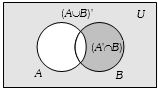
Let $A$ and $B$ be two sets then $(A \cup B)' \cup (A' \cap B)$ is equal to
Answera
(a) From Venn-Euler's Diagram,
$\therefore (A \cup B)' \cup (A' \cap B) = A'$.
View full question & answer→MCQ 151 Mark
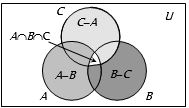
Let $U$ be the universal set and $A \cup B \cup C = U$. Then $\{ (A - B) \cup (B - C) \cup (C - A)\} '$ is equal to
- A
$A \cup B \cup C$
- B
$A \cup (B \cap C)$
- ✓
$A \cap B \cap C$
- D
$A \cap (B \cup C)$
AnswerCorrect option: C. $A \cap B \cap C$
c
(c) From Venn-Euler's Diagram,
Clearly, $\{ (A - B) \cup (B - C) \cup (C - A)\} ' = A \cap B \cap C$.
View full question & answer→MCQ 161 Mark
If $n(U)$ = $600$ , $n(A)$ = $100$ , $n(B)$ = $200$ and $n(A \cap B )$ = $50$, then $n(\bar A \cap \bar B )$ is
($U$ is universal set and $A$ and $B$ are subsets of $U$)
Answerb
$\mathrm{n}(\overline{\mathrm{A}} \cap \overline{\mathrm{B}})=\mathrm{n}(\overline{\mathrm{A} \cup \mathrm{B}})$
$=\mathrm{n}(\mathrm{u})-\mathrm{n}(\mathrm{A} \cup \mathrm{B})$
$=600-(\mathrm{n}(\mathrm{A})+\mathrm{n}(\mathrm{B})-\mathrm{n}(\mathrm{A} \cap \mathrm{B}))$
$=600-100-200+50=350$
View full question & answer→MCQ 171 Mark
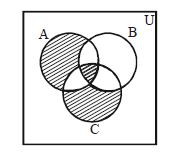
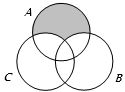
The shaded region in venn-diagram can be represented by which of the following ?
- A
$(A \cup C)\cap (A^C \cup B^C )\cup(A^C \cup C^C )\cup(B^C \cup C^C )$
- B
$(A \cup C)\cap (A^C \cup B^C )\cap(A^C \cup C^C )\cap(B^C \cup C^C )$
- ✓
$(A \cup C)\cap (A^C \cup B^C )\cap(A^C \cup C^C )\cap(B^C \cup C^C) \cup(A \cap B \cap C)$
- D
$(A \cup C)\cap (A^C \cup B^C )\cap(A^C \cup C^C )\cap(B^C \cup C^C\cap(A \cap B \cap C)$
AnswerCorrect option: C. $(A \cup C)\cap (A^C \cup B^C )\cap(A^C \cup C^C )\cap(B^C \cup C^C) \cup(A \cap B \cap C)$
View full question & answer→MCQ 181 Mark
In a town of $10,000$ families it was found that $40\%$ family buy newspaper $A, 20\%$ buy newspaper $B$ and $10\%$ families buy newspaper $C, 5\%$ families buy $A$ and $B, 3\%$ buy $B$ and $C$ and $4\%$ buy $A$ and $C$. If $2\%$ families buy all the three newspapers, then number of families which buy $A$ only is
- A
$3100$
- ✓
$3300$
- C
$2900$
- D
$1400$
AnswerCorrect option: B. $3300$
b
(b) $n(A) = 40\% \ of 10,000 = 4,000$
$n(B) = 20\% \ of\ 10,000 = 2,000$
$n(C) = 10\% \ of \ 10,000 = 1,000$
$n (A \cap B)$ $= 5\% \ of\ 10,000 = 500$
$n (B \cap C)$ $= 3\% \ of\ 10,000 = 300$
$n(C \cap A)$ $= 4\% \ of \ 10,000 = 400$
$n(A \cap B \cap C)$ $= 2\% \ of \ 10,000 = 200$
We want to find $n(A \cap B^c \cap C^c) = n[A \cap (B \cap C)^c]$
$= n(A) -n[A \cap (B \cup C)] = n(A) -n[(A \cap B) \cup (A \cap C)]$
$= n(A) -[n(A \cap B) + n(A \cap C) -n(A \cap B \cap C)]$
$= 4000 -[500 + 400 -200] = 4000 -700 = 3300.$
View full question & answer→MCQ 191 Mark
In a class of $55$ students, the number of students studying different subjects are $23$ in Mathematics, $24$ in Physics, $19$ in Chemistry, $12$ in Mathematics and Physics, $9$ in Mathematics and Chemistry, $7$ in Physics and Chemistry and $4$ in all the three subjects. The total numbers of students who have taken exactly one subject is
Answerd
(d) $n(M) = 23, n(P) = 24, n(C)= 19$
$n(M \cap P) = 12, n(M \cap C)= 9, n(P \cap C)= 7 ,$
$n(M \cap P \cap C) = 4 $
We have to find $n(M \cap P' \cap C'), n(P \cap M ' \cap C' ),n ( C \cap M' \cap P') $
$= n(M)-n(M \cap (P \cup C))$
$= n(M) - n[(M \cap P) \cup (M \cap C)]$
$= n(M) -n(M \cap P)-n(M \cap C) + n(M \cap P \cap C)$
$= 23 -12 -9 + 4 = 27 -21 = 6$
$= n(P)-n[P \cap (M \cup C)] = $ $n(P) - n[(P \cap M) \cup (P \cap C)]$
$= n(P) -n(P \cap M) -n(P \cap C) + n(P \cap M \cap C) $
$= 24 -12 -7 + 4 = 9$
$n(C \cap M' \cap P') = n(C) - n(C \cap P) - n(C \cap M) + n(C \cap P \cap M)$
$= 19 -7 -9 + 4 = 23 -16 = 7.$
So total number of student is $=6+9+7=22$
View full question & answer→MCQ 201 Mark
Of the members of three athletic teams in a school $21$ are in the cricket team, $26$ are in the hockey team and $29$ are in the football team. Among them, $14$ play hockey and cricket, $15$ play hockey and football, and $12$ play football and cricket. Eight play all the three games. The total number of members in the three athletic teams is
Answera
(a) Let $B, H, F$ denote the sets of members who are on the basketball team, hockey team and football team respectively.
Then we are given $n\,(B) = 21,\,n\,(H) = 26,n\,(F) = 29$
$n\,(H \cap B) = 14$, $n\,(H \cap F) = 15$, $n\,(F \cap B) = 12$
and $n\,(B \cap H \cap F) = 8$.
We have to find $n\,(B \cup H \cup F)$.
To find this, we use the formula
$n\,(B \cup H \cup F) = n\,(B) + n\,(H) + n\,(F)$
$ - n\,(B \cap H) - n\,(H \cap F) - n\,(F \cap B) + n\,(B \cap H \cap F)$
Hence,$n\,(B \cup H \cup F) = (21 + 26 + 29) - (14 + 15 + 12) + 8 = 43$
Thus these are $43$ members in all.
View full question & answer→MCQ 211 Mark
In a class of $30$ pupils, $12$ take needle work, $16$ take physics and $18$ take history. If all the $30$ students take at least one subject and no one takes all three then the number of pupils taking $2$ subjects is
Answera
(a) Given $n(N) = 12$, $n(P) = 16$, $n(H) = 18$, $n(N \cup P \cup H) = 30$
From, $n(N \cup P \cup H) = n(N) + n(P) + n(H) - n(N \cap P)$
$ - n(P \cap H) - n(N \cap H) + n(N \cap P \cap H)$
$\therefore n(N \cap P) + n(P \cap H) + n(N \cap H) = 16$
Now, number of pupils taking two subjects
$ = n(N \cap P) + n(P \cap H) + n(N \cap H) - 3n(N \cap P \cap H)$
$ = 16 - 0 = 16$.
View full question & answer→MCQ 221 Mark
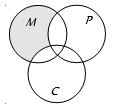
A class has $175$ students. The following data shows the number of students obtaining one or more subjects. Mathematics $100$, Physics $70$, Chemistry $40$; Mathematics and Physics $30$, Mathematics and Chemistry $28$, Physics and Chemistry $23$; Mathematics, Physics and Chemistry $18$. How many students have offered Mathematics alone
Answerc
(c) $n(M\ alone)$$ = n(M) - n(M \cap C) - n(M \cap P) + n(M \cap P \cap C)$
$ = 100 - 28 - 30 + 18 = 60$.
View full question & answer→MCQ 231 Mark
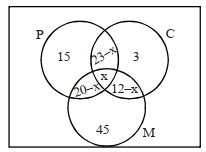
In a class of $100$ students,$15$ students chose only physics (but not mathematics and chemistry),$3$ chose only chemistry (but not mathematics and physics), and $45$ chose only mathematics(but not physics and chemistry). Of the remaining students, it is found that $23$ have taken physics and chemistry,$20$ have taken physics and mathematics, and $12$ have taken mathematics and chemistry. The number of student who chose all the three subjects is
Answerb
(b)
$n ( P \cap \overline{ M } \cap \overline{ C })=15$
$n ( C \cap \overline{ M } \cap \overline{ P })=3$
$n ( M \cap \overline{ P } \cap \overline{ C })=45$
$n ( P \cap C )=23$
$n ( P \cap M )=20$
$n ( M \cap C )=12$
Let $n(P \cap C \cap M)=x$
$n(P \cup C \cup M)=n(P)+n(C)+n(M)$
$\quad n(P \cap C)-n(C \cap M)-n(P \cap M)$
$+n(C \cap M \cap P)$
$100= 82-2 x \Rightarrow x=9$
View full question & answer→MCQ 241 Mark
Let $a>0, a \neq 1$. Then, the set $S$ of all positive real numbers $b$ satisfying $\left(1+a^2\right)\left(1+b^2\right)=4 a b$ is
- ✓
- B
- C
a finite set containing more than one element
- D
$(0, \infty)$
Answera
(a)
Given relation
$\left(1+a^2\right)\left(1+b^2\right)=4 a b$
$\Rightarrow a^2+b^2-2 a b=2 a b-1-a^2 b^2$
$\Rightarrow \quad (a-b)^2=-(1-a b)^2$
$\because a > 0, a \neq 1 \text { and } b \text { is a positive real number}$
$\therefore(a-b)^2 \neq 0 \neq-(1-a b)^2, \text { because }(a-b)^2$
$\text { and }(1-a b)^2 \text { are non-negative real numbers}$
View full question & answer→MCQ 251 Mark
In a classroom, one-fifth of the boys leave the class and the ratio of the remaining boys to girls is $2: 3$. If further $44$ girls leave the class, then class the ratio of boys to girls is $5: 2$. How many more boys should leave the class so that the number of boys equals that of girls?
Answerb
(b)
Let the number of boys and girls in classroom is $x$ and $y$, respectively. Given, $\frac{x-x / 5}{y}=\frac{2}{3} \Rightarrow \frac{4 x}{5 y}=\frac{2}{3}$
From Eqs.$(i)$ and $(ii)$, we get
$x=50, y=60$
Let $z$ number of boy leaves so number of boys and number of girls are equal.
$\therefore \quad 50-10-z=60-44 z=40-16=24$
View full question & answer→MCQ 261 Mark
In a Mathematics test, the average marks of boys is $x \%$ and the average marks of girls is $y \%$ with $x \neq y$. If the average marks of all students is $z \%$, the ratio of the number of girls to the total number of students is
- ✓
$\frac{z-x}{y-x}$
- B
$\frac{z-y}{y-x}$
- C
$\frac{z+y}{y-x}$
- D
$\frac{z+x}{y-x}$
AnswerCorrect option: A. $\frac{z-x}{y-x}$
a
(a)
Let the number of boy $=B$ and number of girls $=G$
Sum of marks obtained by boys $=B x$
$\therefore$ Sum of marks obtained by girls $=G y$
Now, given
$\frac{B x+G y}{B+G}=z$
$\Rightarrow B(x-z)=G(z-y)=\frac{B}{G}=\frac{z-y}{x-z}$
Now, $\frac{G}{B+G}=\frac{1}{\frac{B}{G}+1}=\frac{1}{\frac{z-y}{x-z}+1}=\frac{x-z}{x-y}$
$\frac{G}{B+G}=\frac{z-x}{y-x}$
View full question & answer→MCQ 271 Mark
Let $S$ be the set of all ordered pairs $(x, y)$ of positive integers satisfying the condition $x^2-y^2=12345678$. Then,
AnswerCorrect option: B. $S$ is the empty set
b
(b)
$x$ and $y$ are positive integer
$x^2-y^2=12345678$
$RHS$ $12345678$ is and even number and last digit is $8 .$
$\therefore$ The last digit of $x$ be $3,7$
and the last digit of $y$ be $1,9$.
$\therefore x$ and $y$ must be odd and square of difference is multiple of $8$ but $RHS$ is not multiple of $8$ .
$\therefore S$ is the empty set.
View full question & answer→MCQ 281 Mark
Let $A_1, A_2, \ldots \ldots, A_m$ be non-empty subsets of $\{1,2,3, \ldots, 100\}$ satisfying the following conditions:
$1.$ The numbers $\left|A_1\right|,\left|A_2\right|, \ldots,\left|A_m\right|$ are distinct.
$2.$ $A_1, A_2, \ldots, A_m$ are pairwise disjoint.(Here $|A|$ donotes the number of elements in the set $A$ )Then, the maximum possible value of $m$ is
Answera
(a)
We have, $A_1, A_2, A_3 \ldots, A_m$ are non-empty subsets of $\{1,2,3, \ldots, 100\}$ $\left|A_1\right|,\left|A_2\right|, \ldots,\left|A_m\right|$ are distincts.
$A_1 \cap A_2 \cap A_3 \ldots \cap A_m=\phi$
$\therefore A_1 \cap A_2 \cup A_3 \ldots \cup A_m=\{1,2,3, \ldots, 100\}$
Let $\left|A_1\right|=1\left|A_2\right|=2 \ldots\left|A_m\right|=M$
$A_1, A_2, A_3 \ldots, A_m$ are disjoint set.
$\therefore\left|A_1\right|+\left|A_2\right| \ldots+\left|A_m\right|=100$
$1+2+3 \ldots+m=100$
$\frac{m(m+1)}{2}=100$
$m^2+m-200=0$
$=\frac{-b \pm \sqrt{b^2-4 a c}}{2 a}=\frac{-1 \pm \sqrt{1+4 \cdot 1 \cdot 200}}{2 \cdot 1}$
$=\frac{-1 \pm \sqrt{1+800}}{2}=\frac{-1+\sqrt{801}}{2}$
$=\frac{-1+28.30}{2}=\frac{27.30}{2}=16.65$
$m=\frac{1+28.30}{2}=\frac{29.30}{2}=14.65$
$\therefore m < 14$
$\therefore$ Maximum possible of $m$ is $13$ . ($14$th set will have same size as that of previous size)
View full question & answer→MCQ 291 Mark
For an integer $n$ let $S_n=\{n+1, n+2, \ldots \ldots, n+18\}$. Which of the following is true for all $n \geq 10$ ?
- A
$S_n$ has a multiple of $19$
- B
$S_n$ has a prime
- C
$S_n$ has at least four multiples of $5$
- ✓
$S_n$ has at most six primes
AnswerCorrect option: D. $S_n$ has at most six primes
d
(d)
We have,
$S_n=\{n+1, n+2, n+3, \ldots, n+18\},$
$n \geq 10$
(a) $n=19$, then $S_n$ has not a multiple of 19 .
Hence, option (a) is false.
(b) $S_n$ has more than one prime for $n \geq 10$.
(c) $n=10$
11,28
Only $15,20,25$ are multiple of $5 .$
(d) Number of odd integer in $S_n=9$
So, every third integer is multiple of $3$.
$\therefore S_n$ has at most six primes.
View full question & answer→MCQ 301 Mark
Let $S=\{1,2,3, \ldots, 40)$ and let $A$ be a subset of $S$ such that no two elements in $A$ have their sum divisible by 5 . What is the maximum number of elements possible in $A$ ?
Answerc
(c)
We have,
$S=\{1,2,3,4, \ldots, 40\}$
$A$ is subset of $S$ whose sum of two element of $A$ is not divisible by $5$ .
Possible set $A=\{1,2,5,6,7,11,12,16$, $17,21,22,26,27,31,32,36,37\}$
$\therefore$ Maximum number of elements in $A$ is $17 .$
View full question & answer→MCQ 311 Mark
Let $S=\{1,2,3, \ldots \ldots, n\}$ and $A=\{(a, b) \mid 1 \leq$ $a, b \leq n\}=S \times S$. A subset $B$ of $A$ is said to be a good subset if $(x, x) \in B$ for every $x \in S$. Then, the number of good subsets of $A$ is
- A
$1$
- ✓
$2^n$
- C
$2^{n(n-1)}$
- D
$2^{n^2}$
Answerb
(b)
We have,
$S=\{1,2,3,4, \ldots, n\}$
$A=\{(a, b): 1 \leq a, b \leq n\}=S \times S$
$B=\{(x, x): x \in S\}$
$\therefore \quad B=\{(1,1),(2,2),(3,3), \ldots,(n, n)\}$
Number of elements in $B=n$
Total number of subset of $B$ is $2^n$.
$\therefore$ Total number of good subset of $A$ is $2^n$.
View full question & answer→MCQ 321 Mark
In a certain school, $74 \%$ students like cricket, $76 \%$ students like football and $82 \%$ like tennis. Then, all the three sports are liked by at least $......\%$
Answerb
(b)
Given, $74 \%$ students like cricket $76 \%$ students like football
$82 \%$ students like tennis
$\therefore 26 \%$ student not like cricket
$24 \%$ student not like football
$18 \%$ student not like tennis
Student all the three sports like at least
$=100 \%-$ (sport not likes)
$=100 \%-(26+24+18) \%$
$=100 \%-68 \%=32 \%$
View full question & answer→MCQ 331 Mark
Let $\mathrm{A}=\{\mathrm{n} \in[100,700] \cap \mathrm{N}: \mathrm{n}$ is neither a multiple of $3$ nor a multiple of 4$\}$. Then the number of elements in $\mathrm{A}$ is
Answera
$ \mathrm{n}(3) \Rightarrow \text { multiple of } 3 $
$ 102,105,108, \ldots . ., 699 $
$ \mathrm{~T}_{\mathrm{n}}=699=102+(\mathrm{n}-1)(3) $
$ \mathrm{n}=200 $
$ \mathrm{n}(3)=200 $
$ \because \mathrm{n}(4) \Rightarrow$ multiple of $4$
$ 100,104,108, \ldots ., 700 $
$ T_n=700=100+(n-1)(4) $
$ n=151 $
$ n(4)=151 $
$ \mathrm{n}(3 \cap 4) \Rightarrow \text { multiple of } 3 \& 4 \text { both } $
$ 108,120,132, \ldots ., 696 $
$ T_n=696=108+(n-1)(12) $
$ \mathrm{n}=50 $
$ \mathrm{n}(3 \cap 4)=50 $
$ \mathrm{n}(3 \cup 4)=\mathrm{n}(3)+\mathrm{n}(4)-\mathrm{n}(3 \cap 4) $
$ \quad=200+151-50 $
$ =301$
$\mathrm{n}(\overline{3 \cup 4})=$ Total $-\mathrm{n}(3 \cup 4)=$ neither a multiple of $3$ nor a multiple of $4$
$=601-301=300$
View full question & answer→MCQ 341 Mark
Let the set $C=\left\{(x, y) \mid x^2-2^y=2023, x, y \in \mathbb{N}\right\}$. Then $\sum_{(x, y) \in C}(x+y)$ is equal to
Answera
$x^2-2^y=2023 $
$ \Rightarrow x=45, y=1$
$ \sum_{(x, y) \in C}(x+y)=46 $
View full question & answer→MCQ 351 Mark
$S=\{(x, y, z): x, y, z \in Z, x+2 y+3 z=42$ $\mathrm{x}, \mathrm{y}, \mathrm{z} \geq 0\}$ ...........
Answerb
$x+2 y+3 z=42$, $x, y, z \geq 0$
$z=0$ $x+2 y=42 \Rightarrow 22$
$z=1$ $x+2 y=39 \Rightarrow 20$
$z=2$ $x+2 y=36 \Rightarrow 19$
$z=3$ $x+2 y=33 \Rightarrow 17$
$z=4$ $x+2 y=30 \Rightarrow 16$
$z=5$ $x+2 y=27 \Rightarrow 14$
$z=6$ $x+2 y=24 \Rightarrow 13$
$z=7$ $x+2 y=21 \Rightarrow 11$
$z=8$ $x+2 y=18 \Rightarrow 10$
$z=9$ $x+2 y=15 \Rightarrow 8$
$z=10$ $x+2 y=12 \Rightarrow 7$
$z=11$ $x+2 y=9 \Rightarrow 5$
$z=12$ $x+2 y=6 \Rightarrow 4$
$z=13$ $x+2 y=3 \Rightarrow 2$
$z=14$ $x+2 y=0 \Rightarrow 1$
Total : $169$
View full question & answer→MCQ 361 Mark
If $\mathrm{S}=\{\mathrm{a} \in \mathrm{R}:|2 \mathrm{a}-1|=3[\mathrm{a}]+2\{\mathrm{a}\}\}$, where $[\mathrm{t}]$ denotes the greatest integer less than or equal to $t$ and $\{t\}$ represents the fractional part of $t$, then $72 \sum_{\mathrm{a} \in \mathrm{S}} \mathrm{a}$ is equal to....................
Answera
$ |2 \mathrm{a}-1|=3[\mathrm{a}]+2\{\mathrm{a}\} $
$ |2 \mathrm{a}-1|=[\mathrm{a}]+2 \mathrm{a}$
Case $-1$ : $\mathrm{a}>\frac{1}{2} $
$ 2 \mathrm{a}-1=[\mathrm{a}]+2 \mathrm{a} $
$ {[\mathrm{a}]=-1 \quad \therefore \mathrm{a} \in[-1,0) \text { Reject }} $
Case-$2$: $\mathrm{a}<\frac{1}{2} $
$ -2 \mathrm{a}+1=[\mathrm{a}]+2 \mathrm{a} $
$ \mathrm{a}=\mathrm{I}+\mathrm{f} $
$ -2(\mathrm{I}+\mathrm{f})+1=\mathrm{I}+2 \mathrm{I}+2 \mathrm{f} $
$ \mathrm{I}=0, \mathrm{f}=\frac{1}{4} \quad \therefore \mathrm{a}=\frac{1}{4} $
Hence $ \mathrm{a}=\frac{1}{4} $
$ 72 \sum_{\mathrm{a} \in \mathrm{S}} \mathrm{a}=72 \times \frac{1}{4}=18$
View full question & answer→MCQ 371 Mark
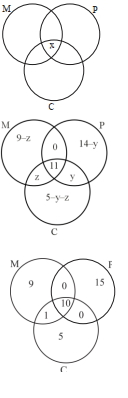
A group of $40$ students appeared in an examination of $3$ subjects - Mathematics, Physics Chemistry. It was found that all students passed in at least one of the subjects, $20$ students passed in Mathematics, $25$ students passed in Physics, $16$ students passed in Chemistry, at most $11$ students passed in both Mathematics and Physics, at most $15$ students passed in both Physics and Chemistry, at most $15$ students passed in both Mathematics and Chemistry. The maximum number of students passed in all the three subjects is___________.
Answera
$11-x \geq 0$ Maths and Physics
$\mathrm{x} \leq 11$
$\mathrm{x}=11$ does not satisfy the data.
$ 11+z \leq 15 \Rightarrow z \leq 4$
$ 11+y \leq 15 \Rightarrow y \leq 4$
Now
$ 9-z+0+14-y+z+11+y+5-y-z=40$
$ \Rightarrow y+z=-1$
Not possible
$\Rightarrow \mathrm{x} \leq 10$
For $\mathrm{x}=10$
Hence maximum number of students passed in all the three subjects is $10$.
View full question & answer→MCQ 381 Mark
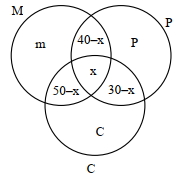
In a survey of $220$ students of a higher secondary school, it was found that at least $125$ and at most $130$ students studied Mathematics; at least $85$ and at most $95$ studied Physics; at least $75$ and at most $90$ studied Chemistry; $30$ studied both Physics and Chemistry; $50$ studied both Chemistry and Mathematics; $40$ studied both Mathematics and Physics and $10$ studied none of these subjects. Let $\mathrm{m}$ and $\mathrm{n}$ respectively be the least and the most number of students who studied all the three subjects. Then $\mathrm{m}+\mathrm{n}$ is equal to .............................
Answerb
$ 125 \leq \mathrm{m}+90-\mathrm{x} \leq 130 $
$ 85 \leq \mathrm{P}+70-\mathrm{x} \leq 95 $
$ 75 \leq \mathrm{C}+80-\mathrm{x} \leq 90 $
$ \mathrm{~m}+\mathrm{P}+\mathrm{C}+120-2 \mathrm{x}=210 $
$ \Rightarrow 15 \leq \mathrm{x} \leq 45 \& 30-\mathrm{x} \geq 0 $
$ \Rightarrow 15 \leq \mathrm{x} \leq 30 $
$ 30+15=45$
View full question & answer→MCQ 391 Mark
The number of elements in the set $\left\{ n \in N : 10 \leq n \leq 100\right.$ and $3^{ n }-3$ is a multiple of $7\}$ is $........$.
Answera
$n \in[10,100]$
$3^{ n }-3 \text { is multiple of } 7$
$3^{ n }=7 \lambda+3$
$n =1,7,13,20, \ldots .97$
Number of possible values of $n=15$
View full question & answer→MCQ 401 Mark
The number of elements in the set $\left\{n \in Z :\left|n^2-10 n+19\right| < 6\right\}$ is $...........$
Answerd
$-6 < n ^2-10 n +19 < 6$
$\Rightarrow n^2-10 n+25 > 0 \text { and } n ^2-10 n +13 < ( n -5)^2 > 0 n \in[5-2 \sqrt{3}, 5+2 \sqrt{3}]$
$n \in R-[5]$
$\therefore n \in[1.3,8.3]$
$\Rightarrow n=2,3,4,6,7,8$
View full question & answer→MCQ 411 Mark
An organization awarded $48$ medals in event '$A$',$25$ in event '$B$ ' and $18$ in event ' $C$ '. If these medals went to total $60$ men and only five men got medals in all the three events, then, how many received medals in exactly two of three events?
Answerc
$| A |=48$
$| B |=25$
$| C |=18$
$| A \cup B \cup C |=60 \quad[\text { Total }]$
$| A \cap B \cap C |=5$
$|A \cup B \cup C|=\sum|A|-\sum|A \cap B|+|A \cap B \cap C|$
$\Rightarrow \sum|A \cap B|=48+25+18+5-60$
$\quad=36$
No. of men who received exactly 2 medals
$=\sum|A \cap B|-3|A \cap B \cap C|$
$=36-15$
$=21$
View full question & answer→MCQ 421 Mark
Let $A =\{1,2,3,4,5,6,7\}$ and $B =\{3,6,7,9\}$. Then the number of elements in the set $\{ C \subseteq A : C \cap B \neq \phi\}$ is
Answerb
$A =\{1,2,3,4,5,6,7\} \text { and }$
$B =\{3,6,7,9\}$
Total subset of $A =2^{7}=128$
$C \cap B =\phi$ when set $C$ contains the element $1,2,4,5$
$\therefore S=\{C \subseteq A ; C \cap B \neq \phi\}$
$=\operatorname{Total}-(C \cap B=\phi)$
$=128-2^{4}=112$
View full question & answer→MCQ 431 Mark
Let $A =\{ x \in R :| x +1|<2\}$ and $B=\{x \in R:|x-1| \geq 2\}$. Then which one of the following statements is NOT true ?
- A
$A - B =(-1,1)$
- ✓
$B - A = R -(-3,1)$
- C
$A \cap B =(-3,-1]$
- D
$A \cup B = R -[1,3)$
AnswerCorrect option: B. $B - A = R -(-3,1)$
b
$A : x \in(-3,1) \quad B : x \in(-\infty,-1] \cup[3, \infty)$
$B - A =(-\infty,-3] \cup[3, \infty)= R -(-3,3)$
View full question & answer→MCQ 441 Mark
Let $A=\{n \in N: H . C . F .(n, 45)=1\}$ and Let $B=\{2 k: k \in\{1,2, \ldots, 100\}\}$. Then the sum of all the elements of $A \cap B$ is
- ✓
$5264$
- B
$5265$
- C
$5255$
- D
$5235$
AnswerCorrect option: A. $5264$
a
Sum of elements in $A \cap B$
$=\underbrace{(2+4+6+\ldots+200)}_{\text {Multiple of } 2}-\underbrace{(6+12+\ldots+198)}_{\text {Multiple of } 2 \; and\; 3 \text { i.e. } 6}$
$\quad-\underbrace{(10+20+\ldots+200)}_{\text {Multiple of } 5 \; and \; 2 \text { i.e. } 10}+\underbrace{(30+60+\ldots+180)}_{\text {Multiple of } 2,5 \; and \;3 \text { i.e. } 30}$
$=5264$
View full question & answer→MCQ 451 Mark
Let $A :\{1,2,3,4,5,6,7\}$. Define $B =\{ T \subseteq A$ : either $1 \notin T$ or $2 \in T \}$ and $C = \{ T \subseteq A : T$ the sum of all the elements of $T$ is a prime number $\}$. Then the number of elements in the set $B \cup C$ is $\dots\dots$
Answera
$B^{\prime}$ is a set containing sub sets of $A$ containing element $1$ and not containing $2$ .
And $C^{\prime}$ is a set containing subsets of $A$ whose sum of elements is not prime.
So, we need to calculate number of subsets of $\{3,4,5,6,7\}$ whose sum of elements plus $1$ is composite.
Number of such $54\,elements\,subset\,=1$
Number of such $4$ elements subset $=3$ (except selecting $3$ or $7$ )
Number of such $3$ elements subset $=6$ (except selecting $\{3,4,5\},\{3,6,7\},\{4,5,7\}$ or $\{5,6,7\}$ )
Number of such $2$ elements subset $=7$ (except selecting $\{3,7\},\{4,6\},\{5,7\})$
Number of such $1$ elements subset $=3$ (except selecting $\{4\}$ or $\{6\}$ )
Number of such $0$ elements subset $=1$
$n\left(B^{\prime} \cap C^{\prime}\right)=21 \Rightarrow n(B \cup C)=2^{7}-21=107$
View full question & answer→MCQ 461 Mark
Let $S=\{4,6,9\}$ and $T=\{9,10,11, \ldots, 1000\}$. If
$A=\left\{a_{1}+a_{2}+\ldots+a_{k}: k \in N, a_{1}, a_{2}, a_{3}, \ldots, a_{k} \in S\right\}$ then the sum of all the elements in the set $T - A$ is equal to $......$
Answerc
$S =\{4,6,9\} \quad T =\{9,10,11 \ldots 1000\}$
$A \left\{ a _{1}+ a _{2}+\ldots . .+ a _{ k }: K \in N \right\} \,and\, a _{ i } \in S$
Here by the definition of set '$A$'
$A=\{a: a=4 x+6 y+9 z\}$
Except the element $11$,every element of set $T$ is of of the form $4 x+6 y+9 z$ for some $x, y, z \in W$
$\therefore T - A =\{11\}$
View full question & answer→MCQ 471 Mark
Let $A=\left\{n \in N \mid n^{2} \leq n+10,000\right\}, B=\{3 k+1 \mid k \in N\}$ and $C=\{2 k \mid k \in N\}$, then the sum of all the elements of the set $A \cap(B-C)$ is equal to $.....$
Answera
$\mathrm{B}-\mathrm{C} \equiv\{7,13,19, \ldots 97, \ldots\}$
Now, $n^{2}-n \leq 100 \times 100$
$\Rightarrow \mathrm{n}(\mathrm{n}-1) \leq 100 \times 100$
$\Rightarrow \mathrm{A}=\{1,2, \ldots, 100\}$
So, $A \cap(B-C)=\{7,13,19, \ldots, 97\}$
Hence, sum $=\frac{16}{2}(7+97)=832$
View full question & answer→MCQ 481 Mark
Out of all the patients in a hospital $89\, \%$ are found to be suffering from heart ailment and $98\, \%$ are suffering from lungs infection. If $\mathrm{K}\, \%$ of them are suffering from both ailments, then $\mathrm{K}$ can not belong to the set :
- ✓
$\{79,81,83,85\}$
- B
$\{84,86,88,90\}$
- C
$\{80,83,86,89\}$
- D
$\{84,87,90,93\}$
AnswerCorrect option: A. $\{79,81,83,85\}$
a
$\mathrm{n}(\mathrm{A} \cup \mathrm{B}) \geq \mathrm{n}(\mathrm{A})+\mathrm{n}(\mathrm{B})-\mathrm{n}(\mathrm{A} \cap \mathrm{B})$
$100 \geq 89+98-\mathrm{n}(\mathrm{A} \cap \mathrm{B})$
$\mathrm{n}(\mathrm{A} \cap \mathrm{B}) \geq 87$
$87 \leq \mathrm{n}(\mathrm{A} \cap \mathrm{B}) \leq 89$
View full question & answer→MCQ 491 Mark
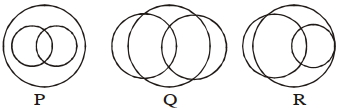
In a school, there are three types of games to be played. Some of the students play two types of games, but none play all the three games. Which Venn diagrams can justify the above statement ?
- A
$P$ and $Q$
- B
$P$ and $R$
- ✓
- D
$Q$ and $R$
Answerc
$A \cap B \cap C$ is visible in all three venn diagram
View full question & answer→MCQ 501 Mark
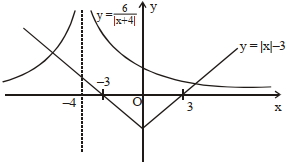
The number of elements in the set $\{x \in R :(|x|-3)|x+4|=6\}$ is equal to
Answerb
$x \neq-4$
$(|x|-3)(|x+4|)=6$
$\Rightarrow \quad|x|-3=\frac{6}{|x+4|}$
No. of solutions $=2$
View full question & answer→MCQ 511 Mark
If $\mathrm{A}=\{\mathrm{x} \in {R}:|\mathrm{x}-2|>1\}, \mathrm{B}=\left\{\mathrm{x} \in {R}: \sqrt{\mathrm{x}^{2}-3}>1\right\}$, $\mathrm{C}=\{\mathrm{x} \in {R}:|\mathrm{x}-4| \geq 2\}$ and ${Z}$ is the set of all integers, then the number of subsets of the set $(A \cap B \cap C)^{c} \cap {Z}$ is .... .
Answera
$\mathrm{A}=(-\infty, 1) \cup(3, \infty)$
$\mathrm{B}=(-\infty,-2) \cup(2, \infty)$
$\mathrm{C}=(-\infty, 2] \cup[6, \infty)$
So, $\mathrm{A} \cap \mathrm{B} \cap \mathrm{C}=(-\infty,-2) \cup[6, \infty)$
$\mathrm{z} \cap(\mathrm{A} \cap \mathrm{B} \cap \mathrm{C})^{\prime}=\{-2,-1,0,-1,2,3,4,5\}$
Hence no. of its subsets $=2^{8}=256$.
View full question & answer→MCQ 521 Mark
Set $A$ has $m$ elements and Set $B$ has $n$ elements. If the total number of subsets of $A$ is $112$ more than the total number of subsets of $B$, then the value of $m \times n$ is
Answerc
$2^m -2^{ n }=112$
$m =7, n =4$
$\left(2^{7}-2^{4}=112\right)$
$m \times n =7 \times 4=28$
View full question & answer→MCQ 531 Mark
Let $\mathrm{X}=\{\mathrm{n} \in \mathrm{N}: 1 \leq \mathrm{n} \leq 50\} .$ If $A=\{n \in X: n \text { is a multiple of } 2\}$ and $\mathrm{B}=\{\mathrm{n} \in \mathrm{X}: \mathrm{n} \text { is a multiple of } 7\},$ then the number of elements in the smallest subset of $X$ containing both $\mathrm{A}$ and $\mathrm{B}$ is
Answera
$\mathrm{n}(\mathrm{A})=25$
$\mathrm{n}(\mathrm{B})=7$
$\mathrm{n}(\mathrm{A} \cap \mathrm{B})=3$
$n(A \cup B)=25+7-3=29$
View full question & answer→MCQ 541 Mark
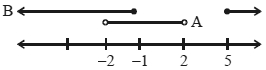
If $A=\{x \in R:|x|<2\}$ and $B=\{x \in R:|x-2| \geq 3\}$ then
- A
$A \cup B=R-(2,5)$
- B
$A \cap B=(-2,-1)$
- ✓
$B-A=R-(-2,5)$
- D
$A-B=[-1,2)$
AnswerCorrect option: C. $B-A=R-(-2,5)$
c
$A: x \in(-2,2) ; B: x \in(-\infty,-1] \cup[5, \infty)$
$\Rightarrow B-A=R-(-2,5)$
View full question & answer→MCQ 551 Mark
Let $\bigcup \limits_{i=1}^{50} X_{i}=\bigcup \limits_{i=1}^{n} Y_{i}=T$ where each $X_{i}$ contains $10$ elements and each $Y_{i}$ contains $5$ elements. If each element of the set $T$ is an element of exactly $20$ of sets $X_{i}$ 's and exactly $6$ of sets $Y_{i}$ 's, then $n$ is equal to
Answerd
$n \left( X _{ i }\right)=10 . \underset{ i =1}{ U } X _{ i }= T , \Rightarrow n ( T )=500$
each element of $T$ belongs to exactly 20
elements of $X _{ i } \Rightarrow \frac{500}{20}=25$ distinct elements
so $\frac{5 n}{6}=25 \Rightarrow n=30$
View full question & answer→MCQ 561 Mark
A survey shows that $63 \%$ of the people in a city read newspaper $A$ whereas $76 \%$ read newspaper $B$. If $x \%$ of the people read both the newspapers, then a possible value of $x$ can be
Answerd
$n(B) \leq n(A \cup B) \leq n(U)$
$\Rightarrow 76 \leq 76+63-x \leq 100$
$\Rightarrow-63 \leq-x \leq-39$
$\Rightarrow 63 \geq x \geq 39$
View full question & answer→MCQ 571 Mark
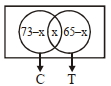
A survey shows that $73 \%$ of the persons working in an office like coffee, whereas $65 \%$ like tea. If $x$ denotes the percentage of them, who like both coffee and tea, then $x$ cannot be
Answerd
$C \rightarrow$ person like coffee
$T \rightarrow$ person like Tea
$n(C)=73$
$n(T)=65$
$n(C \cup T) \leq 100$
$n(C)+n(T)-n(C \cap T) \leq 100$
$73+65-x \leq 100$
$x \geq 38$
$73-x \geq 0 \Rightarrow x \leq 73$
$65-x \geq 0 \Rightarrow x \leq 65$
$38 \leq x \leq 65$
View full question & answer→MCQ 581 Mark
Consider the two sets :
$A=\{m \in R:$ both the roots of $x^{2}-(m+1) x+m+4=0$ are real $\}$ and $B=[-3,5)$
Which of the following is not true?
AnswerCorrect option: A. $A-B=(-\infty,-3) \cup(5, \infty)$
a
$A: D \geq 0$
$\Rightarrow \quad(m+1)^{2}-4(m+4) \geq 0$
$\Rightarrow \quad m^{2}+2 m+1-4 m-16 \geq 0$
$\Rightarrow \quad m^{2}-2 m-15 \geq 0$
$\Rightarrow \quad(m-5)(m+3) \geq 0$
$\Rightarrow \quad m \in(-\infty,-3] \cup[5, \infty)$
$\therefore \quad A=(-\infty,-3] \cup[5, \infty)$
$B=[-3,5)$
$A-B=(-\infty,-3) \cup[5, \infty)$
$A \cap B=\{-3\}$
$B-A=(-3,5)$
$A \cup B=R$
View full question & answer→MCQ 591 Mark
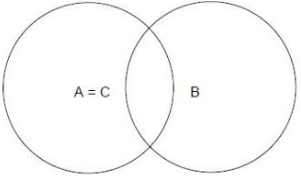
Let $A, B$ and $C$ be sets such that $\phi \ne A \cap B \subseteq C$. Then which of the following statements is not true ?
- ✓
If $\left( {A - C} \right) \subseteq B$ then $A \subseteq B$
- B
If $\left( {A - B} \right) \subseteq C$ then $A \subseteq C$
- C
$\left( {C \cup A} \right) \cap \left( {C \cup B} \right) = C$
- D
$B \cap C \ne \phi $
AnswerCorrect option: A. If $\left( {A - C} \right) \subseteq B$ then $A \subseteq B$
a
For $A\, = \,C,\,A - C\, = \,\phi $
$ \Rightarrow \phi \, \subseteq \,B$
But $A\, \subseteq \,B$
$ \Rightarrow \,$ option $A$ is NOT true
Let $x\, \in \,\,(C\,x\, \in \,(C\, \cup \,A)\,\, \cap (C\, \cup \,B)\,)$
$ \Rightarrow \,x\,(C\, \cup \,A)$ and $x\, \in \,\,(C\, \cup \,B)$
$ \Rightarrow \,(x\, \in \,C$ or $x\, \in \,A)$ and $(x\, \in \,C$ or $x\, \in \,B)$
$ \Rightarrow \,(x\, \in \,C$ or $x\, \in \,\,(A\, \cap \,B)$
$ \Rightarrow \,(x\, \in \,C$ or $x\, \in \,C$ (as $A\, \cup \,B \subseteq \,C\,$ )
$ \Rightarrow \,x\, \in \,C$
$ \Rightarrow (C\, \cup \,A)\,\, \cap (C\, \cup \,B)\, \subseteq \,C\,\,\,(1)$
Now $x\, \in \,C\, \Rightarrow \,x\, \in \,(C\, \cup \,A)$ and $x\, \in \,\,(C\, \cup \,B\,)$
$ \Rightarrow x\, \in (C\, \cup \,A)\,\, \cap (C\, \cup \,B)$
$ \Rightarrow C\, \subseteq \,(C\, \cup \,A)\,\, \cap (C\, \cup \,B)\, \subseteq \,C\,\,\,(2)$
$ \Rightarrow $ from $(1)$ and $(2)$
$C\, = \,(C\, \cup \,A)\,\, \cap (C\, \cup \,B)$
$ \Rightarrow $ option $B$ is true
Let $x\, \in \,A$ and $x\, \notin \,B$
$\Rightarrow \,x\, \in \,(A - B)$
$ \Rightarrow \,x\, \in \,C$ (as $A - B \subseteq \,C$ )
Let $x\, \in \,A$ and $x\, \in \,B$
$ \Rightarrow \,x\, \in \,(A \cap B)$
$ \Rightarrow \,x\, \in \,C$ (as $A \cap B \subseteq \,C$ )
Hence $x\, \in \,A\,\, \Rightarrow \,x\, \in \,C$
$ \Rightarrow A\, \subseteq \,C$
$ \Rightarrow $ option $C$ is true
As $C \supseteq \,(A \cap B)$
$ \Rightarrow B \cap C \supseteq \,(A \cap B)$
As $A \cap B \ne \phi $
$ \Rightarrow B \cap C \ne \phi $
Hence the correct answer is option $(A)$
View full question & answer→MCQ 601 Mark
Let $S = \{1, 2, 3, ….., 100\}$. The number of non-empty subsets $A$ of $S$ such that the product of elements in $A$ is even is
- A
$2^{100} -1$
- ✓
$2^{50} (2^{50} -1)$
- C
$2^{50} -1$
- D
$2^{50} + 1$
AnswerCorrect option: B. $2^{50} (2^{50} -1)$
b
Product is even when atleast one element of subset is even Hence required number of subsets = total subsets -number of subsets all whose elements are odd $= 2^{100} - 2^{50}$
View full question & answer→MCQ 611 Mark
In a class of $140$ students numbered $1$ to $140$, all even numbered students opted Mathematics course, those whose number is divisible by $3$ opted Physics course and those whose number is divisible by $5$ opted Chemistry course. Then the number of students who did not opt for any of the three courses is
Answerd
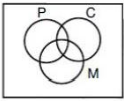
$n(p)\, = \,\left[ {\frac{{140}}{3}} \right]\, = \,46$
$n(C)\, = \,\left[ {\frac{{140}}{5}} \right]\, = \,28$
$n(M)\, = \,\left[ {\frac{{140}}{2}} \right]\, = \,70$
$n(p\, \cup \,C\, \cup \,M)\, = \,n(P)\, + \,n(C)\, + \,n(M)$ $ - \,n(P \cap C) - \,n(C \cap M) - $ $n(M\, \cap \,P)\, + \,n(P \cap M \cap C)$
$ = \,46\, + \,28\, + 70\, - \,\left[ {\frac{{140}}{{15}}} \right]\, - \,\left[ {\frac{{140}}{{10}}} \right]\, - \,\left[ {\frac{{140}}{6}} \right]\, + \,\left[ {\frac{{140}}{{30}}} \right]\,$
$=\,144\,-\,9\,-14\,-\,23+4\,=\,102$
So required number of student $=\,140\,-\,102\,=\,38$
View full question & answer→MCQ 621 Mark
Two newspaper $A$ and $B$ are published in a city. It is known that $25\%$ of the city populations reads $A$ and $20\%$ reads $B$ while $8\%$ reads both $A$ and $B$. Further, $30\%$ of those who read $A$ but not $B$ look into advertisements and $40\%$ of those who read $B$ but not $A$ also look into advertisements, while $50\%$ of those who read both $A$and $B$ look into advertisements. Then the percentage of the population who look into advertisement is
- A
$12.8$
- B
$13.5$
- ✓
$13.9$
- D
$13$
AnswerCorrect option: C. $13.9$
c
Let population $=\,100$
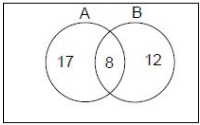
$n(A)\, = \,25$
$n(B)\, = \,20$
$n(A \cap B)\, = \,8$
$n(A \cap \bar B)\, = \,17$
$n(\bar A \cap B)\, = \,12$
Now $\%$ of th population who look advertisement
$=\,\frac {30}{100}\times 17\,+$ $\frac {40}{100}\times 12\,+$ $\frac {50}{100}\times 8$
$=\,13.9$
View full question & answer→MCQ 631 Mark
Let $S = \{ x \in R:x \ge 0$ and $2\left| {\sqrt x - 3} \right| + \sqrt x \left( {\sqrt x - 6} \right) + 6 = 0\} $ then $S:$ . . .
- A
contains exactly one element.
- ✓
contains exactly two elements
- C
contains exactly four element.
- D
AnswerCorrect option: B. contains exactly two elements
b
Case - $I$ : $x\,\in \,[0,\,9]$
$2(3 - \sqrt x )\, + \,x\, - \,6\sqrt x \, + \,6\, = \,0$
$ \Rightarrow \,x\, - \,8\sqrt x \, + \,12\, = \,0\, \Rightarrow \,\sqrt x \, = \,4,2\, \Rightarrow \,x\, = \,16,4$
Since $x\, \in \,[0,\,9]$
$\therefore \,\,x\,=\,4$
Case - $II$ : $x\, \in \,[9,\,\infty ]$
$2(\sqrt x - 3)\, + \,x\, - \,6\sqrt x \, + \,6\, = \,0$
$ \Rightarrow \,x\, - \,4\sqrt x \,\, = \,0\, \Rightarrow \,x\, = \,16,0$
Since $x\, \in \,[9,\,\infty ]$
$\therefore \,\,x\,=\,16$
Hence , $x\,=\,4$ and $16$
View full question & answer→MCQ 641 Mark
In a certain town, $25\%$ of the families own a phone and $15\%$ own a car; $65\%$ families own neither a phone nor a car and $2,000$ families own both a car and a phone. Consider the following three statements
$(A)\,\,\,5\%$ families own both a car and a phone
$(B)\,\,\,35\%$ families own either a car or a phone
$(C)\,\,\,40,000$ families live in the town
Then,
- A
Only $(A)$ and $(C)$ are correct.
- B
Only $(B)$ and $(C)$ are correct
- ✓
All $(A),$ $(B)$ and $(C)$ are correct.
- D
Only $(A)$ and $(B)$ are correct
AnswerCorrect option: C. All $(A),$ $(B)$ and $(C)$ are correct.
c
$n(P)\, = \,25\,\% $
$n(C)\, = \,15\,\% $
$n(P'\, \cup \,C')\, = \,65\,\% $
$ \Rightarrow n(P \cup \,C')\, = \,65\,\% $
$n(P \cup \,C)\, = \,35\,\% $
$n(P \cap \,C)\, = \,n(P)\, + n(C)\, - \,n(P \cup \,C)$
$25\, + \,15\, - 35\, = \,5\% $
$x\, \times \,5\,\% \, = \,2000$
$x\, = \,40,000$
View full question & answer→MCQ 651 Mark
If $X = \{ {4^n} - 3n - 1:n \in N\} $ and $Y = \{ 9(n - 1):n \in N\} ,$ then $X \cup Y$ = . . . . .
Answerb
$ x=\left\{4^{n}-3 n-1\right\} $
$=\{0,9,54, \ldots\} $
$ Y =\{9(n-1)\} $
$=\{0,9,18,27, \ldots\} $
$ \therefore X U Y=Y $
View full question & answer→MCQ 661 Mark
Let $P=\{\theta: \sin \theta-\cos \theta=\sqrt{2} \cos \theta\}$ and $Q=\{\theta: \sin \theta+\cos \theta=\sqrt{2} \sin \theta\}$ be two sets. Then
Answerd
$P=\{\theta: \sin \theta-\cos \theta=\sqrt{2} \cos \theta\}$
$Q=\{\theta: \sin \theta+\cos \theta=\sqrt{2} \sin \theta\}$
From P
$\sin \theta-\cos \theta=\sqrt{2} \cos \theta$
$\sin \theta=(\sqrt{2}+1) \cos \theta$
$\frac{\sin \theta}{\cos \theta}=(\sqrt{2}+1)$
$\tan \theta=(\sqrt{2}+1)$
$\text { from } Q$
$\sin \theta+\cos \theta=\sqrt{2} \sin \theta$
$\sin \theta(\sqrt{2}-1)=\cos \theta$
$\frac{\sin \theta}{\cos \theta}=(\sqrt{2}-1)$
$\tan \theta=(\sqrt{2}-1)$
$\tan \theta=\frac{1}{\sqrt{2}-1} \times \frac{\sqrt{2}+1}{\sqrt{2}+1}=\sqrt{2}+1$
$\therefore P=Q$
Hence, option $(D)$ is correct answer.
View full question & answer→MCQ 671 Mark
Let $S=\{1,2,3,4\}$. The total number of unordered pairs of disjoint subsets of $S$ is equal to
Answerd
Total number of unordered pairs of disjoint subsets
$=\frac{3^4+1}{2}=41 \text {. }$
View full question & answer→MCQ 681 Mark
In a college of $300$ students, every student reads $5$ newspaper and every newspaper is read by $60$ students. The no. of newspaper is
- A
At least $30$
- B
At most $20$
- ✓
Exactly $25$
- D
AnswerCorrect option: C. Exactly $25$
c
(c) Let number of newspapers be $x$. If every students reads one newspaper, the number of students would be $x(60) = 60x$
Since, every students reads $5$ newspapers
$\therefore$ Numbers of students $ = {{x \times 60} \over 5} = 300$, $x = 25$.
View full question & answer→MCQ 691 Mark
Which of the following is the empty set
- A
$\{ x:x$ is a real number and ${x^2} - 1 = 0\} $
- ✓
$\{ x:x$ is a real number and ${x^2} + 1 = 0\} $
- C
$\{ x:x$ is a real number and ${x^2} - 9 = 0\} $
- D
$\{ x:x$ is a real number and ${x^2} = x + 2\} $
AnswerCorrect option: B. $\{ x:x$ is a real number and ${x^2} + 1 = 0\} $
b
(b) Since ${x^2} + 1 = 0,$ gives ${x^2} = - 1$
$ \Rightarrow $ $x = \pm$ $ i x$ is not real but $x$ is real (given) No value of $x$ is possible.
View full question & answer→MCQ 701 Mark
The set $A = \{ x:x \in R,\,{x^2} = 16$ and $2x = 6\} $ equals
- ✓
$\phi $
- B
$\{14, 3, 4\}$
- C
$\{3\}$
- D
$\{4\}$
AnswerCorrect option: A. $\phi $
a
(a) ${x^2} = 16$ ==> $x = \pm 4$
$2x = 6$ ==> $x = 3$
There is no value of $x$ which satisfies both the above equations. Thus, $A = \phi $.
View full question & answer→MCQ 711 Mark
If a set $A$ has $n$ elements, then the total number of subsets of $A$ is
- A
$n$
- B
${n^2}$
- ✓
${2^n}$
- D
$2n$
AnswerCorrect option: C. ${2^n}$
c
(c) Number of subsets of $A{ = ^n}{C_0}{ + ^n}{C_1} + .........{ + ^n}{C_n} = {2^n}$.
View full question & answer→MCQ 721 Mark
The number of proper subsets of the set $\{1, 2, 3\}$ is
Answerc
(c) Number of proper subsets of the set $(1, 2, 3) =$${2^3} - 1 =7$.
View full question & answer→MCQ 731 Mark
In rule method the null set is represented by
- A
$\{\}$
- B
$\phi $
- C
$\{ x:x = x\} $
- ✓
$\{ x:x \ne x\} $
AnswerCorrect option: D. $\{ x:x \ne x\} $
d
(d) It is fundamental concept.
View full question & answer→MCQ 741 Mark
$A = \{ x:x \ne x\} $ represents
- A
$\{0\}$
- ✓
$\{\}$
- C
$\{1\}$
- D
$\{x\}$
AnswerCorrect option: B. $\{\}$
b
(d) It is fundamental concept.
View full question & answer→MCQ 751 Mark
If $Q = \left\{ {x:x = {1 \over y},\,{\rm{where \,\,}}y \in N} \right\}$, then
- A
$0 \in Q$
- ✓
$1 \in Q$
- C
$2 \in Q$
- D
${2 \over 3} \in Q$
AnswerCorrect option: B. $1 \in Q$
b
(b) ${1 \over y} \neq 0,{1 \over y} \neq 2,{1 \over y} \neq {-2 \over 3}, [y \in N]$
${1 \over y}$ can be $1, [ y\ can\ be\ 1].$
View full question & answer→MCQ 761 Mark
Which set is the subset of all given sets
- A
$\{1, 2, 3, 4,......\}$
- B
$\{1\}$
- C
$\{0\}$
- ✓
$\{\}$
AnswerCorrect option: D. $\{\}$
d
(d) Null set is the subset of all given sets.
View full question & answer→MCQ 771 Mark
Let $S = \{ 0,\,1,\,5,\,4,\,7\} $. Then the total number of subsets of $S$ is
Answerb
(b) $S = \,\,\,\,\{ 0,\,1,\,5,\,4,\,7\} $,
then, total number of subsets of $S$ is ${2^n}$.
Hence, ${2^5} = 32$.
View full question & answer→MCQ 781 Mark
The number of non-empty subsets of the set $\{1, 2, 3, 4\}$ is
Answera
(a) The number of non- empty subsets = ${2^n} - 1$
${2^4} - 1 = 16 - 1 = 15$.
View full question & answer→MCQ 791 Mark
The smallest set $A$ such that $A \cup \{1, 2\} = \{1, 2, 3, 5, 9\}$ is
- A
$\{2, 3, 5\}$
- ✓
$\{3, 5, 9\}$
- C
$\{1, 2, 5, 9\}$
- D
AnswerCorrect option: B. $\{3, 5, 9\}$
b
(b) Given $A \cup \,\{ 1,\,2\} = \{ 1,\,2,\,3,\,5,\,9\} $. Hence, $A = \{ 3,\,5,9\} $.
View full question & answer→MCQ 801 Mark
If $A = \{ 1,\,2,\,3,\,4,\,5\} ,$ then the number of proper subsets of $A$ is
Answerc
(c) The number of proper subset $ = {2^n} - 1$
$ = {2^5} - 1$ $ = 32 - 1 = 31$.
View full question & answer→MCQ 811 Mark
Let $A$ and $B$ be two non-empty subsets of a set $X$ such that $A$ is not a subset of $B$, then
- A
$A$ is always a subset of the complement of $B$
- B
$B$ is always a subset of $A$
- C
$A$ and $B$ are always disjoint
- ✓
$A$ and the complement of $B$ are always non-disjoint
AnswerCorrect option: D. $A$ and the complement of $B$ are always non-disjoint
d
(d) $A$ is not a subset of $B$
$\therefore $ Some point of $A$ will not be a point of $B$, So that point will being to ${B^c}$.
Hence $A$ and complement of $B$ are always non-disjoint.
View full question & answer→MCQ 821 Mark
Given the sets $A = \{ 1,\,2,\,3\} ,\,B = \{ 3,4\} , C = \{4, 5, 6\}$, then $A \cup (B \cap C)$ is
- A
$\{3\}$
- ✓
$\{1, 2, 3, 4\}$
- C
$\{1, 2, 4, 5\}$
- D
$\{1, 2, 3, 4, 5, 6\}$
AnswerCorrect option: B. $\{1, 2, 3, 4\}$
b
(b) $B \cap C = \{ 4\} $, $A \cup (B \cap C) =$ $\{1, 2, 3, 4\}.$
View full question & answer→MCQ 831 Mark
If $A$ and $B$ are any two sets, then $A \cup (A \cap B) $ is equal to
Answera
(a) $A \cap B \subseteq A$. Hence $A \cup (A \cap B) = A$.
View full question & answer→MCQ 841 Mark
If the sets $A$ and $B$ are defined as $A = \{ (x,\,y):y = {e^x},\,x \in R\} $; $B = \{ (x,\,y):y = x,\,x \in R\} ,$ then
- A
$B \subseteq A$
- B
$A \subseteq B$
- ✓
$A \cap B = \phi $
- D
$A \cup B = A$
AnswerCorrect option: C. $A \cap B = \phi $
c
(c) Since, $y = {e^x}$ and $y = x$ do not meet for any $x \in R$
$\therefore A \cap B = \phi $.
View full question & answer→MCQ 851 Mark
If $A, B$ and $C$ are any three sets, then $A -(B \cup C)$ is equal to
- A
$(A -B) \cup (A -C)$
- ✓
$(A -B) \cap (A -C)$
- C
$(A -B) \cup C$
- D
$(A -B) \cap C$
AnswerCorrect option: B. $(A -B) \cap (A -C)$
b
(b) It is De' Morgan law.
View full question & answer→MCQ 861 Mark
If $A, B$ and $C$ are non-empty sets, then $(A -B) \cup (B -A)$ equals
AnswerCorrect option: C. $(A \cup B) -(A \cap B)$
c
(c) $(A -B) \cup (B -A) = (A \cup B) -(A \cap B).$
View full question & answer→MCQ 871 Mark
If $A \cap B = B$, then
- A
$A \subset B$
- ✓
$B \subset A$
- C
$A = \phi $
- D
$B = \phi $
AnswerCorrect option: B. $B \subset A$
b
(b) Since $A \cap B = B,\,\,\,\,\therefore B \subset A$
View full question & answer→MCQ 881 Mark
If $A$ and $B$ are two sets, then $A \cup B = A \cap B$ iff
- A
$A \subseteq B$
- B
$B \subseteq A$
- ✓
$A = B$
- D
AnswerCorrect option: C. $A = B$
c
(c) Let $x \in A \Rightarrow x \in A \cup B$,$[\because A \subseteq A \cup B]$
==> $x \in A \cap B$,$[\because A \cup B = A \cap B]$
==> $x \in A$ and $x \in B$ ==> $x \in B$, $\therefore A \subseteq B$
Similarly, $x \in B$ ==> $x \in A$, $\therefore B \subseteq A$
Now $A \subseteq B,\,\,B \subseteq A$ ==> $A = B$.
View full question & answer→MCQ 891 Mark
Let $A$ and $B$ be two sets. Then
AnswerCorrect option: B. $A \cap B \subseteq A \cup B$
b
(b) $A \cap B \subseteq A \subseteq A \cup B$, $\therefore A \cap B \subseteq A \cup B$.
View full question & answer→MCQ 901 Mark
If $A = \{2, 3, 4, 8, 10\}, B = \{3, 4, 5, 10, 12\}, C = \{4, 5, 6, 12, 14\}$ then $(A \cap B) \cup (A \cap C)$ is equal to
- ✓
$\{3, 4, 10\}$
- B
$\{2, 8, 10\}$
- C
$\{4, 5, 6\}$
- D
$\{3, 5, 14\}$
AnswerCorrect option: A. $\{3, 4, 10\}$
a
(a) $A \cap B = \{ 2,\,3,\,4,\,8,\,10\} \cap \{ 3,\,4,\,5,\,10,\,12\} $
$ = \{ 3,\,4,\,10\} $, $A \cap C = \{ 4\} $.
$\therefore (A \cap B) \cup (A \cap C) = \{ 3,\,4,\,10\} $.
View full question & answer→MCQ 911 Mark
If $A$ and $B$ are any two sets, then $A \cap (A \cup B)$ is equal to
Answera
(a) $A \cap (A \cup B) = A$, $[\because A \subseteq B \cup A]$.
View full question & answer→MCQ 921 Mark
If $A, B, C$ be three sets such that $A \cup B = A \cup C$ and $A \cap B = A \cap C$, then
- A
$A = B$
- ✓
$B = C$
- C
$A = C$
- D
$A = B = C$
AnswerCorrect option: B. $B = C$
View full question & answer→MCQ 931 Mark
Let $A = \{a, b, c\}, B = \{b, c, d\}, C = \{a, b, d, e\},$ then $A \cap (B \cup C)$ is
- ✓
$\{a, b, c\}$
- B
$\{b, c, d\}$
- C
$\{a, b, d, e\}$
- D
$\{e\}$
AnswerCorrect option: A. $\{a, b, c\}$
a
(a) $B \cup C = \{ a,\,b,\,c,\,d,\,e\} $
$\therefore A \cap (B \cup C) = \{ a,\,b,\,c\} \cap \{ a,\,b,\,c,\,d,e\,\} $$ = \{ a,\,b,c\} $.
View full question & answer→MCQ 941 Mark
If $A$ and $B$ are sets, then $A \cap (B -A)$ is
AnswerCorrect option: A. $\phi $
a
(a) $A \cap (B - A) = \phi $, $[\because x \in B - A \Rightarrow x\not \in A]$.
View full question & answer→MCQ 951 Mark
The shaded region in the given figure is
- A
$A \cap (B \cup C)$
- B
$A \cup (B \cap C)$
- C
$A \cap (B -C)$
- ✓
$A -(B \cup C)$
AnswerCorrect option: D. $A -(B \cup C)$
View full question & answer→MCQ 961 Mark
If $A$ and $B$ are two sets then $(A -B) \cup (B -A) \cup (A \cap B)$ is equal to
- ✓
$A \cup B$
- B
$A \cap B$
- C
$A$
- D
$B'$
AnswerCorrect option: A. $A \cup B$
a
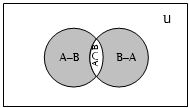
(a) From Venn-Euler's diagram,
$\therefore (A - B)\, \cup (B - A) \cup (A \cap B) = A \cup B$.
View full question & answer→MCQ 971 Mark
If $n(A) = 3$, $n(B) = 6$ and $A \subseteq B$. Then the number of elements in $A \cup B$ is equal to
Answerc
(c) Since $A \subseteq B,\,\,\,\therefore A \cup B = B$
So, $n(A \cup B) = n(B) = 6$.
View full question & answer→MCQ 981 Mark
Let $A$ and $B$ be two sets such that $n(A) = 0.16,\,n(B) = 0.14,\,n(A \cup B) = 0.25$. Then $n(A \cap B)$ is equal to
AnswerCorrect option: C. $0.05$
c
(c) $n(A \cup B) = n(A) + n(B) - n(A \cap B)$
$0.25 = 0.16 + 0.14 - n(A \cap B)$
==> $n(A \cap B) = 0.30 - 0.25 = 0.05$.
View full question & answer→MCQ 991 Mark
If $A$ and $B$ are disjoint, then $n(A \cup B)$ is equal to
- A
$n(A)$
- B
$n(B)$
- ✓
$n(A) + n(B)$
- D
$n(A)\,.\,n(B)$
AnswerCorrect option: C. $n(A) + n(B)$
c
(c) Since $A$ and $B$ are disjoint, $\therefore A \cap B = \phi $
$n(A \cap B) = 0$
Now $n\,(A \cup B) = n(A) + n(B) - n(A \cap B)$
$ = n(A) + n(B) - 0$$ = n(A) + n(B)$.
View full question & answer→MCQ 1001 Mark
If $A$ and $B$ are not disjoint sets, then $n(A \cup B)$ is equal to
AnswerCorrect option: B. $n(A) + n(B) - n(A \cap B)$
b
(b) $n(A \cup B) = n(A) + n\,(B) - n(A \cap B)$.
View full question & answer→MCQ 1011 Mark
Let $A$ and $B$ be subsets of a set $X$. Then
- A
$A - B = A \cup B$
- B
$A - B = A \cap B$
- C
$A - B = {A^c} \cap B$
- ✓
$A - B = A \cap {B^c}$
AnswerCorrect option: D. $A - B = A \cap {B^c}$
d
(d) $A - B = \{ x:x \in A$ and $x\not \in B\} $
$ = \{ x:x \in A $ and $x \in {B^c}\} = A \cap {B^c}$.
View full question & answer→MCQ 1021 Mark
Let $A$ and $B$ be two sets in the universal set. Then $A - B$ equals
- ✓
$A \cap {B^c}$
- B
${A^c} \cap B$
- C
$A \cap B$
- D
AnswerCorrect option: A. $A \cap {B^c}$
View full question & answer→MCQ 1031 Mark
If $A, B$ and $C$ are any three sets, then $A - (B \cap C)$ is equal to
- ✓
$(A - B) \cup (A - C)$
- B
$(A - B) \cap (A - C)$
- C
$(A - B) \cup C$
- D
$(A - B) \cap C$
AnswerCorrect option: A. $(A - B) \cup (A - C)$
a
(a) From De’ morgan’s law, $A - (B \cap C) = (A - B) \cup (A - C)$.
View full question & answer→MCQ 1041 Mark
If $A, B, C$ are three sets, then $A \cap (B \cup C)$ is equal to
- A
$(A \cup B) \cap (A - C)$
- ✓
$(A \cap B) \cup (A \cap C)$
- C
$(A \cup B) \cup (A \cup C)$
- D
AnswerCorrect option: B. $(A \cap B) \cup (A \cap C)$
b
(b) From Distributive law, $A \cap (B \cup C) = (A \cap B) \cup (A \cap C)$.
View full question & answer→MCQ 1051 Mark
If $A = \{1, 2, 3, 4, 5\}, B = \{2, 4, 6\}, C = \{3, 4, 6\},$ then $(A \cup B) \cap C$ is
- ✓
$\{3, 4, 6\}$
- B
$\{1, 2, 3\}$
- C
$\{1, 4, 3\}$
- D
AnswerCorrect option: A. $\{3, 4, 6\}$
a
(a) $A \cup B = \{ 1,\,2,\,3,\,4,\,5,\,6\} $
$\therefore (A \cup B) \cap C = \{ 3,\,4,\,6\} $.
View full question & answer→MCQ 1061 Mark
Consider the following relations :
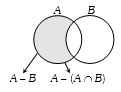
$(1) \,\,\,A - B = A - (A \cap B)$
$(2) \,\,\,A = (A \cap B) \cup (A - B)$
$(3) \,\,\,A - (B \cup C) = (A - B) \cup (A - C)$
which of these is/are correct
- A
$1$ and $3$
- B
$2$ only
- C
$2$ and $3$
- ✓
$1$ and $2$
AnswerCorrect option: D. $1$ and $2$
d
(d) $A - B = A - (A \cap B)$ is correct.
$A = (A \cap B) \cup (A - B)$ is correct.
$(3)$ is false.
$\therefore (1)$ and $(2)$ are true.
View full question & answer→MCQ 1071 Mark
If $n(A) = 3$ and $n(B) = 6$ and $A \subseteq B$. Then the number of elements in $A \cap B$ is equal to
Answera
(a) Since $A \subseteq B,$ $\therefore$ $A \cap B = A$
$\therefore$ $n\,(A \cap B) = n(A) = 3$.
View full question & answer→MCQ 1081 Mark
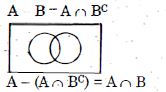
$A-(A-B)$ is
- A
$A \cup B$
- ✓
$A \cap B$
- C
$A \cap {B^c}$
- D
${A^c} \cap B$
AnswerCorrect option: B. $A \cap B$
b
View full question & answer→MCQ 1091 Mark
If $A$ and $B$ are two given sets, then $A \cap {(A \cap B)^c}$ is equal to
- A
$A$
- B
$B$
- C
$\phi $
- ✓
$A \cap {B^c}$
AnswerCorrect option: D. $A \cap {B^c}$
d
(d) $A \cap {(A \cap B)^c} = A \cap ({A^c} \cup {B^c})$
= $(A \cap {A^c}) \cup (A \cap {B^c})$ = $\phi \cup (A \cap {B^c}) = A \cap {B^c}$.
View full question & answer→MCQ 1101 Mark
Let $U = \{ 1,\,2,\,3,\,4,\,5,\,6,\,7,\,8,\,9,\,10\} $, $A = \{ 1,\,2,\,5\} ,\,B = \{ 6,\,7\} $, then $A \cap B'$ is
Answerb
(b) $B' = \{ 1,\,2,\,3,\,4,\,5,\,8\,,9,\,10\} $
$\therefore A \cap B' = \{ 1,\,2,\,5\} \cap \{ 1,\,2,\,3,\,4,\,5,\,8,\,9,\,10\} = \{ 1,\,2,\,5\} = A$
View full question & answer→MCQ 1111 Mark
If $A$ is any set, then
- A
$A \cup A' = \phi $
- ✓
$A \cup A' = U$
- C
$A \cap A' = U$
- D
AnswerCorrect option: B. $A \cup A' = U$
View full question & answer→MCQ 1121 Mark
If $A$ and $B$ be any two sets, then $(A \cap B)'$ is equal to
- A
$A' \cap {\rm B}'$
- ✓
$A' \cup B'$
- C
$A \cap B$
- D
$A \cup B$
AnswerCorrect option: B. $A' \cup B'$
b
(b) From De’ morgan’s law, $(A \cap B)' = A' \cup B'$.
View full question & answer→MCQ 1131 Mark
Given $n(U) = 20$, $n(A) = 12$, $n(B) = 9$, $n(A \cap B) = 4$, where $U$ is the universal set, $A$ and $B$ are subsets of $U$, then $n({(A \cup B)^C}) = $
Answerd
(d) $n(A \cup B) = n(A) + n(B) - n(A \cap B) = 12 + 9 - 4 = 17$
Now, $n({(A \cup B)^C}) = n(U) - n(A \cup B) = 20 - 17 = 3$.
View full question & answer→MCQ 1141 Mark
Which of the following statement is false (where $A$ $\&$ $B$ are two non empty sets)
- A
$A - B = A \cap B'$
- B
$A - B = A - (A \cap B)$
- ✓
$A - B = A - B'$
- D
$A - B = (A \cup B) - B$
AnswerCorrect option: C. $A - B = A - B'$
c
$A \cap B' = A - (A \cap B)$
$A \cap B' = (A \cup B) - B$
View full question & answer→MCQ 1151 Mark
If $A = \{x, y\}$ then the power set of $A$ is
- A
$\{ {x^x},\,{y^y}\} $
- B
$\{ \phi,x, y\}$
- C
$\{\phi, {x}, {2y}\}$
- ✓
$\{\phi, x, y, \{ x, y \} \}$
AnswerCorrect option: D. $\{\phi, x, y, \{ x, y \} \}$
d
The power set is all possible subsets of a set.
Thus power set of $A =\{ x , y \}$ is $\{\phi, x , y ,\{ x , y \}\}$
View full question & answer→MCQ 1161 Mark
In a city $20$ percent of the population travels by car, $50$ percent travels by bus and $10$ percent travels by both car and bus. Then persons travelling by car or bus is......$\%$
Answerc
(c) $n(C) = 20, n(B) = 50, n(C \cap B) = 10 $
Now $n(C \cup B) = n(C) + n(B) -n(C \cap B) $
$= 20 + 50 -10 = 60.$
Hence, required number of persons $= 60\%.$
View full question & answer→MCQ 1171 Mark
$20$ teachers of a school either teach mathematics or physics. $12$ of them teach mathematics while $4$ teach both the subjects. Then the number of teachers teaching physics is
Answera
(a) Let $n\,(P)$= Number of teachers in Physics.
$n\,(M)$= Number of teachers in Maths
$n\,(P \cup M) = n(P) + n\,(M) - n\,(P \cap M)$
$20 = n\,(P) + 12 - 4$ ==> $n\,(P) = 12$.
View full question & answer→MCQ 1181 Mark
In a class of $100$ students, $55$ students have passed in Mathematics and $67$ students have passed in Physics. Then the number of students who have passed in Physics only is
Answerd
(d) $n\,(M) = 55,n\,(P) = 67,n\,(M \cup P) = 100$
Now, $n\,(M \cup P) = n\,(M) + n\,(P) - n\,(M \cap P)$
$100 = 55 + 67 - n\,(M \cap P)$
$\therefore n\,(M \cap P) = 122 - 100 = 22$
Now $n$ ($P$ only) =$n\,(P) - n(M \cap P)$$ = 67 - 22 = 45$.
View full question & answer→MCQ 1191 Mark
The number of elements in the set $\{ (a,\,b):2{a^2} + 3{b^2} = 35,\;a,\,b \in Z\} $, where $Z$ is the set of all integers, is
Answerc
(c) Given set is $\{ (a,\,b):2{a^2} + 3{b^2} = 35,\;a,\,b \in Z\} $
We can see that, $2{( \pm 2)^2} + 3{( \pm 3)^2} = 35$ and $2{( \pm 4)^2} + 3{( \pm 1)^2} = 35$
$ \therefore (2, 3), (2, -3), (-2, -3), (-2, 3), (4, 1), (4, -1),$
$(-4, -1), (-4, 1)$ are $8$ elements of the set.
$ \therefore n = 8$.
View full question & answer→MCQ 1201 Mark
$A$ and $B$ are two subsets of set $S$ = $\{1,2,3,4\}$ such that $A\ \cup \ B$ = $S$ , then number of ordered pair of $(A, B)$ is
View full question & answer→MCQ 1211 Mark
Let $A = \{x:x \in R,\,|x|\, < 1\}\,;$ $B = \{x:x \in R,\,|x - 1| \ge 1\}$ and $A \cup B = R - D,$then the set $D$ is
- A
$\{x:1 < x \le 2\}$
- ✓
$\{x:1 \le x < 2\}$
- C
$\{x:1 \le x \le 2\}$
- D
AnswerCorrect option: B. $\{x:1 \le x < 2\}$
b
(b) $A = [x:x \in R,\, - 1 < x < 1]$
$B = [x:x \in R:x - 1 \le - 1$ or $x - 1 \ge 1]$
= $[x:x \in R:x \le 0{\rm{ or }}x \ge 2]$
$\therefore A \cup B = R - D$, where $D = [x:x \in R,\,1 \le x < 2]$.
View full question & answer→MCQ 1221 Mark
If $X = \{ {4^n} - 3n - 1:n \in N\} $ and $Y = \{ 9(n - 1):n \in N\} ,$ then $X \cup Y$ is equal to
Answerb
(b) Since, ${4^n} - 3n - 1 = {(3 + 1)^n} - 3n - 1$
$ = {3^n}{ + ^n}{C_1}{3^{n - 1}}{ + ^n}{C_2}{3^{n - 2}} + .....{ + ^n}{C_{n - 1}}3{ + ^n}{C_n} - 3n - 1$
(${ = ^n}{C_0}={ ^n}{C_n},{^n}{C_1}$ = ${^n}{C_{n - 1}}$ etc.)
$ = 9{[^n}{C_2}{ + ^n}{C_3}(3) + .....{ + ^n}{C_n}{3^{n - 1}}]$
${4^n} - 3n - 1$ is a multiple of $9$ for $n \ge 2$.
For $n = 1,$ ${4^n} - 3n - 1$ = $4 - 3 - 1 = 0$,
For $n = 2,$ ${4^n} - 3n - 1$= $16 - 6 - 1 = 9$
${4^n} - 3n - 1$ is a multiple of $9$ for all $n \in N$
$X$ contains elements, which are multiples of $9$, and clearly $Y$ contains all multiples of $9$.
$X \subseteq Y$ i.e., $X \cup Y = Y$.
View full question & answer→MCQ 1231 Mark
If $X = \{ {8^n} - 7n - 1:n \in N\} $ and $Y = \{ 49(n - 1):n \in N\} ,$ then
- ✓
$X \subseteq Y$
- B
$Y \subseteq X$
- C
$X = Y$
- D
AnswerCorrect option: A. $X \subseteq Y$
a
(a) Since ${8^n} - 7n - 1 = {(7 + 1)^n} - 7n - 1$
$ = {7^n}{ + ^n}{C_1}{7^{n - 1}}{ + ^n}{C_2}{7^{n - 2}} + .....{ + ^n}{C_{n - 1}}7{ + ^n}{C_n} - 7n - 1$
${ = ^n}{C_2}{7^2}{ + ^n}{C_3}{7^3} + ..{ + ^n}{C_n}{7^n}$,${(^n}{C_0}{ = ^n}{C_n},{\,^n}{C_1}{ = ^n}{C_{n - 1}}\,{\rm{etc}}{\rm{.)}}$
$ = 49{[^n}{C_2}{ + ^n}{C_3}(7) + ......{ + ^n}{C_n}{7^{n - 2}}]$
$\therefore$ ${8^n} - 7n - 1$ is a multiple of $49$ for $n \ge 2$
For $n = 1$, ${8^n} - 7n - 1 = 8 - 7 - 1 = 0$;
For $n = 2,$ ${8^n} - 7n - 1 = 64 - 14 - 1 = 49$
$\therefore$ ${8^n} - 7n - 1$ is a multiple of $49$ for all $n \in N.$
$\therefore $ $X$ contains elements which are multiples of $49$ and clearly $Y$ contains all multiplies of $49$. $X \subseteq Y$.
View full question & answer→MCQ 1241 Mark
Suppose ${A_1},\,{A_2},\,{A_3},........,{A_{30}}$ are thirty sets each having $5$ elements and ${B_1},\,{B_2}, ......., B_n$ are $n$ sets each with $3$ elements. Let $\bigcup\limits_{i = 1}^{30} {{A_i}} = \bigcup\limits_{j = 1}^n {{B_j}} = S$ and each elements of $S$ belongs to exactly $10$ of the $A_i's$ and exactly $9$ of the $B_j's$. Then $n$ is equal to
Answerc
(c) $O(S)$ = $O\left( {\bigcup\limits_{i = 1}^{30} {{A_i}} } \right) = \frac{1}{{10}}(5 \times 30) = 15$
Since, element in the union $S$ belongs to $10$ of $Ai$' s
Also, $O(S)$ = $O\left( {\bigcup\limits_{j\, = 1}^n {{B_j}} } \right) = \frac{{3n}}{9} = \frac{n}{3}$,
$\therefore$ $\frac{n}{3} = 15 \Rightarrow n = 45$.
View full question & answer→MCQ 1251 Mark
In a battle $70\%$ of the combatants lost one eye, $80\%$ an ear, $75\%$ an arm, $85\%$ a leg, $x\%$ lost all the four limbs. The minimum value of $x$ is
Answera
(a) Minimum value of $n=100-(30+20+25+15)$
$ = 100 - 90 = 10$.
View full question & answer→MCQ 1261 Mark
Out of $800$ boys in a school, $224$ played cricket, $240$ played hockey and $336$ played basketball. Of the total, $64$ played both basketball and hockey; $80$ played cricket and basketball and $40$ played cricket and hockey; $24$ played all the three games. The number of boys who did not play any game is
Answerd
(d) $n\,(C) = 224,\,n\,(H) = 240,n\,(B) = 336$
$n\,(H \cap B) = 64,\,\,n(B \cap C) = 80$
$n(H \cap C) = 40$, $n(C \cap H \cap B) = 24$
$n\,({C^c} \cap {H^c} \cap {B^C}) = n\,[{(C \cup H \cup B)^c}]$
$ = n( \cup ) - n(C \cup H \cup B)$
$ = 800 - [n(C) + n(H) + n(B) - n(H \cap C)$
$ - n(H \cap B) - n(C \cap B) + n(C \cap H \cap B)]$
$ = 800 - [224 + 240 + 336 - 64 - 80 - 40 + 24]$
$ = 800 - 640 = 160$.
View full question & answer→MCQ 1271 Mark
A survey shows that $63\%$ of the Americans like cheese whereas $76\%$ like apples. If $x\%$ of the Americans like both cheese and apples, then
- A
$x = 39$
- B
$x = 63$
- ✓
$39 \le x \le 63$
- D
AnswerCorrect option: C. $39 \le x \le 63$
c
(c) Let $A$ denote the set of Americans who like cheese and let $B$ denote the set of Americans who like apples.
Let Population of American be $100$.
Then $n\,(A) = 63,n\,(B) = 76$
Now, $n\,(A \cup B) = n(A) + n(B) - n(A \cap B)$
$ = 63 + 76 - n(A \cap B)$
$\therefore n\,(A \cup B) + n(A \cap B) = 139$
==> $n\,(A \cap B) = 139 - n(A \cup B)$
But $n\,(A \cup B) \le 100$
$\therefore - n\,(A \cup B) \ge - 100$
$\therefore 139 - n\,(A \cup B) \ge 139 - 100 = 39$
$\therefore n(A \cap B) \ge 39$ i.e., $39 \le n(A \cap B)$.....(i)
Again, $A \cap B \subseteq A,A \cap B \subseteq B$
$ \therefore n\,(A \cap B) \le n\,(A) = 63$ and $n\,(A \cap B) \le n\,(B) = 76$
$\therefore n(A \cap B) \le 63$…..(ii)
Then, $39 \le n\,(A \cap B) \le 63$ ==> $39 \le x \le 63$.
View full question & answer→MCQ 1281 Mark
In a certain town $25\%$ families own a phone and $15\%$ own a car, $65\%$ families own neither a phone nor a car. $2000$ families own both a car and a phone. Consider the following statements in this regard:
$1$. $10\%$ families own both a car and a phone
$2$. $35\%$ families own either a car or a phone
$3$. $40,000$ families live in the town
Which of the above statements are correct
- A
$1$ and $2$
- B
$1$ and $3$
- ✓
$2$ and $3$
- D
$1, 2$ and $3$
AnswerCorrect option: C. $2$ and $3$
c
(c) $n(P) = 25\% ,\,\,n(C) = 15\% $
$n\,({P^c} \cap {C^c}) = 65\% ,\,\,n(P \cap C) = 2000$
Since, $n\,({P^c} \cap {C^c}) = 65\% $
$\therefore$ $n\,{(P \cup C)^c} = 65\% $ and $n(P \cup C) = 35\% $
Now, $n(P \cup C) = n(P) + n(C) - n(P \cap C)$
$35 = 25 + 15 - n(P \cap C)$
$\therefore$ $n(P \cap C) = 40 - 35 = 5$. Thus $n\,(P \cap C) = 5\% $
But $n\,(P \cap C) = 2000$
$\therefore$ Total number of families $ = \frac{{2000 \times 100}}{5} = 40,000$
Since, $n(P \cup C) = 35\% $
and total number of families = $40,000$
and $n(P \cap C) = 5\% $. $\therefore$ $(2)$ and $(3)$ are correct.
View full question & answer→MCQ 1291 Mark
If $A, B$ and $C$ are three sets such that $A \cap B = A \cap C$ and $A \cup B = A \cup C$ then
AnswerCorrect option: B. $B = C$
b
$A \cup B=A \cup C$
$\Rightarrow n(A \cup B)=n(A \cup C)$
$\Rightarrow n(A)+n(B)-n(A \cap B)$
$=n(A)+n(C)-n(A \cap C)$
View full question & answer→MCQ 1301 Mark
If $A$ and $B$ are any two non empty sets and $A$ is proper subset of $B$. If $n(A) = 4$, then minimum possible value of $n(A \Delta B)$ is (where $\Delta$ denotes symmetric difference of set $A$ and set $B$)
Answerb
As $A \subset B \Rightarrow A-B=0$
$B-A \geq 1$
$n(A \Delta B)=n((A-B) \cup(B-A)) \geq 1$
minimum value $=1$
View full question & answer→MCQ 1311 Mark
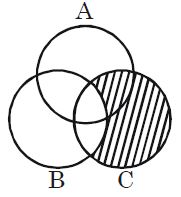
The shaded region in given figure is-
- A
$A \cap B\cup C$
- B
$C-(A \cap B)$
- ✓
$C-(B \cap C)$
- D
$C-(A \cup B)$
AnswerCorrect option: C. $C-(B \cap C)$
View full question & answer→MCQ 1321 Mark
$2n (A / B) = n (B / A)$ and $5n (A \cap B) = n (A) + 3n (B) $, where $P/Q = P \cap Q^C$ . If $n (A \cup B) \leq 10$ , then the value of $\frac{{n\ (A).n\ (B).n\ (A\ \cap\ B)}}{8}$ is
Answera
$2(\mathrm{n}(\mathrm{A})-\mathrm{n}(\mathrm{AB}))=\mathrm{n}(\mathrm{B})-\mathrm{n}(\mathrm{AB})$
$2 n(A)-n(B)=n(A B)$
$\mathrm{n}(\mathrm{A})+3 \mathrm{n}(\mathrm{B})=5 \mathrm{n}(\mathrm{AB})$
$\Rightarrow \mathrm{n}(\mathrm{A})+3 \mathrm{n}(\mathrm{B})=10 \mathrm{n}(\mathrm{A})-5 \mathrm{n}(\mathrm{B})$
$8 n(\mathrm{B})=9 \mathrm{n}(\mathrm{A})$
$\frac{\mathrm{n}(\mathrm{A})}{\mathrm{n}(\mathrm{B})}=\frac{8}{9}$
$\mathrm{n}(\mathrm{A})=8 \mathrm{k} ; \mathrm{n}(\mathrm{B})=9 \mathrm{k}$
$\Rightarrow \mathrm{n}(\mathrm{AB})=7 \mathrm{k}$
$\mathrm{n}(\mathrm{A} \cup \mathrm{B})=10 \mathrm{k} \leq 10$
$\mathrm{k}=1$
View full question & answer→