MCQ
If a charged particle kept at rest experiences an electromagnetic force:
  • A
    The electric field must not be zero.
  • B
    The magnetic field must not be zero.
  • C
    The magnetic field may or may not be zero.
  • A and C both

Answer

Correct option: D.
A and C both
Explanation:
Since particle is at rest, i.e. v=0, hence Fm=0
For electric force, E≠0

Need a full question paper?

Generate a complete, print-ready paper with questions like this in minutes — across 16+ boards, with answer keys.
Start Generating Free

Similar questions

When a positive q charge is taken from lower potential to a higher potential point, then its potential energy will
Imagine a world where free magnetic charges exist. In this world, a circuit is made with a $U$-shape wire and a rod free to slide on it. A current carried by free magnetic charges can flow in the circuit. When the circuit is placed in a uniform electric field $E$ perpendicular to the plane of the circuit and the rod is pulled to the right with a constant speed $v$, the magnetic emf in the current and the direction of the corresponding current, arising because of changing electric flux will be ( $l$ is the length of the rod and $c$ is speed of light)
A train is moving with a speed of $30\, m \,s^{-1}$ in north-south direction on the rails  separated by $2 \,m$. If the vertical component of earth’s field is $8 \times 10^{-5} \,T$, the $e.m.f.$ is
The work function for photoelectric effect:
Diameter of a plano-convex lens is $6\ cm$ and thickness at the centre is $3\  mm$. If speed of light in material of lens is $2 × 10^8\  m/s$, the focal length of the lens is.......$cm$
Ten identical cells connected in series are needed to heat a wire of length one meter and radius $‘r’$ by $10^\circ C$ in time $‘t’.$ How many cells will be required to heat the wire of length two meter of the same radius by the same temperature in time $‘t’$?
A constant voltage is applied between the two ends of a uniform metallic wire. Some heat is developed in it. The heat developed is doubled if.
An uncharged capacitor is connected to a battery. On charging the capacitor
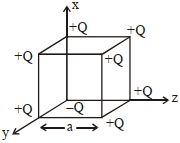
A cube of side $'a'$ has point charges $+Q$ located at each of its vertices except at the origin where the charge is $- Q$. The electric field at the centre of cube is
Consider a planet in some solar system which has a mass double the mass of the earth and density equal to the average density of the earth. An object weighing $W$ on the earth will weight.