Question
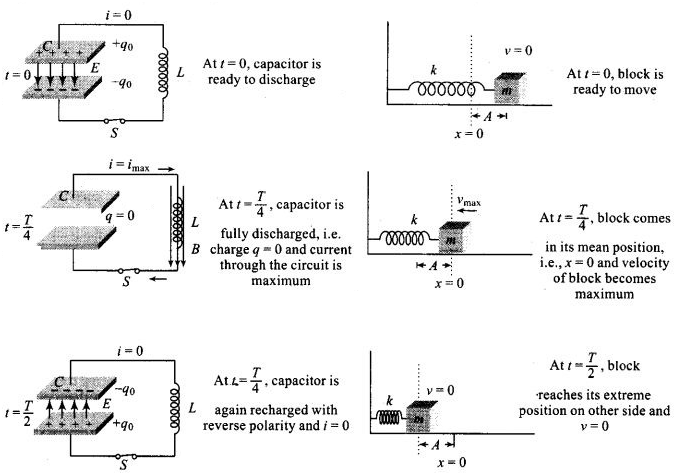
If a $LC$ circuit is considered analogous to a harmonically oscillating spring block system, which energy of the $LC$ circuit would be analogous to potential energy and which one analogous to kinetic energy?
Answer

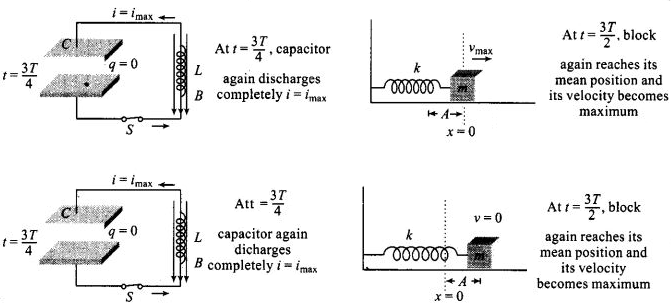
When a charged capacitor $C$ having an initial charge $q_0$ is discharged through an inductance $L,$ the charge and current in the circuit start oscillating simple harmonically. If the resistance of the circuit is zero, no energy is dissipated as heat. We also assume an idealized situation in which energy is not radiated away from the circuit. The total energy associated with the circuit is constant.
The oscillation of the $LC$ circuit are an electromagnetic analog to the mechanical oscillation of a block$-$spring system.
The total energy of the system remains conserved.
$\frac{1}{2}\text{CV}^2+\frac{1}{2}\text{LI}^2=\text{Constant}=\frac{1}{2}\text{CV}^2_0=\frac{1}{2}\text{LI}^2_0$

Mass spring systerm
v/s
$LC$ circuit
Displacement $(x)$
 
Charge $(q)$
Velocity $(v)$
 
Current $(i)$
Acceleration $(a)$
 
Rate of change of current $\Big(\frac{\text{di}}{\text{dt}}\Big)$
Mass $(m) [$Inertia$]$
 
Inductance $(L) [$Inertia of electricity$]$
Momentum $(p = mv)$
 
Magnetic flux $(\phi=\text{Li})$
Retarding force $\Big(-\text{m}\frac{\text{dv}}{\text{dt}}\Big)$
 
Self induced emf $\Big(-\text{L}\frac{\text{di}}{\text{dt}}\Big)$
 
Equation of free oscillations:
$\frac{\text{d}^2\text{x}}{\text{dt}^2}=-\omega^2\text{x};$
where $\omega=\sqrt{\frac{\text{K}}{\text{m}}}$
 
Equation of free oscillations:
$\frac{\text{d}^2\text{q}}{\text{dt}^2}=-\Big(\frac{1}{\text{LC}}\Big).\text{q};\text{where }\omega^2=\frac{1}{\text{LC}}$
$\Rightarrow\ \omega=\frac{1}{\sqrt{\text{LC}}}$
Force constant $K$
 
Capacitance $C$
Kinetic energy $=\frac{1}{2}\text{mv}^2$
 
Magnetic energy $=\frac{1}{2}\text{Li}^2$
Elastic potential energy $=\frac{1}{2}\text{Kx}^2$
 
Elecrical potential energy $=\frac{1}{2}\frac{\text{q}^2}{\text{C}}$
If we consider an $L-C$ circuit analogous to a harmonically oscillating spring block system. The electrostatic energy $\frac{1}{2}\text{CV}^2$ is analogous to potential energy and energy associated with moving charges $($current$)$ that is magnetic energy $\Big(\frac{1}{2}\text{LI}^2\Big)$ is analogous to kinetic energy.

Need a full question paper?

Generate a complete, print-ready paper with questions like this in minutes — across 16+ boards, with answer keys.
Start Generating Free

Similar questions

Is the formula you employ in $(a)$ valid for calculating radius of the path of a $20 MeV$ electron beam? If not, in what way is it modified?
An empty plastic box of mass m is found to accelerate up at the rate of $\frac{\text{g}}{6}$ when placed deep inside water. How much sand should be put inside the box so that it may accelerate down at the rate of $\frac{\text{g}}{6}?$
1 litre of an ideal gas $(\gamma=1.5)$ at $300K$ is suddenly compressed to half its original volume.
  1. Find the ratio of the final pressure to the initial pressure.
  2. If the original pressure is $100kPa$, find the work done by the gas in the process.
  3. What is the change in internal energy?
  4. What is the final temperature?
  5. The gas is now cooled to $300K$ keeping its pressure constant. Calculate the work done during the process.
  6. The gas is now expanded isothermally to achieve its original volume of $1$ litre. Calculate the work done by the gas.
  7. Calculate the total work done in the cycle.
Consider a thin target $(10^{-2}m^2 ,  10^{-3}m$ thickness$)$ of sodium, which produces a photocurrent of $100\mu A$ when a light of intensity $100W/m^2 (\lambda = 660nm)$ falls on it. Find the probability that a photoelectron is produced when a photons strikes a sodium atom. $[$Take density of Na $= 0.97 \ kg/m^3].$
A wire of length l is bent in the form of an equilateral triangle and carries an electric currrent i.
  1. Find the magnetic field B at the centre.
  2. If the wire is bent in the form of a square, what would be the value of B at the centre?
Suppose all the electrons of $100g$ water are lumped together to form a negatively charged particle and all the nuclei are lumped together to form a positively charged particle. If these two particles are placed $10.0\ cm$ away from each other, find the force of attraction between them. Compare it with your weight.
Explain the function of base region of a transistor. Why is this region made thin and lightly doped?  Draw a circuit diagram to study the input and output characteristics of n-p-n transistor in a common emitter (CE) configuration. Show these characteristics graphically. Explain how current amplification factor of the transistor is calculated using output characteristics.
A rectangular metallic loop of length l and width b is placed coplanarly with a long wire carrying a current i. The loop is moved perpendicular to the wire with a speed v in the plane containing the wire and the loop. Calculate the emf induced in the loop when the rear end of the loop is at a distance a from the wire. Solve by using Faraday's law for the flux through the loop and also by replacing different segments with equivalent batteries.
Two masses $m_1$ and $m_2$ are connected by a spring of spring constant $k$ and are placed on a frictionless horizontal surface. Initially the spring is stretched through a distance $x_0$ when the system is released from rest. Find the distance moved by the two masses before they again come to rest.
Figure shows a potentiometer with a cell of $2.0 V$ and internal resistance $0.04\ \Omega$ maintaining a potential drop across the resistor wire $AB$. A standard cell which maintains a constant emf of $1.02 V ($for very moderate currents upto a few $mA)$ gives a balance point at $67.3 \ cm$ length of the wire. To ensure very low currents drawn from the standard cell, a very high resistance of $600\ \text{k}\Omega$ is put in series with it, which is shorted close to the balance point. The standard cell is then replaced by a cell of unknown emf $\varepsilon$ and the balance point found similarly, turns out to be at $82.3 \ cm$ length of the wire.
  1. What is the value $\varepsilon?$
  2. What purpose does the high resistance of $600\ \text{k}\Omega$ have?
  3. Is the balance point affected by this high resistance?
  4. Is the balance point affected by the internal resistance of the driver cell?
  5. Would the method work in the above situation if the driver cell of the potentiometer had an emf of $1.0 V$ instead of $2.0 V$?
  6. Would the circuit work well for determining an extremely small emf, say of the order of a few $mV ($such as the typical emf of a thermo$-$couple$)$? If not, how will you modify the circuit?