Question
A rectangular metallic loop of length l and width b is placed coplanarly with a long wire carrying a current i. The loop is moved perpendicular to the wire with a speed v in the plane containing the wire and the loop. Calculate the emf induced in the loop when the rear end of the loop is at a distance a from the wire. Solve by using Faraday's law for the flux through the loop and also by replacing different segments with equivalent batteries.
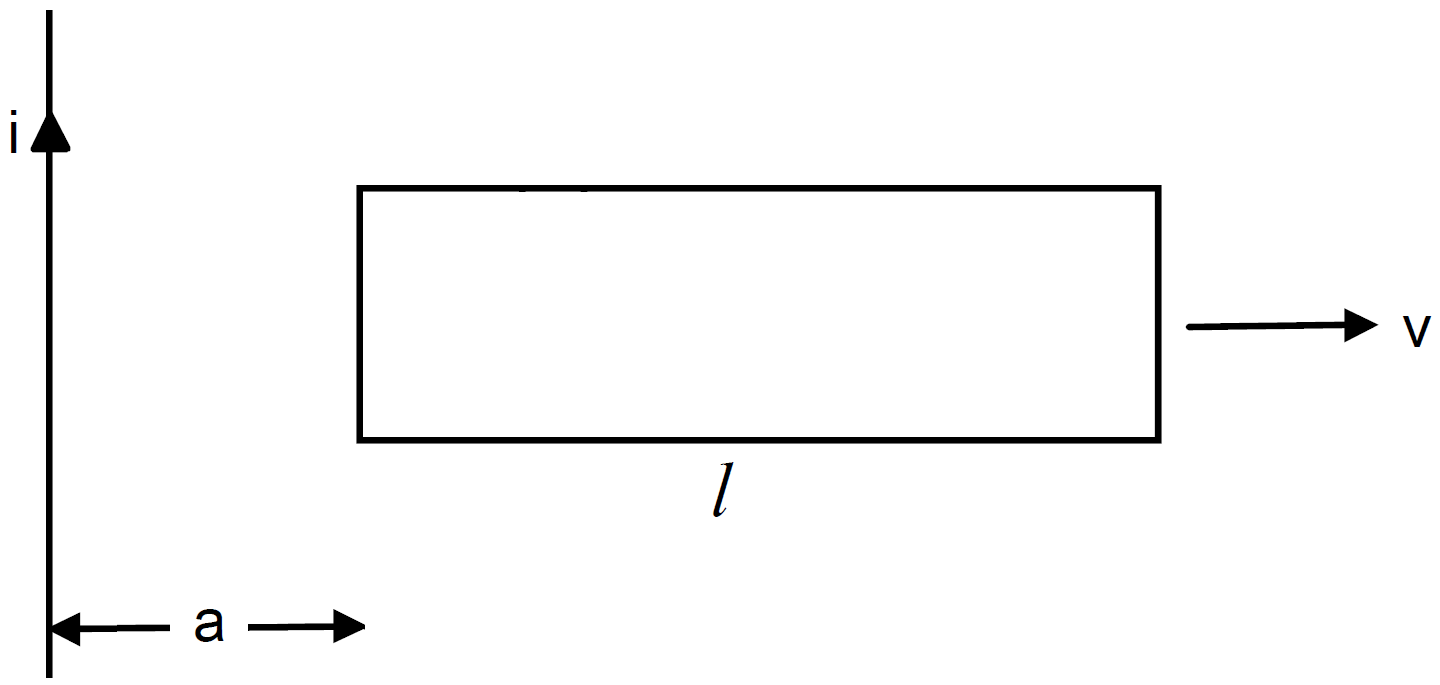
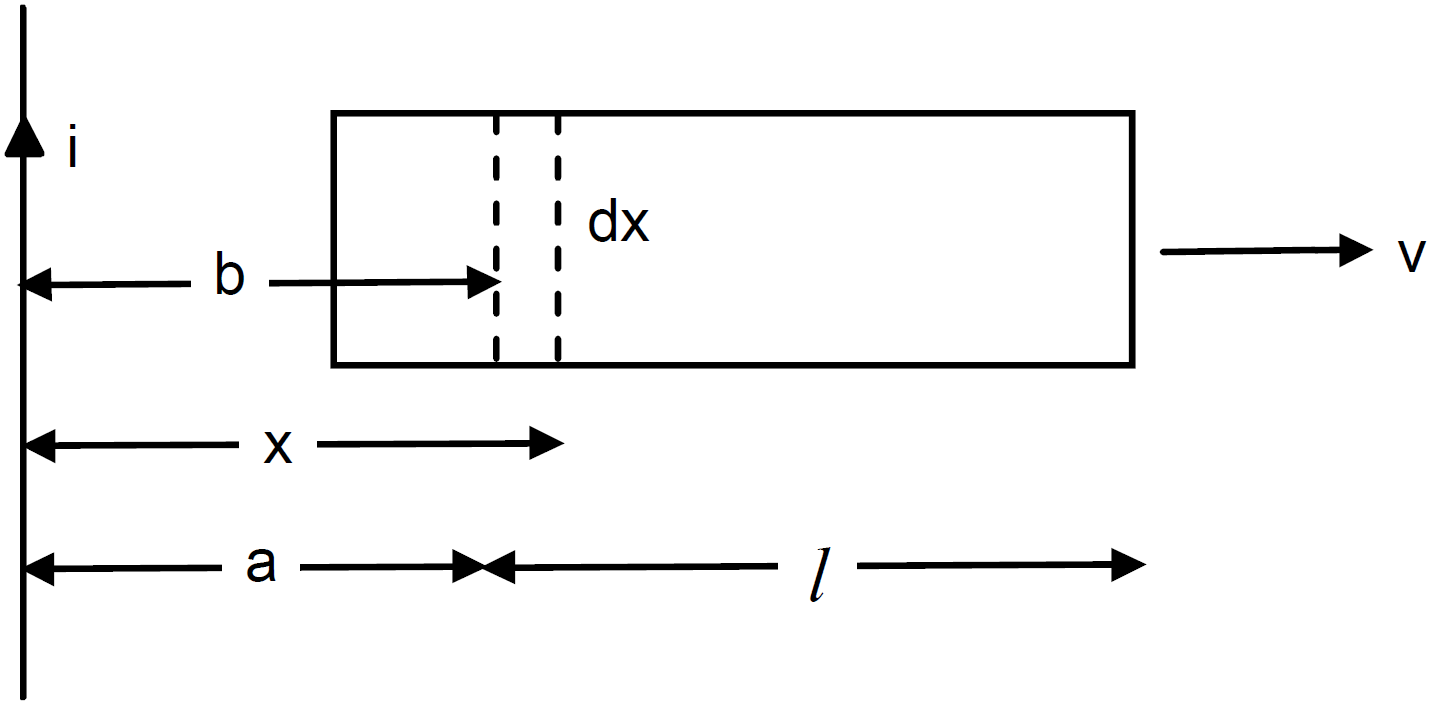 Using Faraday’' law Consider a unit length dx at a distance x $\text{B}=\frac{\mu_0\text{i}}{2\pi\text{x}}$ Area of strip $=\text{b} \ \text{dx}$ $\text{d}\phi=\frac{\mu_0\text{i}}{2\pi\text{x}}\text{dx}$ $\Rightarrow\phi=\int\limits^{\text{a}+1}_\text{a}\frac{\mu_0\text{i}}{2\pi\text{x}}\text{bdx}$ $=\frac{\mu_o\text{i}}{2\pi}\text{b}\int\limits^{\text{a}+1}_\text{a}\Big(\frac{\text{dx}}{\text{x}}\Big)=\frac{\mu_0\text{ib}}{2\pi}\log\Big(\frac{\text{a}+\text{l}}{\text{a}}\Big)$ $\text{Emf}=\frac{\text{d}\phi}{\text{dt}}=\text{dt}\Big[\frac{\mu_0\text{ib}}{2\pi}\text{log}\Big(\frac{\text{a}+\text{l}}{\text{a}}\Big)\Big]$ $=\frac{\mu_0\text{ib}}{2\pi}\frac{\text{a}}{\text{a}+\text{l}}\Big(\frac{\text{va}-(\text{a}+\text{l})\text{v}}{\text{a}^2}\Big)$ $\Big($ Where $\frac{\text{da}}{\text{dt}}=\text{V}\Big)$ $=\frac{\mu_0\text{ib}}{2\pi}\frac{\text{a}}{\text{a}+\text{l}}\frac{\text{vl}}{\text{a}^2}=\frac{\mu_0\text{ibvl}}{2\pi(\text{a}+\text{l})\text{a}}$ The velocity of AB and CD creates the emf. since the emf due to AD and BC are equal and opposite to each other.
 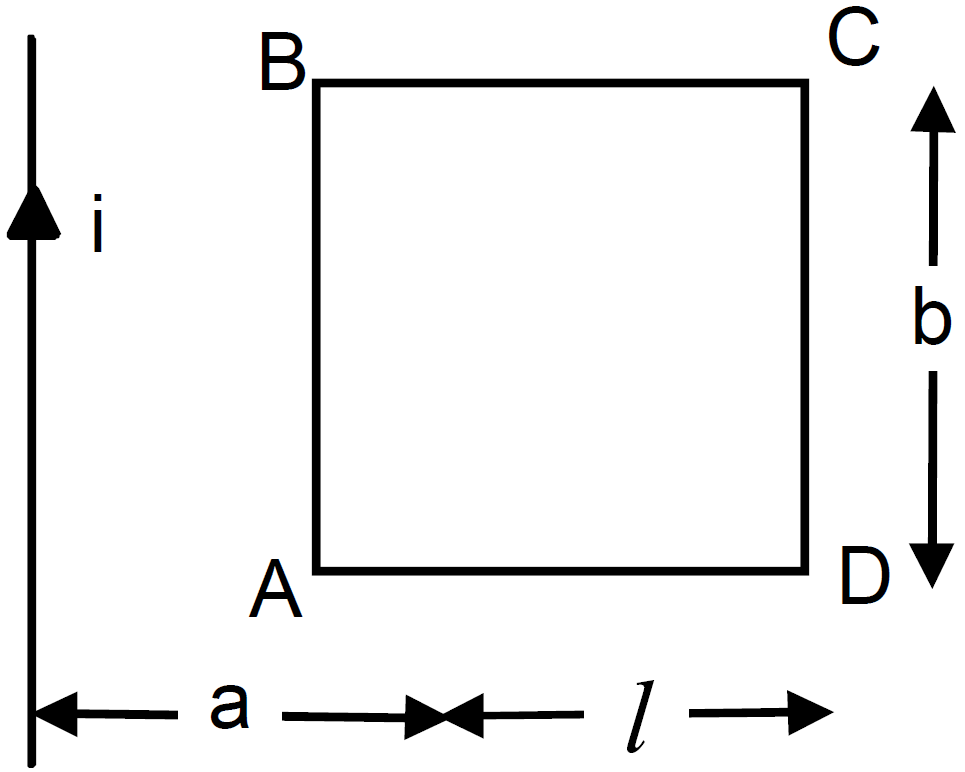 $\text{B}_{\text{AB}}=\frac{\mu_o\text{i}}{2\pi\text{a}} \ \Rightarrow \ \text{E.m.f.} \ \text{AB}=\frac{\mu_0\text{i}}{2\pi\text{a}}\text{bv}$ Length b, velocity v. $\text{B}_{\text{CD}}=\frac{\mu_0\text{i}}{2\pi(\text{a}+\text{l})}$ $\Rightarrow \text{E.m.f.} \ \text{CD}=\frac{\mu_0\text{ibv}}{2\pi(\text{a}+\text{l})}$ Length b, velocity v.Net emf $=\frac{\mu_0\text{i}}{2\pi\text{a}}\text{bv}-\frac{\mu_0\text{ibv}}{2\pi\text{a}(\text{a}+\text{l})}=\frac{\mu_0\text{ibvl}}{2\pi\text{a}(\text{a}+\text{l})}$