Question
If a line makes the angle $\alpha,\beta,\gamma$ with three dimensional coordinate axes respectively, then $\cos2\alpha+\cos2\beta+\cos2\gamma$ is equal to:

Answer

  1. -1
Solution:
We need to find value of $\cos2\alpha+\cos2\beta+\cos2\gamma$
It is further equal to $\cos^2\alpha-1+\cos^2\beta-1+\cos^2\gamma-1$
$=2\big(\cos^2\alpha+\cos^2\beta+\cos^2\gamma\big)-3$
$= 2(1) - 3 = 2 = -1$
$\therefore(\text{l}^2 + \text{m}^2 + \text{n}^2 = 1)$

Need a full question paper?

Generate a complete, print-ready paper with questions like this in minutes — across 16+ boards, with answer keys.
Start Generating Free

Similar questions

Choose the correct answers from the given four options:
If f(x) = 2x and $\text{g(x)}=\frac{\text{x}^2}{2}+1,$ then which of the following can be a discontinuous function:
  1. $\text{f(x)}+\text{g(x)}$
  2. $\text{f(x)}-\text{g(x)}$
  3. $\text{f(x)}\cdot\text{g(x)}$
  4. $\frac{\text{g(x)}}{\text{f(x)}}$
Let $\text{A}=\{\text{x}:-1\leq\text{x}\leq1\}$ and $f : A \rightarrow A$ such that $\text{f(x)}=\text{x}|\text{x}|,$ then $f$ is$:$
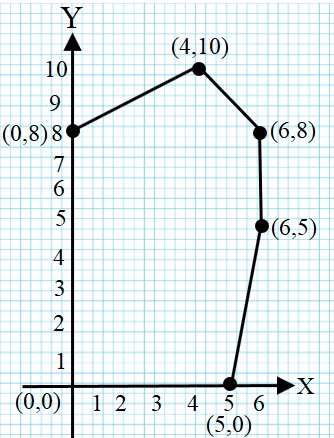
The feasible region for an LPP is shown below:
Let Z = 3x - 4y be the objective function. Minimum of Z occurs at
  1. (0, 0)
  2. (0, 8)
  3. (5, 0)
  4. (4, 10)
If $y=a x^2+b$, then $\frac{d y}{d x}$ at $x=2$ is equal to
If $\text{x}=\text{f}(\text{t})\cos\text{t}-\text{f}(\text{t})\sin\text{t}\ \text{and}\ \text{y}=\text{f}(\text{t})\sin\text{t}+\text{f}(\text{t})\cos\text{t},$ then $\Big(\frac{\text{dx}}{\text{dt}}\Big)^2+\Big(\frac{\text{dy}}{\text{dt}}\Big)^2=$
  1. $\text{f}(\text{t})-\text{f}(\text{t})$
  2. $\{\text{f}(\text{t})-\text{f}(\text{t})\}^2$
  3. $\{\text{f}(\text{t})+\text{f}(\text{t})\}^2$
  4. $\text{None of these}$
The maximum value of Z = 3x + 2y, subjected to $\text{x}+2\text{y}\leq2,\text{x}+2\text{y}\geq8;\text{x},\text{y}\geq0 $ is:
  1. 32
  2. 24
  3. 40
  4. None of these
Choose the correct option from given four options:
$\int\frac{\cos2\text{x}-\cos2\theta}{\cos\text{x}-\cos\theta}\text{dx}$ is equal to:
  1. $2(\sin+\text{x}\cos\theta)+\text{C}$
  2. $2(\sin-\text{x}\cos\theta)+\text{C}$
  3. $2(\sin+2\text{x}\cos\theta)+\text{C}$
  4. $2(\sin-2\text{x}\cos\theta)+\text{C}$
By graphical method solution of $\text{LLP}$ maximize $z = x + y$ subject to $x+y \leq 2 x ; y \geq 0$ obtained at
A box contain 100 pens of which 10 are defective. What is the probability that out of a sample of 5 pens draws one by one with replacement at most one is defective?
  1. $\big(\frac{9}{10}\big)^5$
  2. $\frac{1}{2}\big(\frac{9}{10}\big)^4$
  3. $\frac{1}{2}\big(\frac{9}{10}\big)^5$
  4. $\big(\frac{9}{10}\big)^5+\frac{1}{2}\big(\frac{9}{10}\big)^4$
If $\text{A} = \begin{bmatrix}\cos\alpha&-\sin\alpha\\ \sin\alpha&\cos\alpha\end{bmatrix},\text{then}\ \text{A + A}'=\text{I}$, if the value of a is:
  1. $\frac{\pi}{6}$
  2. $\frac{\pi}{3}$
  3. $\text{n}$
  4. $\frac{3\pi}{2}$