If a proton enters perpendicularly a magnetic field with velocity $v$, then time period of revolution is $T$. If proton enters with velocity $2 v$, then time period will be
Easy


Download our appand get started for free
Experience the future of education. Simply download our apps or reach out to us for more information. Let's shape the future of learning together!No signup needed.*
Similar Questions
- 1Two $10 \; cm$ long, straight wires, each carrying a current of $5 \; A$ are kept parallel to each other. If each wire experienced a force of $10^{-5} \; N$, then separation between the wires is $\dots \; cm$.View Solution
- 2Two parallel wires in free space are $10\, cm$ apart and each carries a current of $10\, A$ in the same direction. The force one wire exerts on the other per metre of length isView Solution
- 3A particle of specific charge $(q/m)$ is projected from the origin of coordinates with initial velocity $[ui - vj]$. Uniform electric magnetic fields exist in the region along the $+y$ direction, of magnitude $E$ and $B.$ The particle will definitely return to the origin once ifView Solution
- 4View SolutionIn a current carrying long solenoid, the field produced does not depend upon
- 5Two wires each carrying a steady current $I$ are shown in four configurations in Column $I$. Some of the resulting effects are described in Column $II$. Match the statements in Column $I$ with the statements in Column $II$ and indicate your answer by darkening appropriate bubbles in the $4 \times 4$ matrix given in the $ORS$.View Solution
Column $I$ Column $II$ $(A)$ Point $P$ is situated midway between the wires. $Image$ $(p)$ The magnetic fields $(B)$ at $P$ due to the currents in the wires are in the same direction. $(B)$ Point $P$ is situated at the mid-point of the line joining the centers of the circular wires, which have same radii. $Image$ $(q)$ The magnetic fields $(B)$ at $P$ due to the currents in the wires are in opposite directions. $(C)$ Point $P$ is situated at the mid-point of the line joining the centers of the circular wires, which have same radii. $Image$ $(r)$ There is no magnetic field at $P$. $(D)$ Point $P$ is situated at the common center of the wires. $Image$ $(s)$ The wires repel each other. 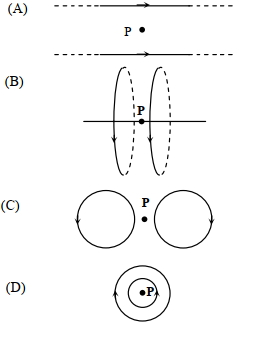
- 6A moving coil galvanometer has a resistance of $50\,\Omega $ and gives full scale deflection for $10\, mA$. How could it be converted into an ammeter with a full scale deflection for $1\,A$View Solution
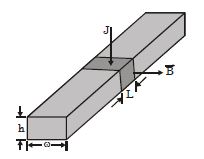
- 7Heart-lung machines and artifical kidney machines employ blood pumps. A mechanical pump can mangle blood cells.Figure represents an electromagnetic pump. The blood is confined to an electrically insulating tube, represented as a rectangle of width $\omega$ and height $h.$ Two electrodes fit into the top and the bottom of the tube. The potential difference between them establishes an electric current through the blood, with current density $J$ over a section of length $L.$ A perpendicular magnetic field exists in the same region. The section of liquid in the magnetic field experiences a pressure increase given by :-View Solution
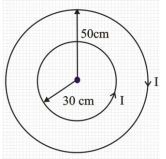
- 8Two concentric circular loops of radii $r _{1}=30\,cm$ and $r_{2}=50\,cm$ are placed in $X - Y$ plane as shown in the figure. $A$ current $I=7\,A$ is flowing through them in the direction as shown in figure. The net magnetic moment of this system of two circular loops is approximately.View Solution
- 9View SolutionWhen a magnetic field is applied in a direction perpendicular to the direction of cathode rays, then their
- 10The magnetic field at the centre of a circular coil of radius $I$, due to current I flowing through it, is $B$. The magnetic field at a point along the axis at a distance $\frac{r}{2}$ from the centre isView Solution