MCQ
If a soap bubble expands, the pressure inside the bubble:
  • A
    increases
  • B
    remains the same
  • C
    is equal to the atmospheric pressure
  • decreases

Answer

Correct option: D.
decreases
d
$P=P_{0}+\frac{4 T}{R}$

$\Rightarrow R$ increases and $P$ decreases

Need a full question paper?

Generate a complete, print-ready paper with questions like this in minutes — across 16+ boards, with answer keys.
Start Generating Free

Similar questions

A mass $m$ is moving with a constant velocity along a line parallel to the $x-$axis away from the origin. Its angular momentum w.r.t. the origin is:
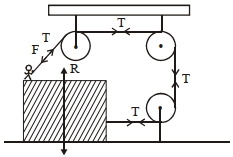
A boy of mass $4\, kg$ is standing on a piece of wood having mass $5 \,kg$. If the coefficient of friction between the wood and the floor is $0.5,$ the maximum force that the boy can exert on the rope so that the piece of wood does not move from its place is ......$N.$(Round off to the Nearest Integer) [Take $g=10 \,ms ^{-2}$ ]
A stone of mass $m$ is tied to a string and is moved in a vertical circle of radius $r$ making $n$ revolutions per minute. The total tension in the string when the stone is at its lowest point is 
A tuning fork with frequency $800 \;\mathrm{Hz}$ produces resonance in a resonance column tube with upper end open and lower end closed by water surface. Surface. Successive resonance are observed at length $9.75 \;\mathrm{cm}, 31.25\; \mathrm{cm}$ and $52.75\; \mathrm{cm} .$ The speed of sound in air is ......$m/s$
Three particles, located initially on the vertices of an equilateral triangle of side $L,$ start moving with a constant tangential acceleration towards each other in a cyclic manner, forming spiral loci that coverage at the centroid of the triangle. The length of one such spiral locus will be
The superposing waves are represented by the following equations :${y_1} = 5\sin 2\pi (10\,t - 0.1x)$, ${y_2} = 10\sin 2\pi (20\,t - 0.2x)$ Ratio of intensities $\frac{{{I_{\max }}}}{{{I_{\min }}}}$ will be
The coefficients of thermal conductivity of copper, mercury and glass are respectively $Kc, Km$ and $Kg$ such that $Kc > Km > Kg$ . If the same quantity of heat is to flow per second per unit area of each and corresponding temperature gradients are $Xc, Xm$ and $Xg$ , then
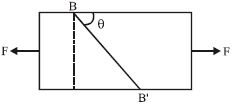
A bar of cross-sectional area $A$ is subjected two equal and opposite tensile forces at its ends as shown in figure. Consider a plane $BB'$ making an angle $\theta $ with the length The ratio of tensile stress to the shearing stress on the plane $BB'$ is
An oscillator of mass $M$  is at rest in its equilibrium position in a potential $V\, = \,\frac{1}{2}\,k{(x - X)^2}.$ A particle of mass $m$  comes from right with speed $u$  and collides completely inelastically with $M$ and sticks to it . This process repeats every time the oscillator crosses its equilibrium position .The amplitude of oscillations after $13$  collisions is: $(M = 10,\, m = 5,\, u = 1,\, k = 1 ).$ 
Two block of masses $10\,kg$ and $4\,kg$ are connected by a spring of negligible mass  and placed on a frictionless horizontal surface. An impulse gives a velocity of $14\, m/s$ to  the heavier block in the direction of the lighter block. The velocity of the centre of mass is ........ $m/s$.