MCQ
An oscillator of mass $M$  is at rest in its equilibrium position in a potential $V\, = \,\frac{1}{2}\,k{(x - X)^2}.$ A particle of mass $m$  comes from right with speed $u$  and collides completely inelastically with $M$ and sticks to it . This process repeats every time the oscillator crosses its equilibrium position .The amplitude of oscillations after $13$  collisions is: $(M = 10,\, m = 5,\, u = 1,\, k = 1 ).$ 
  • A
    $\frac {1}{2}$
  • $\frac {1}{\sqrt 3}$
  • C
    $\frac {2}{3}$
  • D
    $\sqrt {\frac {3}{5}}$

Answer

Correct option: B.
$\frac {1}{\sqrt 3}$
b
In first collision $mu$ momentum will be imparted to system, in second collision when momentum of $(\mathrm{M}+\mathrm{m})$ is in opposite direction $mu$ momentum of particle will make its momentum zero.

On $13^{\text {th }}$ collision,

$\mathrm{m} \rightarrow {\mathrm{M}+12} ; \quad \mathrm{M}+13 \mathrm{m} \rightarrow \mathrm{V}$

$\mathrm{mu}=(\mathrm{M}+13 \mathrm{m}) \mathrm{v} \Rightarrow \mathrm{v}=\frac{\mathrm{mu}}{\mathrm{M}+13 \mathrm{m}}=\frac{\mathrm{u}}{15}$

$v=\omega A \Rightarrow \frac{u}{15}=\sqrt{\frac{K}{M-13 m}} \times A$

Putting value of $M, m, u$ and $K$ we get amplitude

$A=\frac{1}{15} \sqrt{\frac{75}{1}}=\frac{1}{\sqrt{3}}$

Need a full question paper?

Generate a complete, print-ready paper with questions like this in minutes — across 16+ boards, with answer keys.

Start Generating Free

Similar questions

The potential energy for a force field $\overrightarrow{ F }$ is given by $U(x, y)=\cos (x+y)$. The force acting on a particle at position given by coordinates $(0, \pi / 4)$ is $-$
If a solid sphere of mass $5\,kg$ and a disc of mass $4\,kg$ have the same radius. Then the ratio of moment of inertia of the disc about a tangent in its plane to the moment of inertia of the sphere about its tangent will be $\frac{x}{7}$. The value of $x$ is $.........$
The ratio of period of oscillation of the conical pendulum to that of the simple pendulum is : (Assume the strings are of the same length in the two cases and $\theta$ is the angle made by the string with the verticla in case of conical pendulum)
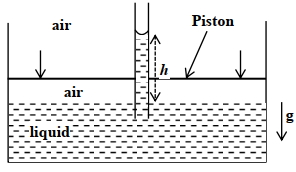
An incompressible liquid is kept in a container having a weightless piston with a hole. A capillary tube of inner radius $0.1 \mathrm{~mm}$ is dipped vertically into the liquid through the airtight piston hole, as shown in the figure. The air in the container is isothermally compressed from its original volume $V_0$ to $\frac{100}{101} V_0$ with the movable piston. Considering air as an ideal gas, the height $(h)$ of the liquid column in the capillary above the liquid level in $\mathrm{cm}$ is. . . . . . .

[Given: Surface tension of the liquid is $0.075 \mathrm{Nm}^{-1}$, atmospheric pressure is $10^5 \mathrm{~N} \mathrm{~m}^{-2}$, acceleration due to gravity $(g)$ is $10 \mathrm{~m} \mathrm{~s}^{-2}$, density of the liquid is $10^3 \mathrm{~kg} \mathrm{~m}^{-3}$ and contact angle of capillary surface with the liquid is zero]

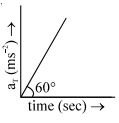
Tangential acceleration of a particle moving in a circle of radius $1\, m$ varies with time $t$ as (initial velocity of particle is zero). Time after which total acceleration of particle makes and angle of $30^o$ with radial acceleration is
With propagation of longitudinal waves through a medium, the quantity transmitted is:
A particle is executing $SHM$ along a straight line. Its velocities at distance $x_1$ and $x_2$ from the mean position are $V_1$ and $V_2$ respectively. Its time period is
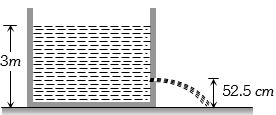
Water is filled in a cylindrical container to a height of $3m. $ The ratio of the cross-sectional area of the orifice and the beaker is $ 0.1. $ The square of the speed of the liquid coming out from the orifice is ....... $m^2/s^2$  ($g = 10 m/s^2$)
The path of a particle moving under the influence of a force fixed in magnitude and direction is
A diatomic molecule has how many degrees of freedom: