MCQ
If $\overrightarrow A  \times \overrightarrow B = \overrightarrow C + \overrightarrow D,$ then select the correct alternative-
  • A
    $\overrightarrow B$ is parallel to $\overrightarrow C + \overrightarrow D$
  • B
    $\overrightarrow A$ is perpendicular to $\overrightarrow C$
  • C
    Component of $\overrightarrow C$ along $\overrightarrow A  = $ component of $\overrightarrow D$ along $\overrightarrow A$
  • Component of $\overrightarrow C$ along $\overrightarrow A  = -$ component of $\overrightarrow D $ along $\overrightarrow A$
Answer

Correct option: D.
Component of $\overrightarrow C$ along $\overrightarrow A  = -$ component of $\overrightarrow D $ along $\overrightarrow A$

d
According to definition of $cross-product$

$\overrightarrow{\mathrm{C}}+\overrightarrow{\mathrm{D}}$ is perpendicular to both $\overrightarrow{\mathrm{A}}$ and $\overrightarrow{\mathrm{B}}$

i.e. $\quad \vec{A} \cdot(\vec{C}+\vec{D})=0$

or $\quad \overrightarrow{\mathrm{A}} \cdot \overrightarrow{\mathrm{C}}+\overrightarrow{\mathrm{A}} \cdot \overrightarrow{\mathrm{D}}=0$

or $\quad$ A (component of $\overrightarrow{\mathrm{C}}$ along $\overrightarrow{\mathrm{A}}$ ) $+\mathrm{A}$

(component of $\overrightarrow{\mathrm{D}} \text { along } \overrightarrow{\mathrm{A}})=0$

or component of $\overrightarrow{\mathrm{C}}$ along $\overrightarrow{\mathrm{A}}$

$=$ $-$ component of $\overrightarrow{\mathrm{D}}$ along $\overrightarrow{\mathrm{A}}$

Need a full question paper?

Generate a complete, print-ready paper with questions like this in minutes — across 16+ boards, with answer keys.

Start Generating Free

Similar questions

When a mass is rotating in a plane about a fixed point, its angular momentum is directed along 
If radius of the sphere is $(5.3 \pm 0.1)\;cm$. Then percentage error in its volume will be
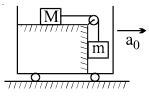
Imagine the situation in which the given arrangement is placed inside a trolley that can move only in the horizontal direction, as shown in figure. If the trolley is accelerated horizontally along the positive $x$ -axis with $a_0$, then Choose the correct statement $(s)$.
A refrigerator consumes an average $35\, {W}$ power to operate between temperature $-10^{\circ} {C}$ to $25^{\circ} {C}$. If there is no loss of energy then how much average heat per second does it transfer? (in ${J} / {s}$)
A horizontal stretched string, fixed at two ends, is vibrating in its fifth harmonic according to the equation, $y(x$, $t )=(0.01 \ m ) \sin \left[\left(62.8 \ m ^{-1}\right) x \right] \cos \left[\left(628 s ^{-1}\right) t \right]$. Assuming $\pi=3.14$, the correct statement$(s)$ is (are) :

$(A)$ The number of nodes is $5$ .

$(B)$ The length of the string is $0.25 \ m$.

$(C)$ The maximum displacement of the midpoint of the string its equilibrium position is $0.01 \ m$.

$(D)$ The fundamental frequency is $100 \ Hz$.

Liquid pressure depends:
A tank is filled up to a height $2H$ with a liquid and is placedon a platform of height $H$ from the ground. The distance $x$ from the ground where a small hole is punched to get the maximum range $R$ is:
The bulk modulus of an ideal gas at constant temperature
A bar is subjected to axial forces as shown. If $E$ is the modulus of elasticity of the bar and $A$ is its crosssection area. Its elongation will be
Find Temperature difference between $B$ and $C$ ? (All rods are identical)