Question
If $A=\left[\begin{array}{ccc}2 & \lambda & -3 \\ 0 & 2 & 5 \\ 1 & 1 & 3\end{array}\right]$, then $A^{-1}$ exists only if

Answer

$A^{-1}$ exists if $|A| \neq 0$
$\text { i.e., }\left|\begin{array}{ccc} 2 & \lambda & -3 \\ 0 & 2 & 5 \\ 1 & 1 & 3\end{array}\right| \neq 0$
$ \Rightarrow 2(6-5)+1(5 \lambda+6) \neq 0$
$\Rightarrow 2+5 \lambda+6 \neq 0 $
$\Rightarrow 5 \lambda \neq-8 $
$\text { i.e., } \lambda \neq \frac{-8}{5}$

Need a full question paper?

Generate a complete, print-ready paper with questions like this in minutes — across 16+ boards, with answer keys.

Start Generating Free

Similar questions

Area bounded by curve y² = 4x, y-axis and line y = 3 is (in sq units)
If G is the intersection of diagonals of a parallelogram ABCD and O is any point, then $\overrightarrow{\text{OA}}+\overrightarrow{\text{OB}}+\overrightarrow{\text{OC}}+\overrightarrow{\text{OD}}=$
  1. $2\overrightarrow{\text{OG}}$
  2. $4\overrightarrow{\text{OG}}$
  3. $5\overrightarrow{\text{OG}}$
  4. $3\overrightarrow{\text{OG}}$
The probability distribution of a discrete random variable $X$ is given below:
$\text{X}:$
$1$
$2$
$3$
$4$
$\text{P}(\text{X}):$
$\frac{1}{10}$
$\frac{1}{5}$
$\frac{3}{10}$
$\frac{2}{5}$
The value of $E(X^2)$ is:
If the lengths of projections of a line segment on the axes be respectively $3,4,12$, then the length of the line segment is:
If the tangent to the curve $x = at^2, y = 2$ at is perpendicular to $x-$axis, then its point of contact is:
Choose the correct answer from the given four option.
The degree of the differential equation $\Big(\frac{\text{d}^2\text{y}}{\text{d}\text{x}^2}\Big)+\Big(\frac{\text{d}\text{y}}{\text{d}\text{x}}\Big)^2-\sin\Big(\frac{\text{d}\text{y}}{\text{d}\text{x}}\Big)$ is:
  1. 1
  2. 2
  3. 3
  4. Not defined
Choose the correct answer from the given four options.
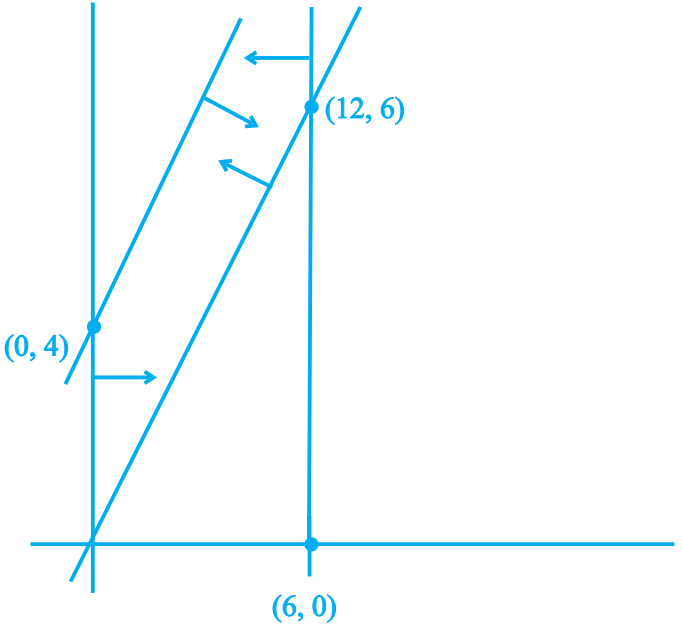
Let F = 3x - 4y be the objective function. Maximum value of F is:
If a line makes angles $\frac{\pi}{4}, \frac{3 \pi}{4}$ with $X -$axis and $Y -$axis respectively, then the angle which it makes with $Z -$axis is
The equation of the plane passing through (2, −3, 1) and is normal to the line joining the points (3, 4, −1) and (2, −1, 5) is given by:
If $\text{A}=\begin{bmatrix} 2 & -1 \\ 3 & -2 \end{bmatrix},$ then $A^n =$