If an ammeter is to be used in place of a voltmeter then we must connect with the ammeter a
AIEEE 2002, Easy
Download our app for free and get started
(c)If ammeter is used in place of voltmeter (i.e. in parallel) it may damage due to large current in circuit. Hence to control this large amount of current a high resistance must be connected in series.

Download our appand get started for free
Experience the future of education. Simply download our apps or reach out to us for more information. Let's shape the future of learning together!No signup needed.*
Similar Questions
- 1If an electron revolves around a nucleus in a circular orbit of radius $R$ with frequency $n$, then the magnetic field produced at the centre of the nucleus will beView Solution
- 2A shunt of resistance $1\,\Omega $ is connected across a galvanometer of $120\,\Omega $ resistance. A current of $5.5\, ampere$ gives full scale deflection in the galvanometer. The current that will give full scale deflection in the absence of the shunt is nearly ............... $ampere$View Solution
- 3The magnetic moment of a bar magnet is $0.5 \mathrm{Am}^2$. It is suspended in a uniform magnetic field of $8 \times 10^{-2} \mathrm{~T}$. The work done in rotating it from its most stable to most unstable position is:View Solution
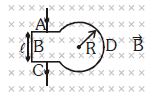
- 4The figure shows a conducting loop $ABCDA$ placed in a uniform magnetic field perpendicular to its plane. The part $ABC$ is the $(3/4)^{th}$ portion of the square of side length $l$ . The part $ADC$ is a circular arc of radius $R$ . The points $A$ and $C$ are connected to a battery which supply a current $I$ to the circuit. The magnetic force on the loop due to the field $B$ isView Solution
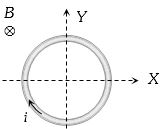
- 5A conducting loop carrying a current $I$ is placed in a uniform magnetic field pointing into the plane of the paper as shown. The loop will have a tendency toView Solution
- 6A circular loop is kept in that vertical plane which contains the north-south direction. It carries a current that is towards south at the topmost point. Let $A$ be a point on axis of the circle to the east of it and $B$ a point on this axis to the west of it. The magnetic field due to the loop :-View Solution
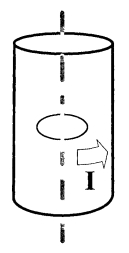
- 7A long circular tube of length $10 \ m$ and radius $0.3 \ m$ carries a current $I$ along its curved surface as shown. A wire-loop of resistance $0.005$ ohm and of radius $0.1 \ m$ is placed inside the tube with its axis coinciding with the axis of the tube. The current varies as $I=I_0 \cos (300 t)$ where $I_0$ is constant. If the magnetic moment of the loop is $N \mu_0 I_0 \sin (300 t)$, then ' $N$ ' isView Solution
- 8The magnetic field at the centre of a circular coil of radius $r$ carrying current $I$ is ${B_1}$. The field at the centre of another coil of radius $2 r$ carrying same current $I$ is ${B_2}$. The ratio $\frac{{{B_1}}}{{{B_2}}}$ isView Solution
- 9View SolutionA negative test charge is moving near a long straight wire carrying a current. The force acting on the test charge is parallel to the direction of the current. The motion of the charge is
- 10Through two parallel wires $A$ and $B$, $10$ and $2$ $ampere$ of currents are passed respectively in opposite direction. If the wire $A$ is infinitely long and the length of the wire $B$ is $ 2\, m$, the force on the conductor $B$, which is situated at $10\, cm$ distance from $A$ will beView Solution