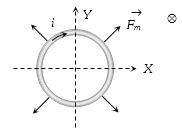
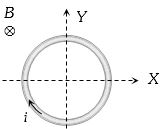
A conducting loop carrying a current $I$ is placed in a uniform magnetic field pointing into the plane of the paper as shown. The loop will have a tendency to
IIT 2003, Diffcult
Download our app for free and get started
(b) Net force on a current carrying loop in uniform magnetic field is zero. Hence the loop can’t translate. So, options $(c)$ and $(d)$ are wrong.
From Fleming's left hand rule we can see that if magnetic field is perpendicular to paper inwards and current in the loop is clockwise (as shown) the magnetic force $\overrightarrow {{F_m}} $ on each element of the loop is radially outwards, or the loops will have a tendency to expand.
Download our app
and get started for free
Experience the future of education. Simply download our apps or reach out to us for more information. Let's shape the future of learning together!No signup needed.*
A current $i$ flows in a circular coil of radius $r$. If the coil is placed in a uniform magnetic field $B$ with its plane parallel to the field, magnitude of the torque that acts on the coil is
A coil of $12$ turns made by a constant length current carrying wire. If number of turns makes $3$ then change in magnetic field produced at its centre
A coil is placed in $y-z$ plane making an angle of $30^{\circ}$ with $x$ -axis. The current through coil is $I,$ and number of turns are $N$. If a magnetic field of strength $'B'$ is applied in positive $x-$direction, then find the torque experienced by the coil (Radius of coil is $R$) (in $N \cdot m$)
$\left(N=100, I=1 A, R=2\, m, B=\frac{1}{\pi} T\right)$
A uniform magnetic field of $0.3\; T$ is established along the positive $Z$ -direction. A rectangular loop in $XY$ plane of sides $10 \;cm$ and $5 \;cm$ carries a current of $I =12\; A$ as shown. The torque on the loop is
The current in the windings on a toroid is $2.0\,A$. There are $400$ $turns$ and the mean circumferential length is $40\,cm$. If the inside magnetic field is $1.0\,T$, the relative permeability is near to
A $50\,\Omega $ resistance is connected to a battery of $5\,V$. A galvanometer of resistance $100\, \Omega $ is to be used as an ammeter to measure current through the resistance, for this a resistance $r_s$ is connected to the galvanometer. Which of the following connections should be employed if the measured current is within $1\% $ of the current without the ammeter in the circuit ?
A moving coil galvanometer has $150$ equal divisions. Its current sensitivity is $10$ divisions per milliampere and voltage sensitivity is $2$ divisions per millivolt. In order that each division reads $1\, volt$, the resistance in $ohms$ needed to be connected in series with the coil will be
A proton moving with a velocity, $2.5 \times {10^7}\,m/s$, enters a magnetic field of intensity $2.5\,T$ making an angle ${30^o}$ with the magnetic field. The force on the proton is